
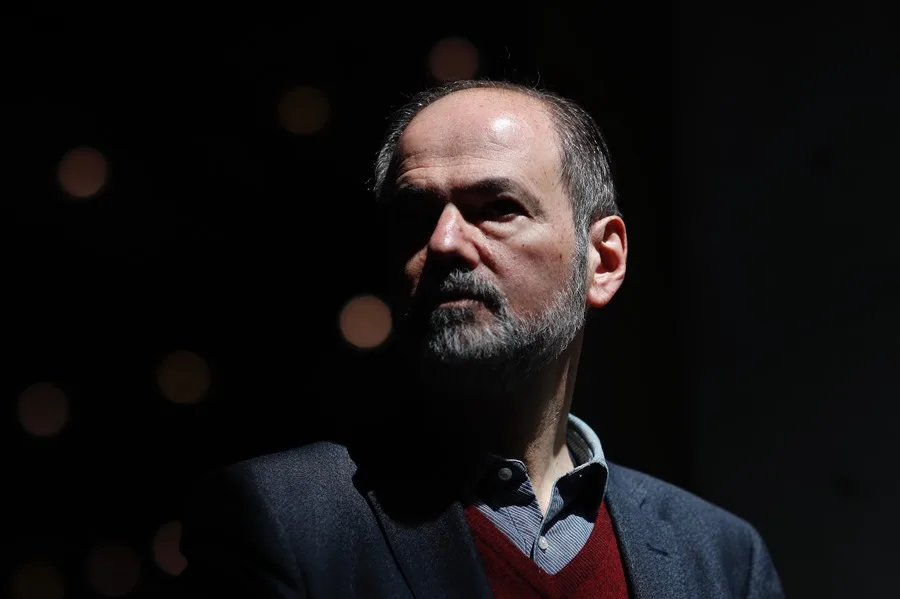
The Carlos Fuentes International Prize for Literary Creation in the Spanish Language, established in 2012 to pay tribute to the author of Aura and The Death of Artemio Cruz, is awarded by the National Autonomous University of Mexico and the Mexican government’s Secretariat of Culture. It has gradually solidified its status as one of the premier prizes in the Spanish language—ranking just behind the Cervantes Prize and placed alongside awards such as the Rómulo Gallegos and the one granted by the Guadalajara International Book Fair (FIL), though the latter encompasses other languages. Thus, alongside a distinguished roll call that includes Mario Vargas Llosa, Sergio Ramírez, Luis Goytisolo, Elena Poniatowska, and Gioconda Belli, this year’s laureate is Juan Villoro (Mexico City, 1956). His work stands out as one of the most robust and versatile in contemporary Spanish-language literature, a range he has explored with excellence across journalism, essays, fiction, and drama. The Award Jury has rightly valued “the breadth and reach of his oeuvre, which traverses several genres with both mastery and rigor,” while underscoring that Villoro has also been a “teacher of new readers,” fostering “a dialogue between the present and tradition from a humanist perspective.” Villoro’s writing possesses a quality that has allowed it to endure across generations of young readers, who are drawn to his ability to render the themes he treats into accessible matters through a prose that is clear, incisive, and imbued with humor and irony. Among his more than thirty books, the classics include his short-story collections The Navigable Night and The House Loses, as well as The Guilty Ones; novels such as Disposed Matter, The Witness, and The Land of the Great Promise; the essays Personal Effects and The Usefulness of Desire, and the chronicles of The Eleven of the Tribe. His work also includes chronicles on rock, football, art, and other subjects, in addition to his children’s and young adult literature, such as Secret Treats, The Field of Desires, Professor Zíper, and and the Lost Words. Hence, the prize of $125,000, the Vicente Rojo sculpture, and the recognition of a close, unpretentious author who has managed to nurture a literary oeuvre of significant artistic value is fully deserved.
LA KAFKIANA BUROCRACIA DE LAS BIBLIOTECAS MEXICANAS
A reader arrived at the desk of the colossal José Vasconcelos Library in Mexico City, a temple of knowledge inaugurated in May 2006, where free access to library services and to a range of cultural activities is offered. It makes available to the public, both on-site and for home borrowing, a bibliographic collection of about 600,000 books and multimedia materials—children’s items, Braille materials, and music—spread across more than 40,000 linear meters of shelves. When the reader requested a credential to access the home-loan service, the staff member told her that she would need proof of address, her identity card, and a fixed-line phone number in Mexico City that could be called to verify her data. The number could not be a mobile, foreign, or extension line, but had to be a home landline. “I don’t know anyone with a landline; services for landlines were canceled years ago because of cell phones,” the applicant replied, part astonished, part frustrated. “Yes, that’s the only way to proceed,” the official insisted, understandably following orders from whoever crafted such a bureaucratic absurdity to lend books in these days of mobile phones. So she began searching for someone who would permit her to provide a landline so the library staff could complete their checks, and after numerous back-and-forths, including administrative glitches at the institution—on one occasion they did not call at the promised time and never at any other—the process stretched out to three months before she finally registered with Vasconcelos as a home-loan borrower. Of course, the reader reflects that “it is a mistake to let bureaucracy and antiquated procedures obstruct free and universal access to books and reading,” and that “enrolling in a public library should be a simple, accessible procedure that resonates with the reality we inhabit.” Consequently, she has publicly urged simplifying bureaucratic processes and eradicating these quirks at their root so that one can begin to imagine a more efficient Mexico. “Until then,” she laments, “we will be swimming in a sea of pointless paperwork that distances us from reading and from freedom.” Kafkaesque, indeed, we are all.