
«Someone calls to me from Seir: “Watchman, what of the night, when will it end? What of the night, when will it end?” And the watchman answers: “The morning comes, but the night will return soon. So if you want to know more, come back later and ask again.”». (Isaiah 21, 11-12)
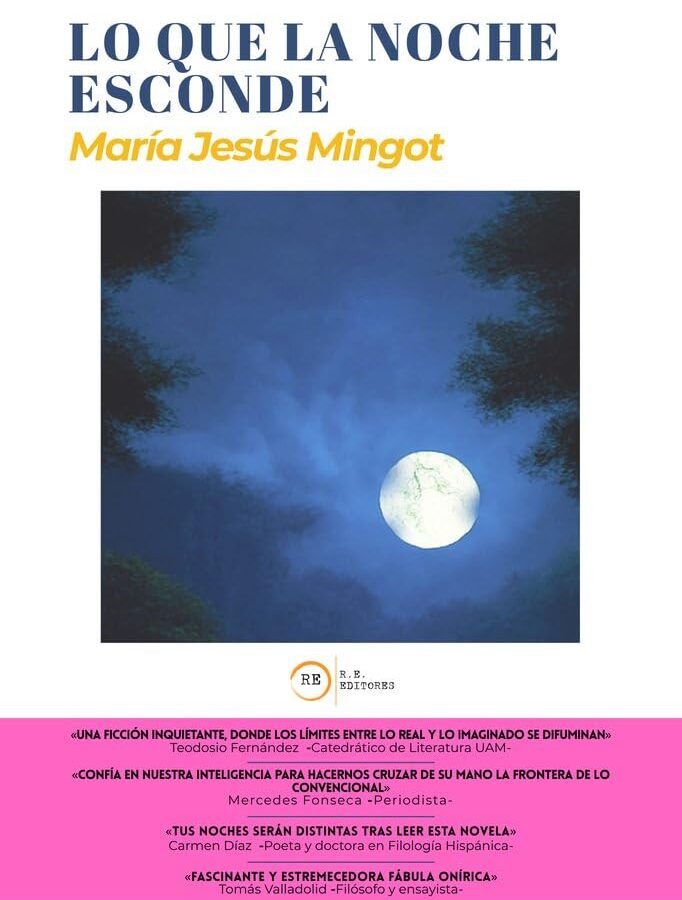
What the Night Hides is the title of the latest novel by María Jesús Mingot, a teacher, poet and philosopher. In her writing, the inhumanity of the animal man takes root. With her exalted reflective ascent, she weaves it and unfolds it in its excess and in its decline. And with a nearly sacred respect to observe it in the height and the depth of herself. Words and ideas that burst into clusters to reach the great that lies within the minute. Words and names that name those sunk in an unfading gesture of pity. A longing for memory in the face of oblivion, against the prohibition of the promise. Hence the immense significance that the backdrop of childhood assumes in this excellent novel.
*
Diving into the plot of this book makes the reader feel a strange communion, for the world where those roots branch out is like Seir—the land of storms and silence. A world of terrible dualities; inhabited by beings whose existence is a harsh wandering along the border abysses of the night, where the exterior and the interior mingle and mingle. Beings dissimilar and yet alike at the same time, who play the game of distances and live subjected “to earning bread with the sweat of their steps.”
Fascinating and chilling dreamlike fable. A dream within another dream with no dream. A journey to a sinister world: space and time of damaged lives, horrors and curses. Where the invisible and the visible interchange, reality and its ghost, hatred and love, trust and suspicion, light and darkness, night and morning, goodness and evil. Diaphonic crossings of nightmares, dreams, shadows and clearings; cruelty, compassion, revenge and forgiveness; power and servitude, friendship and discord; silence, voice, oblivion and memory; strength, weakness, fear and hope…
How then is it told or narrated, giving testimony of all and everything? Who, with what words or tropes, activates memory? For what the night hides, the word undoes it, names it and reveals it; and interrupts its enchantment, without dissolving the mystery. «Return later and ask again», as the oracle says.
I think that the narration of this novel retains the mystical poetic and the philosophical ethos that characterize María Jesús Mingot’s writing. Her narrative is imbued with oracular wisdom and an ocular experience, that is to say: her voice has a mistagogic tone, or in other words, it calls and leads toward the mystery of man, but with a gaze toward the abyss. She knows that words can create the world, but they can destroy it as well: they both cause it to flourish and render it fatal.
With respect to this, it is no coincidence that María Jesús Mingot has expressed a special reverence for a poem by Zbigniew Herbert, from which I recall the following verses: On words we fall asleep / we wake in words // one must dream patiently / hoping that the text completes / that the missing words / integrate into those stiff phrases / and that the certainty we await / anchors
*
Indeed, the logos that unfolds in the writing of What the Night Hides is evident in its sensitive character. Its narrative voice is not alien to the corporeal nature of happiness and suffering. Even the cosmos itself sweats with fears and trembles! This is a notable achievement given that melodramatic sensibility, dominant in certain literary and non-literary circles, exerts strong pressure.
Thus, to dare to feel and to make others feel in that manner, with an incarnate ethical sense, is one of the main excellences of the writer María Jesús Mingot. And it is especially so in this novel which reveals—without unveiling or tearing apart—what the night hides in the hour of full responsibility. Therefore, I venture to speak of a kind of sensuality that brings her close to what exists—in its sinistrality—with a will to touch it, sniff it, savor it, and gaze at it in the abyssal depth of the world that encloses it. Ultimately, reality and language tighten around the imagination of the human being. In that hidden and inhospitable place where the shadows of what the night hides are projected; and where hope presents itself as a fortune.
*
In a sentence titled “Blood of Our Shadow,” Juan Ramón Jiménez wrote the following: “An aphorism, a poem, a book, contain, cast, drag, gather (sic) always a shadow, its shadow; that carries within it our shadow; that within it, as in all of our being, is something like blood of the soul.” In some sense, these words of the poet of Animal de fondo connect with a Nietzschean exhortation that makes them more apt to conclude this review of What the Night Hides: “Write with blood and you will discover that blood is spirit”.
And certainly, thanks to the spirit of María Jesús Mingot, to the feeling of the strange communion previously noted, the reader can also appreciate the sense of how beautiful it is not to be alone where the voice of “the necessary shadows of the forest” cries out in its silence.
—————————————
Author: María Jesús Mingot. Title: What the Night Hides. Publisher: R. E. Editores. Sales: Todos tus libros.