
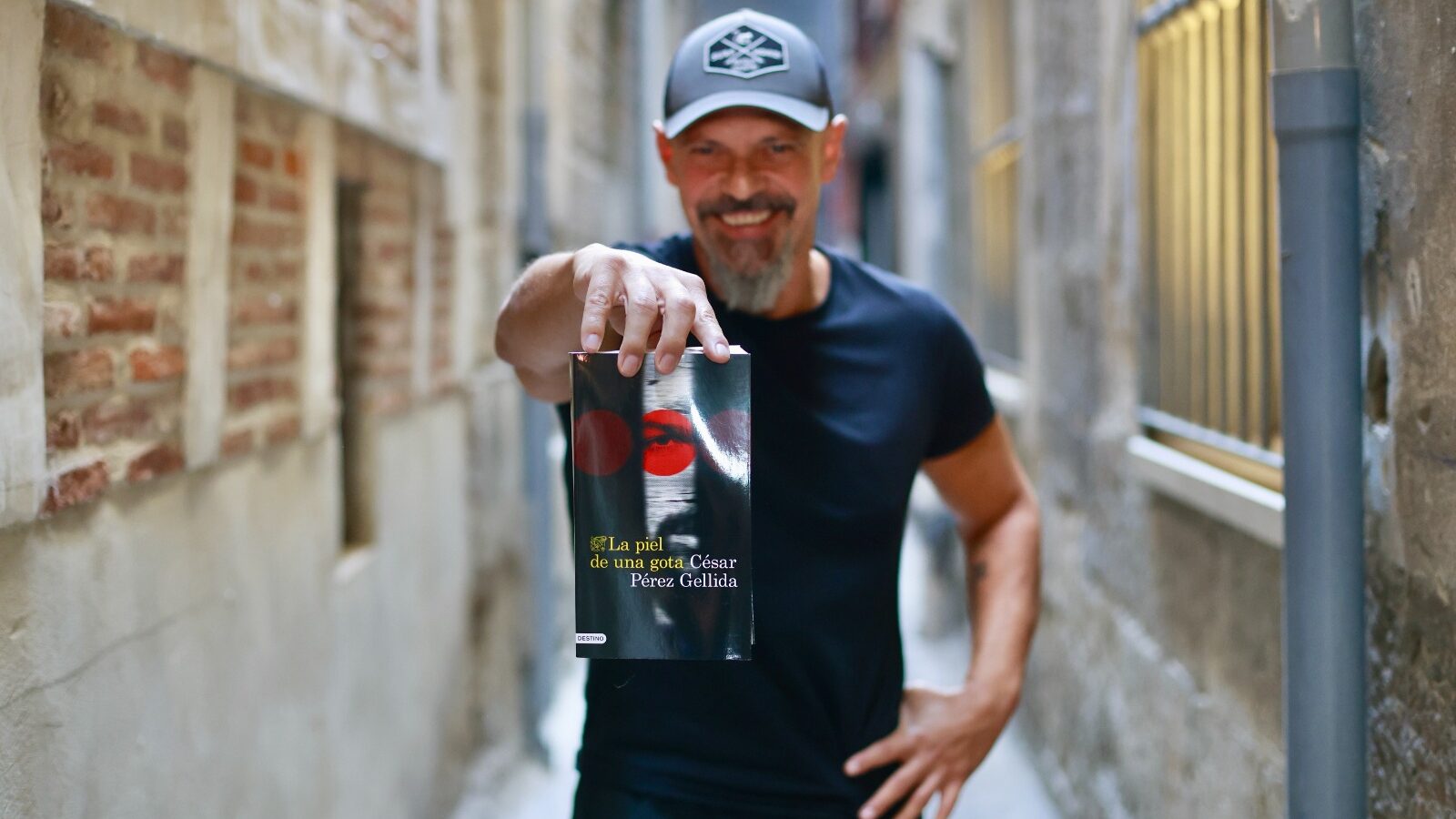
The launch of César Pérez Gellida’s latest novel in his homeland, Valladolid, the setting for the events of La piel de una gota (Destino), drew writers, humorists, and people from all over Spain to the Teatro Zorrilla to pay a kind of homage to the author with a gesture of few friends, and to whom, however, he has plenty of friends—the good ones—as seen at the novel’s presentation, with local authorities and a photo call included.
It was a beautiful and heartfelt spectacle, as is traditionally done for those who have passed away, with the difference that Gellida was there, very much present in person, sporting his impenetrable cap, which is like a second skin, accompanied by Dolores Redondo —they are great friends and their families travel together—, who served as interviewer. Then, one by one, guests began to drift across the stage at the invitation of Carmen Corazzini, the host of the event.
Not everyone could be there. Some of the friends who could not attend sent a video, including Antonio Chicote, Miguel Santiago, Blue Jeans, or Juan Gómez-Jurado, whose words were the ones that most surprised me: “César is a great writer, but even more so a good person.” It’s not that we doubted Pérez Gellida’s moral qualities, but that air of rogueishness and cynicism he tends to maintain at a distance is not the ideal ground for a Franciscans’ faith. Perhaps, like the antagonist of his novel, El Témpano, the writer carries a persona of coldness that is only professional. Or perhaps it is a mask, an avatar. At the book’s presentation he whispered—softly—something unsettling: “It’s not that Ramiro Sancho resembles me, but that I am increasingly starting to resemble this character.”
For those who are not readers (as I am told) of César Pérez Gellida, Ramiro Sancho is his great literary creation: a police inspector from Valladolid’s Homicide Group, tall and with an Irish-like appearance, reserved, sensitive, fond of rugby and proverbs, who, in his work, does not chase hunches but follows the evidence and tries to understand the killer’s motives as a shortcut to catching him. He was the absolute protagonist of his first six novels, divided into two trilogies, which feel more like titles dreamed up by a seventies singer-songwriter: Versos, canciones y trocitos de carne and Refranes, canciones y rastros de sangre, names that are not commercially appealing in crime fiction and far from the publishing world’s norms; which led me to ask him how a publisher could permit such old-fashioned, non-commercial titles for a debut author. By the way, the first novel of the first trilogy, Memento mori (this already sounds like the title of a poetry collection entering a contest), has been adapted for television in a series available on Prime.
Ramiro Sancho, who also features in some stories, fades from Gellida’s fiction in 2017, and now (eight novels later) reappears, with all due pomp, in La piel de una gota to pursue one of the most formidable and destructive antagonists in his work: the Témpano, a former military man, expert in explosives, who has been in the Congo and plans a terrible revenge against Valladolid. In fact, the book trailer for the novel opens with a bucolic (idyllic) image of the Plaza Mayor lit up for Christmas, followed by a tremendous explosion that destroys the huge decorated tree and wrecks the place.
If you begin to read the novel, it may seem that the death of his dog in the city festivities’ fireworks is the reason for so much indiscriminate violence. The author clarifies: “This event is the turning point, but there is a past behind it—the death of a woman and other motives that will be revealed throughout the novel to understand the spiral of violence and destruction that the character unleashes against the city and, more gravely, against its inhabitants.” The sentence may not be exact, but the idea is there.
That is the suspense, the mystery, the pull for the reader: to uncover the genocidal motives of the character, because here you don’t have to guess who the killer is, since he is shown to us (with his dog still alive) from the very first page. And, curiously and sadly, the more harm this complex character causes, the more he is understood (or so it seems).
La piel de una gota —now 16 books in all— was the author’s best novel up to its publication, but since Gellida makes no concessions to time or rest, as soon as he handed it in to the editor he began writing the next one, which he now considers superior. “The best novel is always the one I’m writing.” It is likely a continuation —at least in time and space— of this one, without trying to be a sequel, since La piel de una gota is self-contained. However, and he noted this, the new novel must account for the city’s partial destruction and the ongoing reconstruction. We sense that Ramiro Sancho, the character whom the author will end up resembling (except for the red mane), will continue to move through his pages. He had set him aside for more than four years and was pleased to reconnect with him. It felt like seeing an old friend again.
“Piel” and “gota” may be words particularly apt for a crime novel title, but not together, which explains the confusion around La piel de una gota. Why that image? The author spoke of symbolism, of trying to reflect the immense fragility and tension to which the city is subjected in his book, where a single individual can ruin many lives. He reiterates it in another way: “As a society, we are very vulnerable. A person with certain knowledge can put an entire city or even a country at risk.” This was evident during the Covid era.
The novel is set two years after the pandemic’s end in Valladolid, whose mayor at the time was then Óscar Puente, and he naturally appears in the pages, though not by name (“he hasn’t given me his permission,” the author quips), but under the perhaps more fortunate name Omar Fuentes.
The most singular thing about Pérez Gellida, who came to books through environmental circumstances, is the way he approaches his craft. He doesn’t wall-paper his surroundings like Juan Ramón Jiménez, nor does he seek a soundtrack to accompany him; instead, he — as he states — cannot write without the hot breath and the constant noise of a hair dryer running, and as such he acknowledges that he must sell many books to pay for the dozens or hundreds of hair dryers he buys, this writer with a gleaming bald head who has not forgotten the sensation of his childhood hair dryer.
Following the success of his first two trilogies and other novels published with Suma, the idyll finally broke in 2024. “Why did you switch to Destino?” we asked. He answers in three words: “The Nadal Prize.” Because the Nadal Prize, which once lent prestige to the Valladolid-born Miguel Delibes, opened doors he didn’t think he could reach. “I used to be a crime-fiction writer; now I’m on that list of Nadal winners.”
The Destino publishing house, after releasing the Nadal-winning Bajo tierra seca and its follow-up, Nada bueno germina, has fully backed the new book and the revival of its star detective, Ramiro Sancho. This was evident at the book’s presentation—a full-day affair that will probably become one of Pérez Gellida’s most beautiful and memorable moments. With local and national journalists, the essence of the novel was discussed atop Valladolid’s cathedral’s bell tower, from which the entire city could be seen—the city that, in his novel, is laid to waste—and there he summarized the core of his book: “In my novels things happen, and in La piel de una gota they happen on a grand scale.”
Over lunch—in a grand fashion—we spoke with Anna Soldevila, the editor, who brought the exciting news of the upcoming publication of Borges, a huge diary (more than a thousand pages) by Bioy Casares that Destino published in a single volume long ago and quickly sold out. Now, after many years of waiting, it will be reissued in two manageable volumes. Hopefully —we’ll comment on them in another chronicle— with an index of names.
The launch day for the novel and tribute to César Pérez Gellida served as a prologue to the sixth edition of the Blacklladolid literary days, which the author runs with Dolores Redondo. Despite its name, it isn’t a crime-fiction contest but a broader literary gathering. This year the focus was on fashion, and among the guests would be Burgos-born designer Amaya Urzuaga and the author of The Time in Between, María Dueñas.
***
P.S. At the end of the 540 pages of the novel, we encounter a prolific author’s note, in which he recounts his writerly details and thanks, and makes an allusion to the title that differs from what he told us. Here he refers to an apocryphal fable from Lugbara mythology (from the Congo), “a fable about a drop of divinity transformed into skin that turns out to be both gift and curse.”