
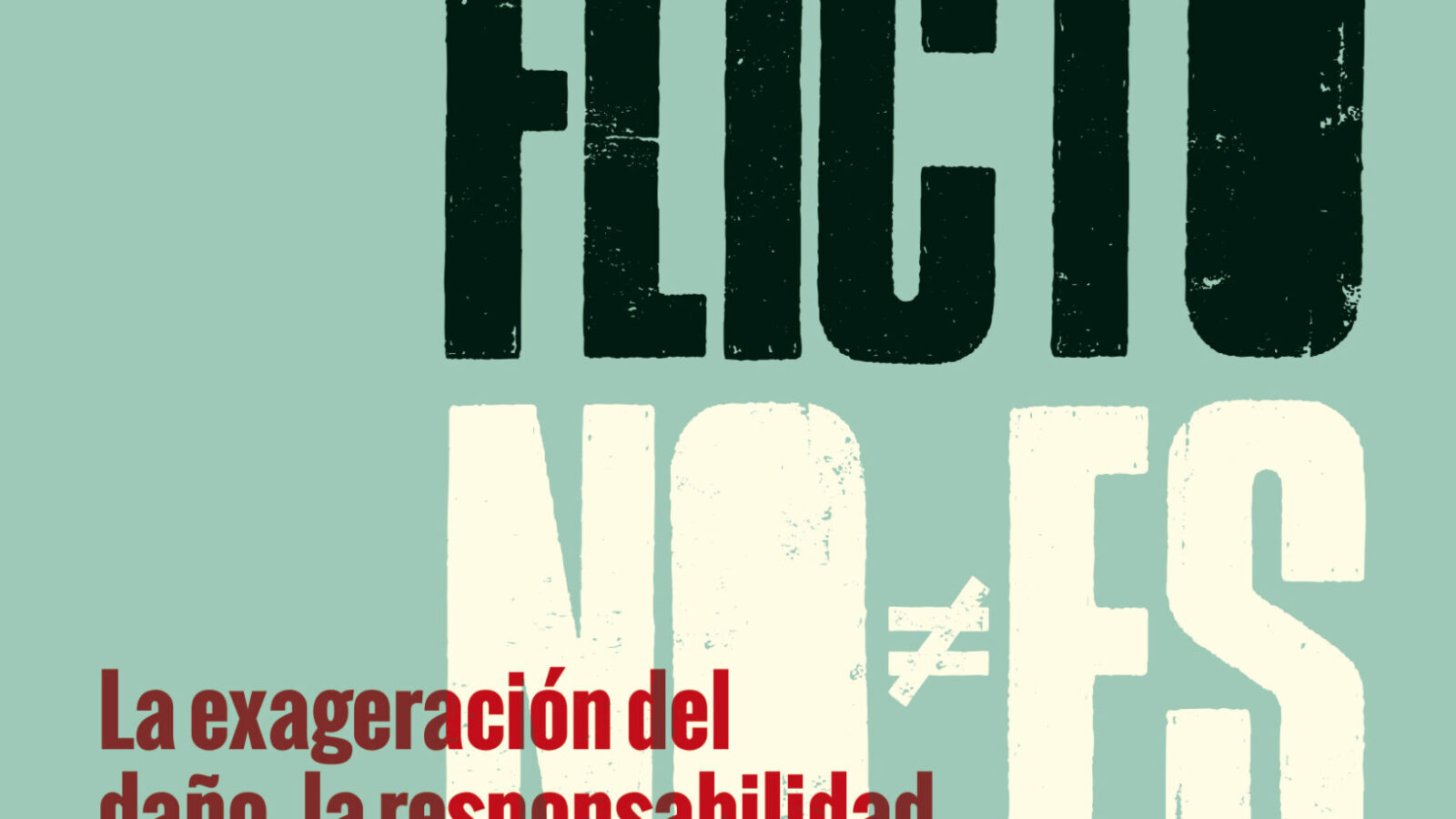
This book analyzes contemporary and historical issues related to personal, racial, and geopolitical differences as instruments that escalate toward injustice, exclusion, and punishment, whether the targets of dehumanization are other people within our families or communities, people with HIV, African Americans, or Palestinians.
In Zenda we reproduce the opening of The Conflict Is Not Abuse (Capitán Swing), by Sarah Schulman.
***
Introduction
A Manifesto for Repair
“Not everything that is faced can be changed;
but nothing can be changed until it is faced.”James Baldwin
As this book began, in the summer of 2014, the human community witnessed, with exhaustion and frustration, the repeated, systemic cruelty that goes unjustifiably unchallenged. We saw white police officers in Ferguson (Missouri) and Staten Island (New York) kill two unarmed Black men, Michael Brown and Eric Garner. We saw a wealthy and powerful professional American football player, Ray Rice, strike his wife in an elevator, rendering her unconscious. We witnessed the Israeli government mass-murdering more than two thousand Palestinian civilians in Gaza. It quickly became evident that the methods we have collectively developed to understand such actions and prevent them are inadequate.
As a novelist, in order to create characters with credibility, I apply the principle that people do things for definite reasons, even if they are not conscious of those reasons or cannot admit that their actions have motivation, rather than adopting a stance of neutrality and objectivity. When applying this principle to the analysis of the incidents cited, I must ask what white police officers, the wealthy football player, and the militarized nation-state believe is happening so that their brutal actions can be produced and justified. As the video and witnesses’ accounts attest, neither Michael Brown nor Eric Garner did anything to justify the way they were treated by the police. Eric Garner was selling loose cigarettes, and Michael Brown was walking down the street. Both attempted to offer the police alternatives to cruelty. Eric Garner told the officers of the consequences of their actions toward him, when he said eleven times, while they were illegally choking him: “I can’t breathe.” Michael Brown raised his hands in surrender and said: “Don’t shoot.” But something occurred within the minds, impulses, and group identities of the white police to interpret that original non-event, together with factual and peaceful communications, as a kind of threat or attack. In other words, these police officers perceived the nothingness itself, the complete absence of threat, and nonetheless saw a danger grave enough to justify murder. Nothing happened, yet these people with power perceived an aggression.
We know, from surveillance footage captured in the lobby of a casino and in an elevator, that the Baltimore Ravens running back Ray Rice and his wife were arguing. No matter how much we dislike fights within our relationships and wish they did not occur, disagreement with the person we love is a common part of the human experience. It is impossible to live without it happening at least once. Intimate disagreement is, as they say, part of life. Yet Ray Rice experienced that ordinary, everyday conflict that occurs in every relationship, family, and home around the world as something so overwhelmingly intolerable and threatening that he struck his wife unconscious, dragged her lifeless body by the ankles out of the elevator, and left her lying in a hallway. He observed a common, everyday conflict and responded with extreme cruelty. He saw the ordinary, even banal, expression of difference and read it as a threat.
The Israeli government has kept the Gaza Strip besieged since 2005. This has turned the daily life of its inhabitants into something almost unbearable. Toward the end of spring 2014, the Netanyahu government intensified pressure on the Palestinians, who had already endured for some time, and some factions within Gaza responded with low-quality rockets that scarcely produced any symbolic impact. The Israeli government reacted in turn with more than two days of airstrikes and ground invasions that caused mass deaths and the large-scale destruction of its cultural and psychological infrastructure. The people of Gaza were reacting to a state of injustice that the Israelis had created: they were resisting. They refused to accept an unbearable and unjustifiable deal. The Israelis experienced this resistance to ongoing injustice as an attack.
Brown and Garner did nothing more than be Black. Janay Rice expressed a common and ordinary conflict. The people of Gaza resisted an unbearable treatment. In all of these cases, the police, the husband, and the nation magnified the harm. They took the nothingness, the common conflict, and the resistance, and twisted these reasonable positions of difference into violence. From the intimacy of a relationship between two people to the crushing reality of occupation, through the power of the police, these actors deployed a distorted interpretation in which merely understandable behaviors were understood as aggression. In this way, they reacted in a disproportionate manner to a level that produced tragedy, pain, and division. It is precisely this moment of disproportionate reaction that I want to examine in this book. My thesis is that at many levels of human interaction there exists the possibility of confusing discomfort with threat, of identifying internal anxiety as external danger, and, in turn, of escalating rather than solving. I will show how this dynamic, whether between two individuals, between groups of people, between Governments and civilians, or between nations, constitutes a fundamental doorway to either tragedy or peace. Conscious knowledge of these political and emotional mechanisms gives us the possibility to confront ourselves, to attain recognition and understanding in order to prevent an escalation toward unnecessary pain.
[…]
—————————————
Author: Sarah Schulman. Title: The Conflict Is Not Abuse. Translation: Nicolas Cuello and Diego del Valle Ríos. Publisher: Capitán Swing. Sales: Todos tus libros.