
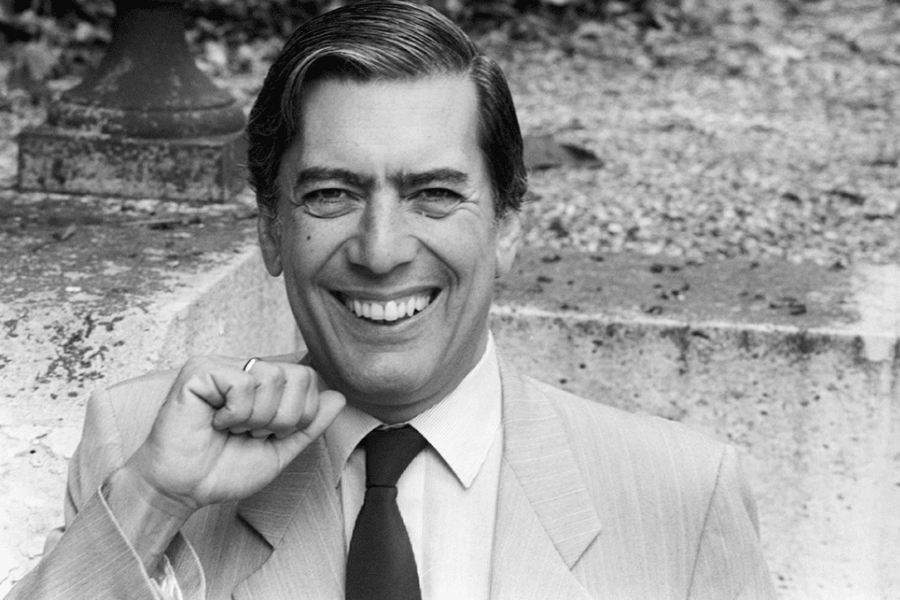
“There is a certain vocation for countries to mess themselves up. Countries choose their fate,” said Mario Vargas Llosa.
For about forty years, more or less, I was the interviewer and editor of Mario Vargas Llosa (March 28, 1936 – April 13, 2025), whose life I will never forget. This text forms part of some of the interviews I conducted when I was no longer editing his books. The excerpt comes from dialogues that were published years ago and will soon appear in another format.
He was not given to clichés, not even thinking about them. In the winter of 2005 I interviewed him at the Guadalajara Book Fair, Mexico, where they were celebrating the year of his country, and I asked him what Peru had given him. He used to tick his fingers, turning them into one hand. On this occasion it was the same, and this was the answer he gave me about what he gave Peru: “A troublesome, turbulent, and terrible material. And a certain way of writing Spanish. That remains my way of writing Spanish, the one that comes from Peru.”
And since we’re at it, I asked him: “Why don’t you tell us exactly at what moment Peru got screwed, after all that phrase he gave to his country for life?” “That,” he said, “doesn’t happen in a day. There is a certain vocation for countries to screw themselves up. Countries choose their fate.” Speaking of nations, he came up with the remark that Mexico, the homeland of his friend Octavio Paz, was the perfect dictatorship, and there was a great uproar between the two countries and their most prominent representatives. Mario reconciled with Paz, “such a great friend… Since that controversy things have changed a great deal. The country [Mexico] is freer and more democratic than it used to be. And I’m sure it will not go back to what made me call it the perfect dictatorship.”
He reached seventy and remained as Zavalita was: “Young, athletic, diligent, curious about everything that happens, at home and in the wider world; awkward with machines, but incredibly deft with literature and journalism,” he still dared to travel “to conflict zones (Israel, Palestine) or into distant geographies and characters (Gauguin, Polynesia, the far reaches of Brazil) to undertake narrative or journalistic tasks that cannot be done from an office.” With his ego tucked away… A journalist from the Paris Review asked him: “Why do you write?” An unforgettable answer: “I write because I am not happy. I write because it is my way of fighting unhappiness.”
Unhappiness was his starting point. That seventy-year interview returned to memories of his father, the rancor with which he remembered him, his relationship with Leoncio Prado, the childhood nightmare, the impossible reconciliation with that man… “He was ashamed to have a poet son: a bohemian son, one of those who haunt cafés, a somewhat ridiculous figure! He couldn’t face me, but by writing poems I could feel myself as his adversary.” “In secret, I read and wrote. Reading was salvation. The true life was neither routine nor fear, but the life found in books.”
The Town and the Prisoners helped him tell his father (to a kind of father who resembled his own) and, later, The Time of the Hero, which became the touchstone of his future life, when he somehow broke with his country and with his father… And his children afterward? “I dreaded that my children would see in me a figure like the one I lived with in my father… I have always cared deeply for my children. When Gonzalo became a Rastafarian, of course we were terrified; we could end up like so many boys, going to Abyssinia, disappearing in Kathmandu!, or getting involved with drugs, a problem that his generation has faced so intensely and so tragically…”.
It must have been hard concerning his son Álvaro… “It was very difficult… When he believes in something, he commits with a radiant passion, without weighing the risks, like me. In the case of Toledo, he identified with his goal and his campaign; he believed that was the most effective path to free us from the dictatorship of Fujimori, and Montesinos. At one point he grew disillusioned with Toledo, with the candidate’s circle, in which there were buddies with shady backgrounds. That led to a very violent rupture at a critically tense moment in the campaign.”
“And if Álvaro’s campaign against Toledo had prospered, he would not have become president: Alan García would have triumphed, and Peru would have been ruined. So I had to confront him publicly; personal relationships were not broken, but it was a very unpleasant episode, and very well exploited by unscrupulous people. It was a difficult period. But, well, sometimes it’s inevitable to have deep divergences with people you love.”
And you yourself, how did you go from being a convinced leftist to embracing liberal positions? “It was a process. I spent a year in the Communist Party when I was at university. I was an avid reader of Sartre, of the French existentialists. That influence helped me counter the dogmatic character that the Peruvian Communist Party and all Latin American communist parties held.”
He used “arguments from Jean-Paul Sartre against socialist realism, and it was in one of those discussions when a fellow cell-mate called me subhuman. I distanced myself from the communists, but I remained engaged in the broader leftist movements; I even joined the Christian Democrats, because they clustered around Bustamante Rivero, who had been a truly honorable president, and also my uncle, a man who was a model of rectitude. I fought with the Christian Democrats until the fall of Odría’s dictatorship.”
Pro-Cuban militant
Mario Vargas Llosa told me in that same interview, “I became politically active for Cuba in Europe…”. “It seemed as if I was creating what I, and many others on the left who felt rejected by dogmatic Marxism, were seeking. So I joined the pro-Cuba campaign in Europe. I went there, sent by French television, during the missile crisis; changes had already begun, but I did not see them. And I went there every year, until 1966, until concentration camps were established, where homosexuals, as well as regime opponents, were imprisoned alongside common criminals.”
That was Mario Vargas Llosa’s first crisis with Fidel. “I wrote to Fidel Castro, and he had me come; I went with Julio Cortázar, among others. And he spoke to us all night, explaining that abuses had been committed. I made peace, but a critical spirit remained inside me that I would not abandon with respect to the Cuban Revolution. Later I was in Prague during the spring, and in the USSR, and that was a very depressing experience. I began reading other thinkers, chose Albert Camus over Sartre, and discovered liberal figures like Isaiah Berlin or Karl Popper.”
The liberalism, the boom, the enmity with Gabo…
Mario Vargas Llosa never refused a question, except once, and he did so forever. He was the great friend of Gabo and ceased to be the great friend of Gabo forever. In that interview he said it for the umpteenth time, but since the interview concerned a very specific year in his life—the 70th anniversary of his birth—it seemed appropriate to ask again. What happened with Gabo, what was the root of his enmity? The question arose in the middle of the conversation, right when it seemed the journalist should pose it. He answered: “I won’t talk about that.”
4.1/5