
The conversation in Letras Sevillas was scheduled under a title — Forget or Remember — and with a view toward memory, the Civil War, and the Transition. But current events moved ahead. Pedro Sánchez had announced a few hours earlier the calling of general elections for November 29, and it was impossible last night to sit down before José María Aznar, former Prime Minister and head of the Popular Party and current president of the FAES Foundation, without starting there.
*****
JUANMA LAMET.—President, welcome and thank you very much for being here tonight in Letras in Sevilla. The first question is inevitable. Pedro Sánchez has announced today early general elections for November 29. What is your view of the call? Are we facing elections that could mark a before and after for Spain?
JOSÉ MARÍA AZNAR.—Indeed. In my opinion, we are facing the most important elections since the beginning of the Transition. And it is important to understand very clearly what is going to be decided, because we are not facing ordinary elections in which one simply plays for the alternation in government. Those who summon these elections and their allies want to give them a virtually constitutive character. If the current government coalition were to win the elections or could form a government again, it is evident that the constitutional system we have known until now would be in question. The unity of Spain as we have known it would be in question, and the constitutional monarchy would be in question. That is why I say they are absolutely determinant elections. The unity of Spain is being challenged by the aim of transforming it into a plurilingual reality; the constitutional system is being challenged by talk of a new constitutional period; and all of that inevitably affects one of the essential elements of our Constitution, which is the Crown. The Spanish citizen must therefore know what he will vote for. He will not be voting merely for who sits in La Moncloa for the next four years. He will be voting on something of much greater scope. And the past may please us more or less, but it no longer depends on us. The future, yes.
—If Sánchez could form another majority, would we, in your view, be facing a definitive rupture?
—These elections are also a reckoning after two legislatures and everything that has happened over these years. But beyond that, Spain needs to undertake a very deep task of political, economic, social, institutional, and territorial reconstruction. It is not simply about substituting one coalition for another. It is about rebuilding what has deteriorated.
—If we are so close to the dissolving situation you describe and the one who manages to form a government is Alberto Núñez Feijóo, how far would the change have to go?
—That is for him to determine. I do not pretend to speak on behalf of anyone. But I think it is essential to recover institutional and constitutional values, to recover the core values of the Transition, to restore channels of dialogue and to set common objectives again. We must recover everything that makes a nation stronger: solid institutions, a respected rule of law, and citizens who trust those institutions again.
—Are you talking about a kind of second Transition?
—I am talking about a deep national reconstruction agenda. And I consider it absolutely indispensable: from a demographic standpoint, from the health of institutions, from the survival of the rule of law, and from the very functioning of the country.
—You have insisted on several occasions that it is not the same a People’s Party with 160 deputies and Vox with 30 as a PP with 130 and Vox with 60. Polls point toward a significant Vox rise, while PSOE and Vox seem to feed off each other. Are you afraid that dynamic will accelerate during the campaign?
—One of the fundamental elements of Pedro Sánchez’s strategy is precisely that: try to divide the space to his right as much as possible. His interest is to do as much damage as possible to the People’s Party and to favor Vox as much as possible. Why? Because Spain will need after the elections a strong government, backed by a very solid majority. It is not the same for the governing party to be strong and the complementary party to be weak as it is to face the opposite. That has obvious consequences for the ability to govern.
—Among those following us and those here tonight there will be many voters on the border between PP and Vox. Since precampaign begins today, why should a liberal-conservative voter vote for the People’s Party and not for Vox?
—Between those following us and those here tonight there will be many voters on the border between PP and Vox. Since precampaign begins today, why should a liberal-conservative voter vote for the People’s Party and not Vox?
—Because if one thinks that the Constitution is at stake, that our system of coexistence is at stake, one cannot imagine that changing the constitutional system, ending the Transition, or challenging the Parliamentary Monarchy would not deeply affect coexistence. Of course it affects. We are talking about the unity of Spain, the maintenance of the Constitution, the Rule of Law, the sustainability of the Welfare State, and Spain’s international presence. These are historic issues of primary significance. And none of that can be faced by a weak government or a government that is conditioned. A strong government is needed.
—UGT and Comisiones Obreras have already signaled the possibility of a general strike if the right wins.
—What Spain was missing to see was a general strike against the alternation. Because, let us be clear: a general strike against what? Against the citizenry’s right to choose another government? That would be to say: “The wall we have built over these years, if possible, we will raise three times higher.” With all due respect to the unions, proposing a general strike against a democratic alternative seems politically delirious to me. It means losing sight of what democratic alternation means.
—These elections also come with housing as one of the major social concerns. Could this be a decisive factor in changing votes, especially among the young?
—Housing is a serious problem, but it did not arise yesterday. What makes no sense is trying to solve it by turning the owner into little more than a criminal and the landlord into little more than a thief. If someone owns a home and knows they are going to be forced to set the rent, that they will have difficulty reclaiming their property, that certain conditions will automatically be extended, and that legal certainty will permanently increase, why would they put that home on the market to rent? That reduces supply. And when you reduce supply, prices go up. If you want to solve the housing problem, you have to build more, create legal certainty, increase supply, and promote jobs for the young. The rest may sound great at a rally, but it does not solve the problem.
—Do you then think housing will not move votes?
—It can, naturally. But it is worth remembering a few things. When I was president, around 82% of Spaniards owned their home. Today that figure is lower. Does that make all those owners into criminals? Obviously not. There will be bad landlords and bad tenants. But if every measure adopted reduces the supply of rentals, increases legal uncertainty, and in addition does not build enough housing, the result will be inevitable: obtaining housing will become increasingly difficult and expensive.
—There is another issue that directly connects with these elections. We have learned of the census that will, in principle, be used on November 29, closed before certain judicial decisions related to people naturalized under the so-called Grandchildren Law. Santiago Abascal has also called for caution with mail-in voting. Is there any real reason to distrust the Spanish electoral system?
—Spain has reasonably had a good electoral system throughout its democracy. I may like some aspects more or less, but it has worked well. Now, however, the question of nationality deserves reflection. I do not know many countries where a great-grandchild of someone who left the country generations ago can obtain nationality and, automatically, certain political rights without ever having set foot in that country. In my travels I have met people who explained to me, in English or Portuguese, that they had just acquired Spanish nationality. And when you ask about their parents or grandparents, you discover how distant their actual connection with Spain was. I think the grant of Spanish nationality should be subject to very precise rules. And the right to vote deserves even greater care.
—Are you saying that you fear an alteration of the electoral census?
—I am saying that any warning about a possible alteration of the electoral census is legitimate.
—But I ask you directly: do you believe they would be capable of doing it?
—If you ask me whether I think someone might try to alter the rules when they believe they need to, my answer is that there are sufficient reasons to stay vigilant.
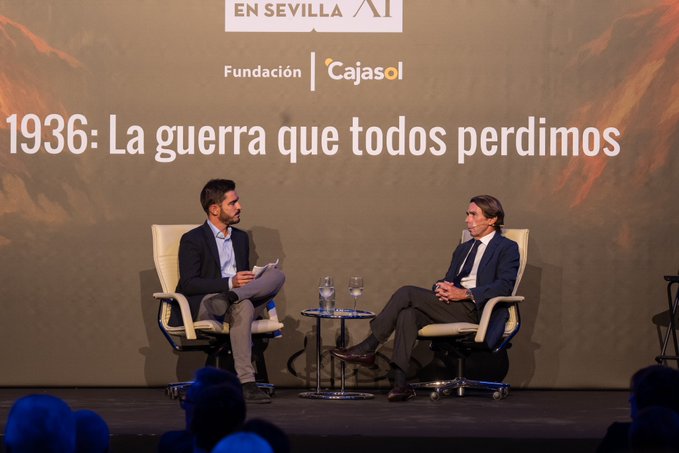
—Now, let us delve into the matter that brought us here this evening. The phrase behind us reads: “The war was lost by everyone.” Do you agree?
—In a general sense, yes. There is no greater misfortune than a civil war. That said, one must be careful with the phrase “the war was lost by everyone.” We can say it in a historical and moral sense, but the other thing is that those who were born later declare themselves winners or losers of that war. I did not participate in it. You did not either. I do not consider myself heir to one side or the other. And I detest policies that attempt to realign us according to the sides of then, because that does not respond to present-day Spain. It is precisely from that to which the Transition led, when national reconciliation occurred.
—So, today there are not two Spains, but politicians interested in invoking them again?
—Exactly. And here lies one of the great opportunities we have in these elections: to recover a Spain that wants to develop, to guarantee its Rule of Law, and to recover the spirit of convivencia that made the Transition possible. Because the Transition was not an act of forgetting. It was a forward-looking exercise. And there is a question we should ask ourselves: what sense does it make for the grandparents to have forgiven, for the parents to have coexisted, and for now some grandchildren to seek to revive the Civil War? What sense does it make? Today those sides do not exist in Spain in the terms of 1936. What exists are policies that seek to return us to that confrontation and reopen something that Spaniards decided to overcome. That is precisely what we must not permit.