
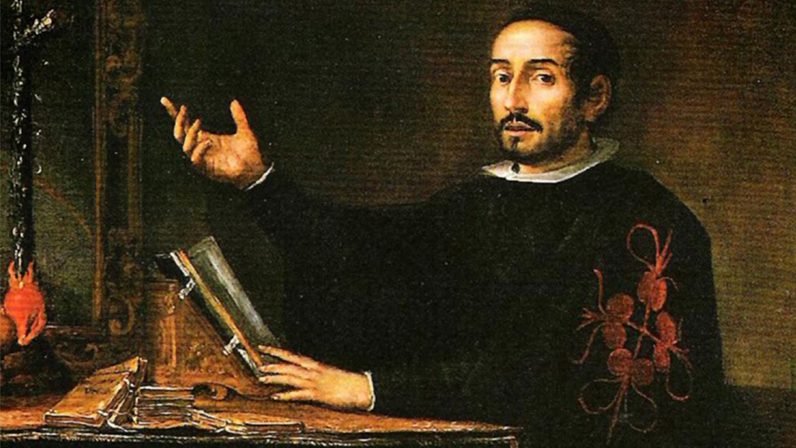
The rich live overwhelmed by cares,
The poor live submerged in misery;
The monarch, intoxicated by flattery;
And a shepherd bound to sorrow.
The soldier, bowed by triumphs;
The scholar remains bound to civil life;
The wise man oppressed by providence;
The fool lives of no use to those raised above him.
The religious life is lived under restraints;
In his work the official fair flourishes;
And death, for all, receives the final embrace.
And what is dying? It is letting go of passions.
Then living is a bitter death;
Then dying is a sweet life.
(Miguel Mañara Vicentelo de Leca)
Brother Alonso slowly crosses the hospital archway. The child he carries in his arms grows weaker by the moment; he will not survive to eight years, nor weigh more than twenty kilos, but he was already the third patient he had picked up that day, and exhaustion slows him down. Amid chills, the boy coughs again and again. How many days he has lain in the alley where the brother found him is anyone’s guess, for the boy is so frail that he cannot speak. Undoubtedly, the plague is wreaking horrible havoc among the poor of Seville.
The year is 1679, and the Indies port is suffering the umpteenth epidemiological crisis of recent decades. As one of the most veteran members of the Brotherhood of Charity, Alonso still remembers the tragic plague of 1649, which claimed the lives of 60,000 Sevillians. Now, typhus was preying upon the city’s most vulnerable: poor hygiene, overcrowding, and inadequate nourishment formed the perfect breeding ground for the disease to race through Sevilla’s humbler neighborhoods, bringing with it symptoms such as intense headaches, rash, chills, and extreme weakness. In the Brotherhood, they could not keep up: since its founding in the fifteenth century, its members had been responsible for burying beggars, rogues, those sentenced to death, and the destitute, and later they expanded their welfare work to all kinds of poor and ailing people.
Alonso curses his strength; he has not arrived in time. A little after entering the Hospital de la Caridad, and while seeking a spot for the child he carried, he has drawn his last breath. He is dead. Exhausted and in tears, the brother leaves the ward assigned to the care of the sick and moves toward the adjoining church of the Brotherhood. He is crushed and yearns to pray for the souls of those abandoned souls, for his advanced age and the day’s labor have drained his strength to continue gathering the sick.
The Church of the Brotherhood of Charity, under the patronage of Saint George, had been inaugurated five years earlier, yet some decoration details were still being completed. The temple was a jewel of Sevillian Baroque, and some of the city’s most renowned artists had already worked within. With his head bowed, Brother Alonso advances along the central nave, pondering the cracks that appear in the wall of the nave of the Gospel. The structural problems have long threatened the church’s walls, begging for urgent intervention. Alonso’s troubled mind cannot help but draw analogies: that temple resembles the fragile Seville. His city controls trade with the Indies, a port that receives immense riches crossing the ocean, the true heart of the empire where the sun never sets, cradle of great artists, patrons, and intellectuals; and yet typhus ravages its neighborhoods without mercy, just as the cracks that threaten to bring down the sumptuous walls of the San Jorge church, decorated with works by Valdés Leal, Murillo or Pedro Roldán. The temple, like the city, is wounded at its core.
A presence surprises Alonso as he nears the presbytery. Someone prays in whispers, seated on a wooden chair. It is a knight dressed in black, with a white ruff and a cloak bearing the order of Calatrava.
—Miguel! Is that you? —the knight halts his prayer—. Forgive me for interrupting your devotions… But I am so glad to see you! I feared for your health, brother, and your presence is needed today more than ever for us…
Alonso suddenly falls silent as he studies the face of his interlocutor, who now offers him a smile. Indeed, it was Miguel Mañara, the head of Charity, but his countenance betrayed a deplorable physical state that made him almost unrecognizable. By all accounts he presented a grave fever, with enormous dark circles around which dozens of red blotches lay, the unmistakable signs of typhus that distorted the leader’s face.
—Welcome, brother. Step closer, please.
Alonso pulls up a chair and places it in front of Miguel, observing him with a chastened air. He genuinely admires the man, and thus restrains any impulse to call his behavior reckless. The Council of Government, which guided the Brotherhood, had advised Mañara to avoid direct contact with the afflicted because of the high risk of contagion. As the head and spiritual guide of Charity, he ought to safeguard his health and let other, lesser-ranking brothers take on the caregiving duties. Yet Mañara paid no heed to these warnings, repeatedly exposing himself to contagion, even requesting a cell inside the Hospital to live among the poor and sick, whom he regarded as “his masters and masters.”
—I know you see me as reckless.
—Miguel, you must understand how much we value you and how indispensable your leadership is to the Brotherhood. You could have kept your distance, for the others yearn to serve the afflicted and we are, unlike you, merely dispensable.
—Only God is necessary, Alonso, and all of us are contingent. But if we were to establish degrees of contingency within the world, I would be the most dispensable of all creatures.
—You have transformed the spirit of this Brotherhood; you are the pioneer of this temple, and your teachings guide us along the true paths of Charity. Why insist on underestimating yourself?
—Because I have been the worst of all men.
A long silence interrupts the conversation, after which Mañara resumes his prayers, since Alonso does not know how to respond to that last confession. The elder brother assumes a sullen air and his gaze sinks among the images of the great altarpiece. He contemplates the Santo Entierro that presides, the work of Pedro Roldán, while seeking a reply to the elder’s words.
The past of Miguel Mañara was known to many inside and outside the Brotherhood. Born into one of Seville’s wealthiest families, he soon lost his two elder brothers and was left fatherless at twenty-one, thereby inheriting a vast fortune at a young age. Up to then, he had led a life of nocturnal escapades, given to libertinage. A spendthrift, ambitious and proud, fond of gambling and appearances, skilled with a sword, a chronic late-night reveler, and always central to the gossip of Seville; thus the young Mañara. Shortly after his father’s death he married Jerónima Carrillo de Mendoza, a noblewoman from Alcalá, and she managed to steer the youth away from his wayward course. Miguel was immediately smitten with Jerónima, and the arrogance and excesses of youth gave way to a stable, fruitful maturity alongside the woman he loved more than himself. These were years of joy and prosperity: the couple accrued substantial wealth and influence, and Mañara was named Provincial of the Holy Brotherhood, a position of enormous influence in Seville at the time, in addition to Knight of the Twenty-Four and Mayor of the city. The crème de la crème of Seville’s nobility bowed before this aristocrat, whose fame and power extended beyond Andalusia, elevating Mañara to the rank of ambassador of the city before the royal Court.
But at the pinnacle of his aristocratic life, the scythe of death returned to remind him of the Latin phrase: Memento, homo, quia pulvis es, et in pulverem reverteris — a very sad morning in his thirteenth year of marriage when Jerónima died suddenly. Not long after turning thirty, Mañara lost his life partner. He never recovered from the loss; an atrocious grief seized his soul, and he felt his life’s meaning fade away.
—I had everything and yet nothing, Alonso. I knew then that my vast fortune and my long list of offices and influences were vain conquests, empty illusions in light of the unalterable fate of death — Alonso listens with surprise, for the Head of the Brotherhood rarely shares such painful memories with others. — In those days, my existence lacked meaning. Worldly success gave way to an anguished void that shadowed my days and drove me toward a conscious withdrawal. I retired to the Desert of the Snows, in the heart of the mountains of Ronda, and entered the Carmelite monastery there. I spent months, I do not recall how many, practicing a stringent penitence. I fasted and refused a bed, laying each night my exhausted body upon the cold floor of my cell. I deliberately worsened my health, for I believed that the strictest penance would enable me to escape worldly pain, atone for my sins of greed, and discover a way out of the void that filled every corner of my soul. But the pain did not cease and my penance began to seem futile.
—I was unaware you stayed in that monastery. I’m sorry you went through that…
—The privations left me in a deplorable physical state —Mañara continues absorbed in his memories, oblivious to his companion’s attempt at consolation—. On the days when my despair rose highest, I surpassed the fasting limits laid down by the monastic rule. I even renounced the legume dish that was due to me and spent weeks living on stale bread and water. Starvation, joined to my deep spiritual crisis, drove me to the edge of death, and I began to think that this might be my destined fate and the only way to quickly reunite with Jerónima. It was then, with my entire being poised on the brink of the abyss, that a group of venerable Carmelite fathers, moved by pity for my afflicted soul, summoned me to a meeting that would alter my destiny. They showed me that letting myself die would prevent me from serving God in the mission He had entrusted to me: to help the poor through acts of charity.
—Was that when you decided to join the Brotherhood?
—That is so. Those Carmelite fathers were my confessional physicians. I owe them an eternal debt. As you well know, I donated all my wealth to the Brotherhood, and here I have found the seventeen happiest years of my life. If this illness devours me, dear Alonso, know that I shall die peacefully, for having served the destitute in this city, who are my masters and lords, became the path to the fullness of my soul in this earthly life.
—I admire the noble character with which God endowed your soul. However, permit me to reiterate today the counsel those friars gave you: you are still needed in this earthly world. I plead with you to fight the disease with all your strength, for losing you would mean bidding farewell too soon to the leader who transformed the Brotherhood of Charity and who shows us the paths of mercy.
—Know, Alonso, that the physicians gave me no more than two weeks of life.
The silence returns to the church, interrupted minutes later by the sound of spring drizzle hanging over Seville. Alonso remains seated beside Miguel, who has returned to his prayers. The worst fears of the Charity brothers are confirmed by Mañara’s resolute verdict. In recent weeks, rumors had circulated in the refectory about the fragile state of the elder brother’s health. The most pessimistic warned that the virulence of the typhus symptoms affecting Mañara could end his life. He had spent days confined to his cell, even requesting meals be brought there. Alonso, who had clung to a more hopeful outlook, now feels his own hopes crushed, tears streaming down his face.
—Do not grieve for me, Alonso, but for those who suffer even more in this world. I leave this world in peace and with a profound longing to see God. Remember how my book began, The Discourse of Truth.
The rain intensifies. Alonso is intimately familiar with Mañara’s work from eight years earlier, yet he senses he has not yet grasped its true meaning. The book contained deep reflections on death and the transience of corporeal life. Mañara had suffered the loss of several loved ones since youth, and that text appeared to reflect a very particular stance on the end of existence. Alonso had reread it countless times, trying to decipher a message that seemed to elude his understanding.
—“This is the first truth, which must reign in our hearts: dust, ashes, corruption, and worms; tomb, and oblivion. Everything ends: today we are, and tomorrow we do not appear; today we miss in the eyes of people, tomorrow we are erased from the hearts of men.” Mañara slowly recites the first lines of his Discourse of Truth.
—I fear I will never understand how you have managed to normalize death so completely, when losing your parents, siblings, and wife has brought you such immense suffering. I too lost my parents young, Miguel, and even at sixty I fear death, oblivion, nothingness. When this morning a defenceless child died in my arms, more than sorrow I felt fear, terror at the grim fate that awaits us all at any moment. Of course, as a good Christian, I entertain hopes of reuniting with the Most High after death, but I cannot help fearing the thought of leaving this world entirely. Moreover, our presence in Paradise is not guaranteed; we are all great sinners, and only God will choose who must accompany Him for all eternity. And if I am not among the chosen? What if confession is not enough to expiate my monstrous faults? What then awaits me? Only the darkest nothing! Tell me, Miguel, how do you find comfort in this horrible uncertainty?
The panic that runs through Alonso’s spirit contrasts with the serenity of Mañara, who appears completely confident and assured in his words:
—Saint Augustine said that truth resides in the soul illuminated by the Word. It is there too that we find truth about the end of our days. We must listen to the voice of the soul. I found peace and approached truth when I renounced sensual pleasures, and God enlightened me with His infinite wisdom. Thus I understood: Mortui, qui in Christo sunt, resurgent primi.
—My God! I cannot grasp those abstractions or your tangled language! —Alonso seems to despair—. My fear is worldly, earthly; for years I have tried to understand the reflections you defend with such certainty, but uncertainty keeps gnawing at me.
Although Alonso, seized by desperation, has raised his voice, Mañara remains calm and smiles gently at his pupil. The slight note of reproach in his voice does not offend the elder, who answers with patience:
—I’m sorry for not making myself understood. Perhaps my physical state clouds my rational capacity and hinders me from speaking clearly.
Alonso regrets his sudden irritability and regards Mañara with concern, who now appears to strive to facilitate the understanding of his thoughts:
—See, I would not wish to leave this world without clarifying what sense must guide the Brotherhood of Charity in the years to come. Of course, we must maintain our old goals: bury the dead and shelter, give bed and sustenance to the destitute. Yet there is something that transcends these actions, a principle intelligible that forms the very core of our condition and must be grasped by all. This idea, this foundation, you can find in the canvases placed in the top of the church, especially on the side of the Epistle.
—Do you mean those painted by Valdés Leal?
—Exactly. You should know, dear Alonso, that Valdés Leal is my brush. All my work, all my thought, is distilled in that painting. Help me to rise, brother; let us approach it. With its aid, I will help you understand what my words can no longer explain, I will show you where the riches and vanities of this world end.
Holding onto each other, Alonso and Miguel move toward the church’s feet. Night has fallen on Seville and a fierce storm hovers over the city. While sailors try to safeguard their ships at the Indies port and protect the chests full of precious metals that have crossed the ocean, the two priests pause in the Church of San Jorge before a canvas of grand dimensions.
Approaching the port, the storm has damaged the mast of a grand galleon and its captain is furious. After crossing the vast Atlantic, he loses control of the ship in a Guadalquivir that seems more furious than any ocean. With less than a mile to reach his final destination, the galleon sinks. The captain throws himself into the water with one of the chests full of eight-real pieces. He hopes to reach the riverbank and rescue at least a portion of the loot, but the weight of the chest and the torrent of the waters prevent him from advancing. With nothing left and one arm growing ever more fatigued, he clings to the chest and refuses to let go. When he has only twenty meters left to the shore, his sight suddenly blurs.
Meanwhile, Alonso gazes at the figure depicted in the painting. The skeleton smiles at him in macabre fashion. What Mañara then revealed left him astounded.