
Had Elizabeth Barrett Browning’s spaniel not been immortalized in her verses, the English poet’s dog would have disappeared without leaving a literary trace — “Beloved friend, a gift from one / Who, in true faith, had to run / Through nature in the low places; / Be my blessing, I said / with a hand upon the head, / gentle companion”—, Browning immortalized in a poem entitled A Flush, My Dog, dated 1844. Nearly a century later, Virginia Woolf penned Flush: A Biography (1932), in which, wielding extraordinary imagination, she reconstructed and deconstructed the spaniel’s life, focusing especially on his many journeys with Barrett Browning and her husband, the fellow poet Robert Browning, as well as his abduction in the Whitechapel district of London, then home to drinkers, ruffians, and workers. In Woolf’s work, Flush marks a departure: it is the first tale to carry a component of critique aimed at the staggering social inequality that ruled England at the time — and which still lingers today, including in Whitechapel, a neighborhood located just a few meters from the City’s financial heart. Although Woolf had long been calling for a room of one’s own, it’s worth remembering that the Bloomsbury group to which she belonged constituted an intellectual and economic elite, not representative of the average citizen of 1930: a worker, a child of a worker, a housewife. Thanks to Barrett Browning’s dog, Woolf’s gaze for the first time shifted toward the common people; the dog enabled Woolf to rewrite history from the “low” vantage point, in opposition to the establishment, with the spaniel becoming a metaphor for the working class. Since then, Flush has not been remembered merely as that “gentle companion” from Barrett’s lines, but also, perhaps more strikingly, as a narrative instrument to undo what has been done, offering a re-interpretation of the past from below, an alternative to the power’s hegemonic discourse. A counter-power.
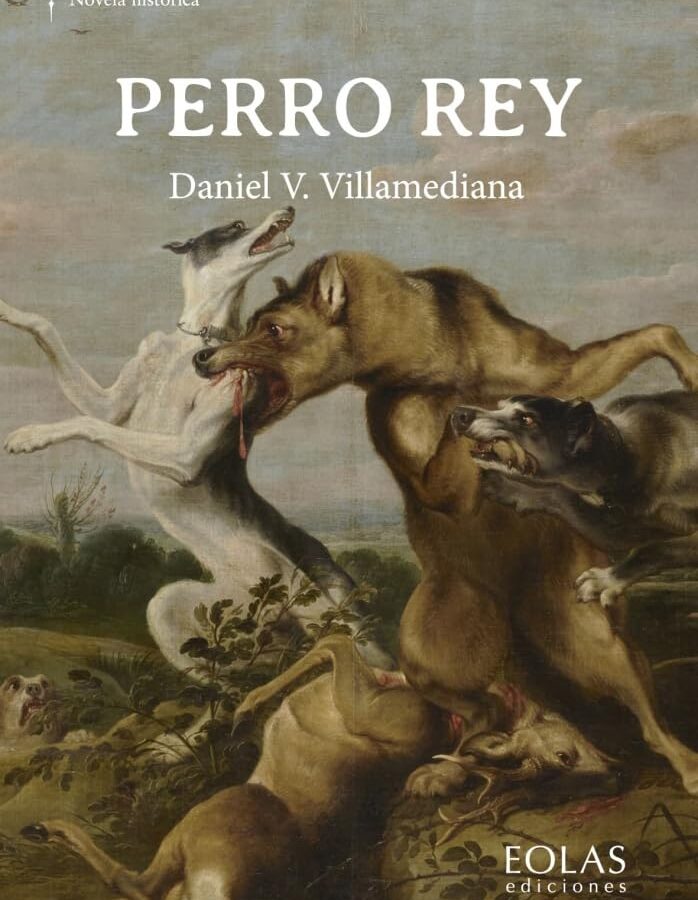
“Desandar lo andado” is not Woolf’s phrase but that of Thani, one of the characters in the latest novel by Daniel V. Villamediana, Perro Rey (2026, Eolas Ediciones), in which the Valladolid-born writer reimagines and expands the project of the English author with grand literary ambition, scholarly rigor, and creativity that spills beyond the borders of fiction to offer a poetics and politics of alternative futures that can and should be read as a guide for the present. Perro Rey unfolds within the “Spain” of the sixteenth century — a political concept more than a geographic one, embracing colonies in both Europe and the New World — that era’s tumult and decisive turn in world history, supposedly marked by Discovery and Conquest — with their accompanying genocides of indigenous populations — the dawn of Modernity, the nightmare of the Inquisition, the autocracy of the Catholic Monarchs and later of Philip II, the overwhelming power of the Catholic Church, the arrival of the printing press that relegates orality to the popular, among other “grand narratives” and events that have traditionally dominated that period’s storytelling. These grand narratives, as Jean-François Lyotard defined them in La condition postmoderne (1979), tend to leave little room for other perspectives, other eras, other knowledges, which in this novel do find a place — or perhaps we should say occupy the space — thanks to the figure of Perro, a dog whose uncanny gift for speech and listening pushes us to unravel the threads of the past to propose an other narrative, from “below.” Perro Rey thus joins a catalog of literary projects that inhabit — occupy — the political dimension of the colonial past as the anguished limbo of Zama (1956) by Antonio di Benedetto, the interweaving of times in Llanto: novelas imposibles (1992) by Carmen Boullosa, the extended wanderings in El largo atardecer del caminante (1992) by Abel Posse, and, above all, El entenado (1982) by Juan José Saer, a colossal novel about a cabin boy who arrives in the New World and is captured by a tribe whose ways of life profoundly alter his understanding of time and space, placing him in coordinates other than those of the European social order — is it permissible to lie with a relative? Why walk forward when we can circle? Should posterity be earned and remembered, or is memory’s end death? —. Yet, unlike these Latin American writers, Villamediana rewrites colonial time from a European vantage that nonetheless seeks to decolonize the notion of the New World, i.e., to undo what has been done by those grand narratives that began with Columbus and the Chroniclers of the Indies — contradiction, or a necessary gesture to acknowledge the wound of the past?—.
Villamediana’s novel unfolds in a linear arc through the sixteenth century, centering on the life of the exceptional dog Perro, re-created through a tapestry of testimonies from various figures who crossed paths with him and shared his conversations; in the background, the great historical events recede to the foreground as they are told not by those in power — the monarchy, the Church, the chronicler — but by everyday people (the perspective of Flush) who struggle to survive rather than to transcend and endure in time — “in that city [Valladolid], which had been the capital of the realm, nobles, dukes, marquises and the rest lived. It was, in truth, a city of great wealth, but also vastly poor. He met many beggars, maimed men, and half-men who tried to draw attention with desperate gestures,” notes the narrator. A shift in vantage and in mode of seeing that conceals a political postulate: there is another history, and it can be told, as Saer did before him, when he reintroduced us, Europeans, to the Colastiné tribe in El entenado.
More than the what, the how matters; comparisons with Saer’s novel are, if anything, inevitable. As in El entenado, Perro Rey offers a profound meditation on memory’s role in the (re)writing of history: only that which is written will be remembered beyond oral, fugitive, and brief transmission, and thus writing is a weapon of power that must be safeguarded, as the narrator notes at the conclusion of a story that, chronologically, also serves as the starting point for remembrance: “I realized then that there was only one thing I ought to do: fulfill the mission I had entrusted to myself, and that was none other than to perpetuate the memory of my king. I must tell his life, his suffering, and his feats so that they may be learned from.” The pedagogical aim, not moralizing, is implicit from the opening of the novel when a not-too-contented friar teaches Perro to speak, and he decides to call him father. Just as in El entenado, where the narrator refers to the priest who taught him to write as father, the given and transmitted word symbolizes a chosen — not imposed — family. The absence of lineage and tradition is not read as a negative of abandonment or deprivation, but as a possibility of freedom to construct a sense of reality independent of the canonical forms imposed by social, religious, and political institutions — which, from the start in Perro Rey, are rejected as elements of authority. Among them, the sedentary ideal that fosters a sense of belonging to a fixed place as a model for life, and perhaps more importantly, as a political horizon — recall that the sixteenth century is when the idea of the nation-state begins to blossom in Europe, eventually imposing itself across the world. In Perro Rey, the main character and all who accompany him on a quest toward a better world are forever in motion. “Why do you always travel?” Perro asks a dwarf from an itinerant theatre troupe whom he joins in the early chapters of his life. “Because freedom lies in movement,” the dwarf replies. “He who remains still loses it… what of the lords in their castles, surrounded by impregnable walls? They cannot abandon them for fear of losing them! The gold they guard, like a magnet, compels them to remain close, for man does not possess the vile metal, but rather the opposite happens to him.” Words that function as a prologue to Perro’s nomadic, anarchic life and that forecast an idea of travel as a modus vivendi, not merely an exceptional time in an individual life. A movement that rejects borders and the idea of sovereignty on which today’s nation-state political system rests — is this then a novel about the past as it would tempt us to believe with its numerous historical references, or about the present of walls, barbed wire, and increasing concentrations of wealth in a few hands?—.
As the narrative progresses, the institutions that allegedly sustain and define the world of that era —or is ours the world now?— gradually collapse: the Church is not the benevolent enterprise it claims to be, the monarchy leaves its servants starved, every trace of family Perro encounters dissolves as if nuclear forces were toxic. In the second part, Perro ventures to the New World, and it is here that the novel reaches its apex as a guide to other possibilities, and as a reminder not only of what was lost and what memory has failed to preserve, but also of what remains remembered and what constitutes the colonial archive (and recall that Perro Rey is told through a Spanish and European lens that nonetheless aims to undo what has been done rather than reinforce the status quo). Remembering is here an act of power, but what is recalled is less about great feats or defeats, depending on who narrates them, than about the disastrous consequences of war for ordinary people, starting with millions of deaths and not forgetting the extinction of knowledge and cultures that had no written record. The speculative backdrop of this part of the novel — what could that world have looked like without any archive? — is utterly compelling. For instance, the journey along the huacas (paths) through Perro’s jungle with Thani, a girl captured by a Spaniard who also holds Perro, and whom they flee inland to seek hatun runa (common people, the social axis of the novel), introduces words that insert themselves into the Spanish text to remind us that there was a time when that language did not exist as such, when that tongue was not even a language — a kind of silence?—.
In the act of rewriting the history that the novel embodies, there is also space for reshaping historical events by flipping the script in the manner of Quentin Tarantino in his films (for example, Django, Inglorious Basterds, and Once Upon a Time… in Hollywood). In one of the most memorable chapters, a group of Spaniards is soundly defeated by armored horsemen assisted by heavy artillery improvised by locals, orchestrated with the help of a Spaniard in love with one of them, Malinche in reverse. In this portion, the novel is rich with moments of communion and cultural hybridity, challenging the binary of us and them. The Spaniards are Spaniards but also the foreigners in the New World; in the middle, without belonging irrevocably to anyone or anything, Perro and his companions form a social fabric that transcends simple divisions and categories — what does it mean to be Spanish in the sixteenth century? — and it reminds us, without minimizing the ravages of conquest, that even in the so-called New World there existed vertical and oppressive social structures.
Chased also in the New World for its singularity, in the novel’s final section Perro travels back to Europe, taking with him the experiences and testimonies of the New World. Globalization is already a fact in the XVI century, and it is worth noting that one of the most ambitious political theses of the book is the reminder that the history and collective memory of Europe, and more specifically of the country that calls itself “Spain,” cannot be understood without the land across the Atlantic. In Utopia and Memory (2005), a vigorous essay that remains timely, Luisa Passerini argues that many European memories did not even originate in Europe. “Memories in the plural allude to the multiplicity of cultures and languages that arise from the diaspora of peoples across the world today, a multiplicity that we hope will become imbued with a full sense of mutual respect, so that multiculturalism, multilingualism, and multiraciality do not become empty words,” Passerini writes. This, and most notably, is what Villamediana achieves in his novel through a boundless country of fiction and with the marginal yet free figure of Perro.
Beside formal experiments like Las olas (1931) and Mrs Dalloway (1925), or the extravagant acts of imagination such as Orlando (1928), Virginia Woolf’s Flush: A Biography is regarded as a minor work by critics, including Woolf herself, who even described it as a joke. It is worth remembering here that the canon is a power structure that designates certain works as more worthy of being remembered and read than many others, that the history of literature and thought is written by a few authors, while the vast majority fade into oblivion, excluded. Against this tendency, works like Flush, and especially Perro Rey, teach us that another path is possible: the past can serve as a compass to rewrite the present not from above, as is typically done from Columbus, but “from below,” “the gentle companion.” Woof, woof…
—————————————
Author: Daniel V. Villamediana. Title: Perro Rey. Publisher: Eolas. Available at: Todostuslibros.