
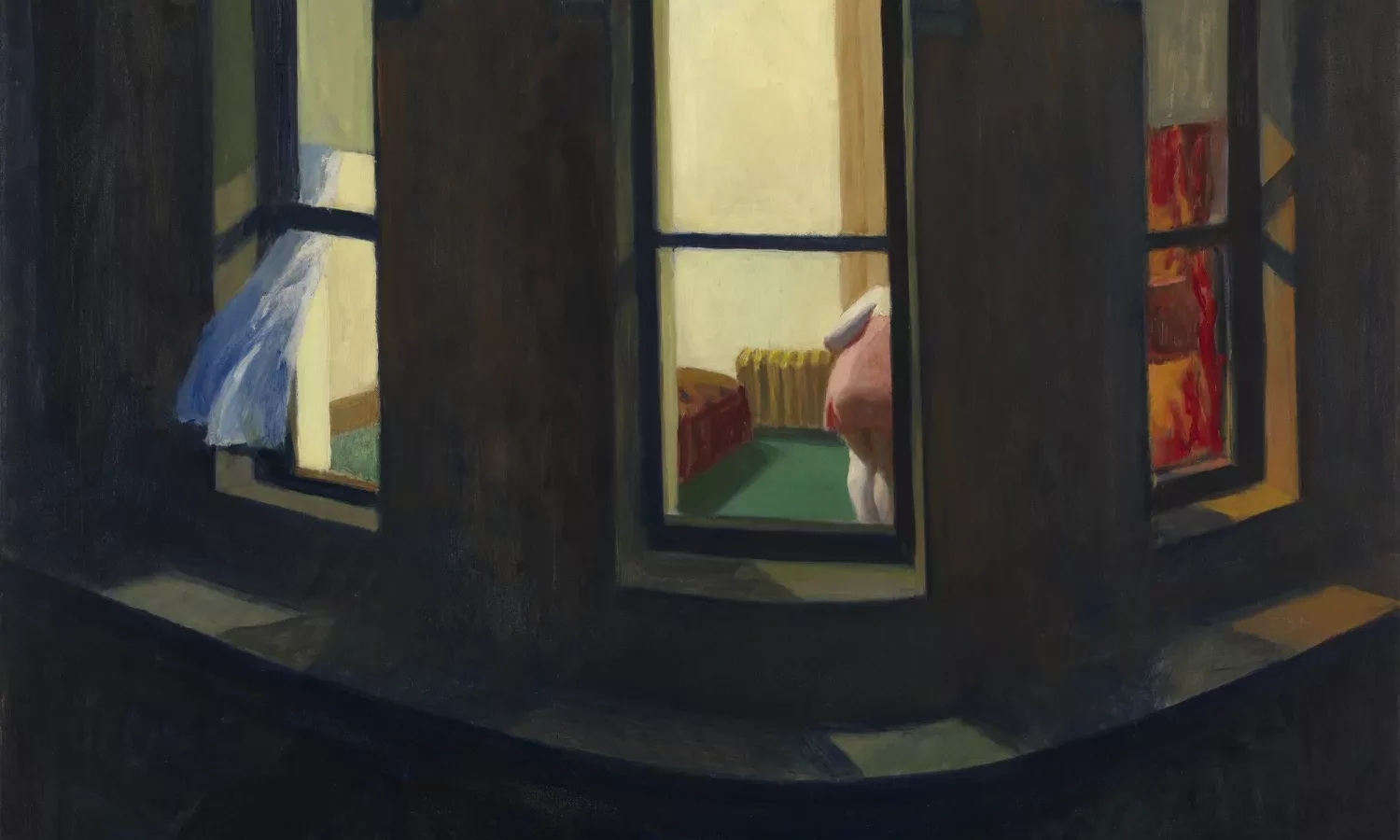
I had grown accustomed to her imperfect handwriting, with the i’s slanted toward the east, the o’s not quite closed, and the j’s and p’s truncated at the bottom, as if she never had time to let them drop.
Her words, bearing astonishing morphemes, devastate the lexemes that challenge me in every sentence, and I fix them in my gaze for minutes at a time so they won’t slip from memory. They perfectly imitate the rounded shapes of her body, the curves of her generous hips ready to try anything, while her uplifted breasts push through each sentence and lift my dimming spirits. Nothing of her body is superfluous, and nothing is lacking in her handwriting. There is an exact proportion between the two that I conjure as I read her postcards. I reconstruct her voice, which I will never hear. But it doesn’t matter: what is a voice without a message, without a story to tell? Without a caress.
It drizzles. In an hour, at dusk, the drizzle will crystallize into bitter flurries that will cover the window sill. This afternoon I retrieved from the mailbox her latest postcard. Wednesdays ceased to be Wednesdays; they became the day when the postman left me the longed-for correspondence. For a long time I have reread all of her postcards a thousand times, sent over the course of a year, always from the same city that I now know better than Madrid, from imagining its streets, its squares, and its churches. I think this last one is the one I like the most. It is an image of the city of Sofia buried in snow. In the background stands the Alexander Nevsky Cathedral, a bulwark of a city with a thousand cultures, as she herself— a woman of a thousand guises. I know this postcard is unlike all the others. I sense it by the weight it rests on the desk. It is the weight of a declaration I do not have the courage to read, because I can guess what it is.
The farewell.
She will not send any more.
That is why I do not intend to read it.
I will leave it on the desk, propped against the lamp, to gaze at the cathedral buried in snow until I grow tired and decide to turn it over. Perhaps I will read it someday. I have a lifetime ahead of me, the time to postpone the final twist in which she explains why she leaves me.
I want to imagine that this afternoon, at six thirty, I will see her again as she enters her building.
First: she will rummage through the bottom of her purse until she finds the keys.
Second: she will push the door open with her knee.
Third: at that moment her mobile will ring inside her bag. She will hesitate on the threshold, unsure of what to do: whether to go inside or remain on the street, trying to silence the sound, nerves frayed, perhaps muttering a Bulgarian cuss at the ridiculous size of that cheap bag slung over her shoulder.
Fourth: she will locate the phone and a smile will brighten her face when she sees the number on the screen. Unfortunately, that call will never be mine. She will listen and then hang up. She will step into her building and disappear from my sight.
Fifth: half an hour later, at seven o’clock sharp, the man who presumably called her will arrive in a taxi. Clad in his flawless suit, he will press the intercom, the door will open, and he will enter as a furtive intruder.
Sixth: at eight fifty in the evening, the same taxi will arrive again. It will park in front of the entrance and the engine will go quiet.
Seventh: at nine, not a minute before nor a minute after, the suited man will emerge, running to catch the waiting taxi.
I suspect the driver is a constant hire. There are certain businessmen who loathe the hassle of city driving and don’t want a chauffeur for the sake of discretion. That man is twice Ivanka’s age. On the other hand, I have never felt jealousy, and I am certain that such a relationship benefits her. It is comforting to think someone looks after her. Older lovers tend to be protective if the women are much younger, and not their own. Knowing this truth nullifies any jealous ache those meetings might provoke in me. I admit I am playing with an advantage.
By five twenty in the afternoon I’m already home. I make myself tea and sit at the desk beneath the window that faces the street and her building. Hour after hour, I feed my old Olivetti with blank sheets, filling them with words that sometimes say nothing at all, other times speak of her and me; of us, of the love we had, of our marriage crushed to pieces and of a future unattainable.
I have never dared to go down to the street and take her by the arm to tell her that I live opposite her building. That I spy on her. That I know perfectly well her life’s messes to which she is entitled, of course. That I work before a typewriter since I came home from a job I hate, but which guarantees my rent; in that, I have thrived, I would tell her. But I say nothing. I do nothing except lift my gaze from the keys and look out the window.
I have written hundreds of pages about the day our daughter was run down. In one of them, my little girl squeezed my hand, lying on the asphalt, paralyzed from the waist down. I wiped away her tears with my dirty handkerchief and consoled her, knowing she would not survive. Our daughter died in my arms. I have rewritten that scene many times, exploring every possible ending. None of them could save her. I acknowledge that it is a very sad tale, but a writer cannot feel pity for his characters or pervert their stories.
I see in her final postcard a snowy city I have never visited. I imagine Ivanka sinking her feet into that snow, taking my hand to hurry us inside the cathedral as if we were tourists. Yet I sit before a fresh blank page, unsure how to end this story about a woman so beautiful.
The beginning of our end began the day Ivanka stopped appearing behind my window. I grew frustrated waiting, day after day, for six thirty to arrive. I lived in a state of unease, incapable of conjuring a good sentence. Was she ill? Had she gone on a trip? She hadn’t left with suitcases, not even with a weekend bag. Nothing indicated her routine had changed.
The last time I saw her leave her building, her coat cinched at the waist and a small handbag in her hand. No other bundle that would reveal a prolonged absence. The man hadn’t shown up all week, at seven precisely. That is what alarmed me most. He had to know where Ivanka was. Had they run away together? Or… had she been murdered by him? I had noted the taxi’s license plate and would have no trouble recognizing the daily chauffeur; nor him—the dapper man with a thinning hairline and a bluish tinge at the temples. A distinguished man, without a doubt.
I was determined to wait a couple of days before reporting Ivanka’s disappearance to the police. But the thought that she could be in trouble in her own apartment, just twenty meters from my studio, while I pressed my fingers into the Olivetti’s keys and wrote stories about her, kept me distracted. What if everything I was writing turned against me and became real? What if my poor Ivanka had fallen prey to that old sadist and was bleeding out on her carpet, naked, hands bound behind her back, waiting for me to write another script for her or to twist her ending in an unforeseen direction? I pictured her green eyes, trembling and brimming with tears, begging me to break the pages that condemned her to death.
All of that was impossible. Impossible that my fiction could leap into fact. Yet I was not at ease and needed to see her again, climbing the sidewalk, stopping to rummage in her enormous market-bag for her house keys. So I decided to approach her building and take a look to see if I could find any sign of her absence.
I donned the old trench coat, my aviator sunglasses, and stepped out. I crossed the street. Her building’s door was ajar. A good chance to go unnoticed. A year of watching from my window had taught me how to stumble upon Ivanka at any moment. I peered into the mailboxes until I found a white sticker bearing her name—Ivanka Dvoretzka—handwritten in that familiar script of hers, the i slanted eastward and the o not fully closed. It took little effort to force the little door open. I checked that there was no mail, only fast-food adverts and flyers from neighborhood stores. I rode the elevator to the second floor. I stood before the letter D and pressed my ear to the door.
No one inside.
I relished the scent of Ivanka’s perfume. I felt like a hound tracking the arousal of a stranger. I thought of an expensive perfume, perhaps a touch too sweet. Surely he paid for it, as he would pay for the rent of that apartment in a dim old Malasaña building; the neighborhood where I have lived for three years, a place of offbeat souls that fuels my wildest stories.
I turned back and rode the elevator down. Just as I was about to exit, a neighbor entered the building—an elderly woman from the third floor who lives alone, aside from the cat that often naps on the kitchen windowsill—just above Ivanka’s place. I greeted her pleasantly. She responded with unexpected warmth, almost grateful to encounter another human being. She paused to rest. I took the opportunity to ask whether she had seen Ivanka lately below her apartment. She hesitated to answer, weighed down by a supermarket bag, breathing hard. I feared for her, but she recovered quickly. She told me not to worry; Miss Ivanka had left for her homeland. The young woman, she added with a conspiratorial glance, had finished her university studies and was on her way. Before her departure, she had packed a box full of keepsakes she could not bring with her. A young woman so kind and affectionate toward the elderly; her family in Bulgaria left her very alone in Madrid.
I pressed her for details, begging her to recall more. It seemed unlikely that Ivanka had been studying at a university, yet she grew more confident in her account, with a memory tested against any question. She told me about Ivanka’s last conversation: apparently she had finished her master’s work in Hispanic literature and, with that, her time in Spain; she planned to marry the Bulgarian beau she’d left in Sofia as soon as she returned to Bulgaria. The young man wrote to her every day; his letters betrayed restlessness, he kept demanding more of her, and they argued often. It seemed the Bulgarian couple had the air of a long-ago romance, the kind that starts when one scarcely remembers a time before it. As soon as Ivanka returned to Sofia, wedding plans would begin. In the end, the old woman lamented that the young woman, hurried by her departure, hadn’t left any address where to send her letters or to write to her on occasion.
As I returned to my hideout, the motive for jealous lovers’ favorite murder came to mind: jealousy itself. It sends you down winding paths. But it was also possible that Ivanka had invented the boyfriend, imagining a life where I no longer had anything left to write.
I must admit that I felt unsettled. Also sad. I needed to know what contents lay in the box Ivanka had supposedly given to her elderly neighbor. I remembered the words she had used: “Keepsakes she could not take with her.” A terrible surge of anxiety came over me—I needed to know what those memories were. I pictured the photographs of our love scattered in the box’s depths, mixed with the images she had taken with her protector; all tangled together, our romantic and tender moments blending with the images of the abhorrent sexual acts she performed with him. I did not understand how I had failed to question the old woman deeper about the box: whether she had opened it, whether she knew what memories it contained that should have stayed in Madrid; whether she knew who I was and had feigned ignorance to tell me all this and set me on the track of the truth; or whether she was a matchmaker, intent on drawing me away from Ivanka without sparing me any sorrow. All these hypotheses tormented me, and I tried to pick the most suitable one.
Ivanka’s decision to return to Bulgaria filled me with a deep sadness. The issue of the boyfriend wasn’t mine to solve; I never wrote that story. Perhaps that’s why I never saw the quiet taxi arrive in the afternoons, nor did I glimpse his protector emerge from the cab, worried about being seen. I considered locating the stranger to clear my doubts, to confirm whether Ivanka had indeed run off with her Bulgarian lover. If so, I would try to persuade him to intervene and bring her back; he’s an attractive man, and perhaps she remains in love with the donor of all those gifts. I am certain that neither him nor I should care about her possible marriage to that Bulgarian fiancé who will surely offer her a future far better than any life I could conjure for her, nor the lives I have invented in my stories that she will never read. Better so. She will be spared the heartbreak of witnessing our daughter’s death in a terrible car crash, and of the dreadful endings I have written for her.
She would also be spared the secret affair with a married man who will never leave his family, and who may well end up killing her. Ivanka inspired so many tales for me… all of them sad. Her face is that of a simple woman with a smile ready to be shot at any moment like a bullet aimed at the hearts of the men who cross her path.
Now I only have eyes for her last postcard from Sofia and the sorrow of her departure.
It is curious how one gets used to the daily routines that give life to our habits. When they vanish, it feels as if something deep inside dies. This absence has left me in a state of numb acceptances. I need to replace the vanished routine with others that will fill this void, this absence of creativity. I will try to write a novel that alters the course of another novel that records what I have written about us and about Ivanka. Because now I know she will not reappear in any of my stories again, whether because she left for Bulgaria or because she has been murdered by her lover, as I intend to write. The reason is secondary; what matters is that she is gone and what we had is finished. Thinking about moving to another apartment would serve no purpose now. Nor will continuing to write Sofia’s postcards, which are becoming harder to find in the old shops of El Rastro. And the reason to mail them weekly, with my studio’s address, forwarding her Slavic handwriting and the sense of a thousand cultures, and to invent what she might write to me if we had lived what I’ve narrated for her, no longer exists.
If I knew where in that enchanted city she lived, at the foot of Mount Vitosha, I would send them as wedding gifts. Every single one of them. But my life as a writer continues in a quiet waiting, hoping that another wonderful woman, like her, who will inspire me to fill the blank pages I keep in a drawer, will settle into her own apartment, and that I’ll dream up new lives for her, replacing the Sofia postcards with those from another city I will never visit.
——————————