
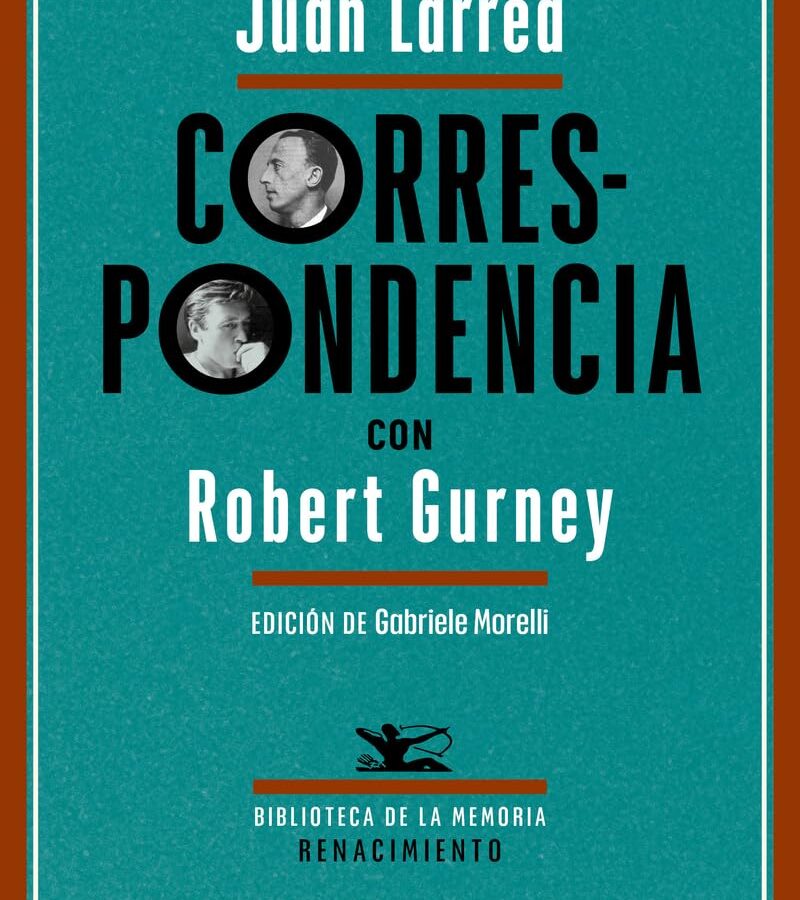
Before the work proper begins, the editor of the edition, the renowned and prestigious Italian Hispanist Gabriele Morelli, has kindly provided photographs of the two main protagonists: on one side, the Basque writer Juan Larrea, and on the other, the British professor and researcher Robert Gurney, who has loaned this valuable correspondence so that Larrea’s figure may attain greater prominence and perhaps public recognition, if anything possible.
Larrea wears a dark jacket and tie, very much in the style of the era, as well as a light-colored shirt that stands out in the black-and-white photograph. By contrast,
the image of Gurney presents a true contrast with the other snapshot: a still-young man, wearing a modern white sweater, with a contemplative expression, his left fist covering a large part of his mouth. He is, moreover, an attractive man—comparable to Robert Redford in his prime—handsome, with thick, abundant hair brushed back, light-colored hair, and somewhat dreamy eyes that betray his clear intelligence.
Larrea (Bilbao, 1895 – Córdoba, Argentina, 1980) is regarded as one of the great forgotten figures of the 27 movement, perhaps due to his early exile to American soils as a result of the Civil War. A forgotten figure who was brought back to literary life shortly after his death when, in 1984, the First International Juan Larrea Conference was held in San Sebastián. And a few years later, Seix Barral, under the editorship of Pere Gimferrer, rescued a substantial portion of his poetic diary, titled Orbe.
It is evident that the good name and the good literature of Larrea are still awaiting serious study and new research. Hence the opportunity to shed light on them, under the guidance of a specialist in the field like Gabriele Morelli, this correspondence which, though not very long, illuminates his life and, especially, his work.
This small volume, barely two hundred pages long, consists of an introduction, where the timely and well-considered comments of Morelli appear, as he tries to stay on the sidelines and not let emotion run away with him; a second part with the letters that Juan Larrea writes to Robert Gurney; and, finally, some clarifying notes that make the content of those missives more comprehensible.
Morelli defines Larrea as a poet “stubbornly elusive and solitary,” while Gurney, who occupies here a clearly secondary position, appears with the not insignificant credential of being a forward-looking disciple of Ian Gibson, the well-known biographer of García Lorca, Dalí and Antonio Machado, among others. Gabrielle Morelli, with good judgment, aims to remain on the sidelines, letting the reader of this edition draw his or her own conclusions, so that, instead of judging certain attitudes of the exiled poet, he gathers materials from his letters in which one can discern, with reliable evidence, Larrea’s temperament, somewhat irascible and combative. Thus, for example, when he himself places, perhaps deservedly, in a chair surrounded by Vicente Huidobro and César Vallejo, because all of them coincided in disagreeing with Surrealism.
But perhaps the most striking part of this thoughtful introduction, which speaks for itself of the strong personality of the Basque writer, lies in that passage in which, through a memorable letter, Larrea challenges Luis Buñuel, who, in turn, had “cursed” Larrea with his words. It is known that the Aragonese filmmaker was a man of action and was always feared for his brutality, which he liked to display quite often. But Larrea, as a good Bilbao-born man, does not back down and enters the fray with a bravery beyond doubt: “… be advised that the day you lay a hair on me would be a sad day for your teeth and if you were stronger than I you would find five slaps in the belly, even if you had to search underground and even if I rot in prison.” The bibliography used in this fresh edition, which might have deserved a more striking cover and higher-quality paper, is wide and selective, and it includes in it the great specialists in the field, from Bodini to C. B. Morris, passing through the unavoidable Gerardo Diego, Vicente Aleixandre, and Luis Felipe Vivanco.
The letters clearly define, with evident clarity, Larrea’s poetics, as well as the personality that likely soured somewhat due to exile. He hated typographical errors and grammatical mistakes, and was also one of those writers who did not mind filling many sheets to achieve the desired effect for his poetry and prose. A very strong character and, at times, not to be understated, somewhat vain and arrogant when considering himself: “My name—as he writes in his letter to Gurney, dated November 16, 1974—though taboo for censorship, is today on the rise.” And a little earlier, in his letter of June 14, 1972, he states that in his poem entitled “Evasion” Ulises is present “three years before Joyce’s book appeared.”
In the letters gathered here, Larrea, who already begins to regard his British colleague as a friend, speaks openly, without euphemism, about his relations with the other writers of his time, sometimes with unnecessary verbal violence. It is true that Juan Larrea came to know that César Vallejo had once stated that the Basque poet was mad, to the point of believing himself the Messiah, to which Larrea, after stating that César Vallejo was little more than a brother—though he felt unable to understand Trilce’s poetry—refers to as “a fanatic of sensibility.”
Vicente Huidobro deserves a separate comment. Despite admitting that, in his eyes, he had become “a spectacular figure,” a few lines later, within the same letter, he speaks of the author’s “unbridled selfishness,” with his “constitutive arrogance” and his “incorrigible urge for dominance.”
In these letters, which, in most cases, are certainly entertaining, there are moments when a minimal portion of Larrea’s intimacy peeks through, always cautious in these matters. But this is not the most frequent occurrence. Thus, in a letter dated in Córdoba (Argentina) on September 21, 1973, Larrea gives Robert Gurney details of the theft carried out by Ana María, “la Gorda,” the woman who did the house chores and who left without warning “taking fifteen hundred pesos from my drawer.” Also not lacking, in very small doses, are some green shoots of healthy humor, as when his dog devours, almost completely, an envelope with photocopies of Max Aub and Paul Ilie: “The postman must have slipped it under the door more than a month ago, and in a moment of malignant humor the dog gnawed it and then fully hid the resulting mess.”
It is striking that, after 1975, Larrea, in his condition as an aging exile, speaks little, almost nothing, about the new Spanish situation after the death of the dictator. Only once, in a letter from late 1976, does he write that “in Spain things also seem to be moving,” without further details of note. The correspondence with Robert Gurney, now brought to light, began in August 1969 and ends in September 1978. Juan Larrea died two years later, in July 1980, in Córdoba, Argentina, with the possibility of returning to a Spain to which he owed so much now completely lost.
—————————————
Author: Juan Larrea. Title: Correspondence with Robert Gurney. Publisher: Renacimiento. Sale: Todos tus libros.