
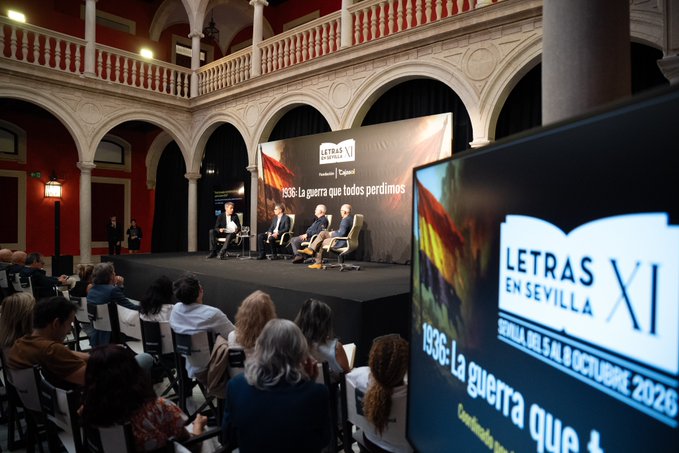
The eleventh edition of Letras en Sevilla gathered at the Fundación Cajasol historians, writers, journalists, filmmakers, and representatives from a range of political sensibilities to retrace, ninety years later, the path that led Spain from the failure of the Second Republic to Franco’s victory. Four days, four chapters, and one question that still lacks a unanimous answer: what have we learned from that tragedy?
The eleventh edition of Letras en Sevilla began with the force of unadorned words. Before historians, politicians, and writers took their seats at the debate tables, the actor Emilio Buale lent his voice to a carefully chosen set of reflections on the Spanish Civil War. Twenty-nine testimonies from intellectuals, historians, and political leaders across generations and sensibilities, ranging from Manuel Azaña, Antonio Machado, and Adolfo Suárez to Felipe González, Paul Preston, Santos Juliá, Miguel Delibes, or Javier Cercas. Voices separated by time and by ideas, yet gathered around a single understanding: that war left wounds, losses, and consequences that touched every segment of Spanish society.
The interpretation by Buale turned that sequence of quotations into something like a coral prologue, a journey through ninety years of memory, literature, and history. And it also became an answer, built with others’ words, to the controversy that had surrounded the conference’s title: 1936: The War That We All Lost. Because before beginning to argue about victors and the vanquished, the Fundación Cajasol wanted those who, from very different positions, had reflected on the human and moral price of that tragedy to speak. A way of reminding us that history can and should be debated, but to do so it is advisable to start by listening.
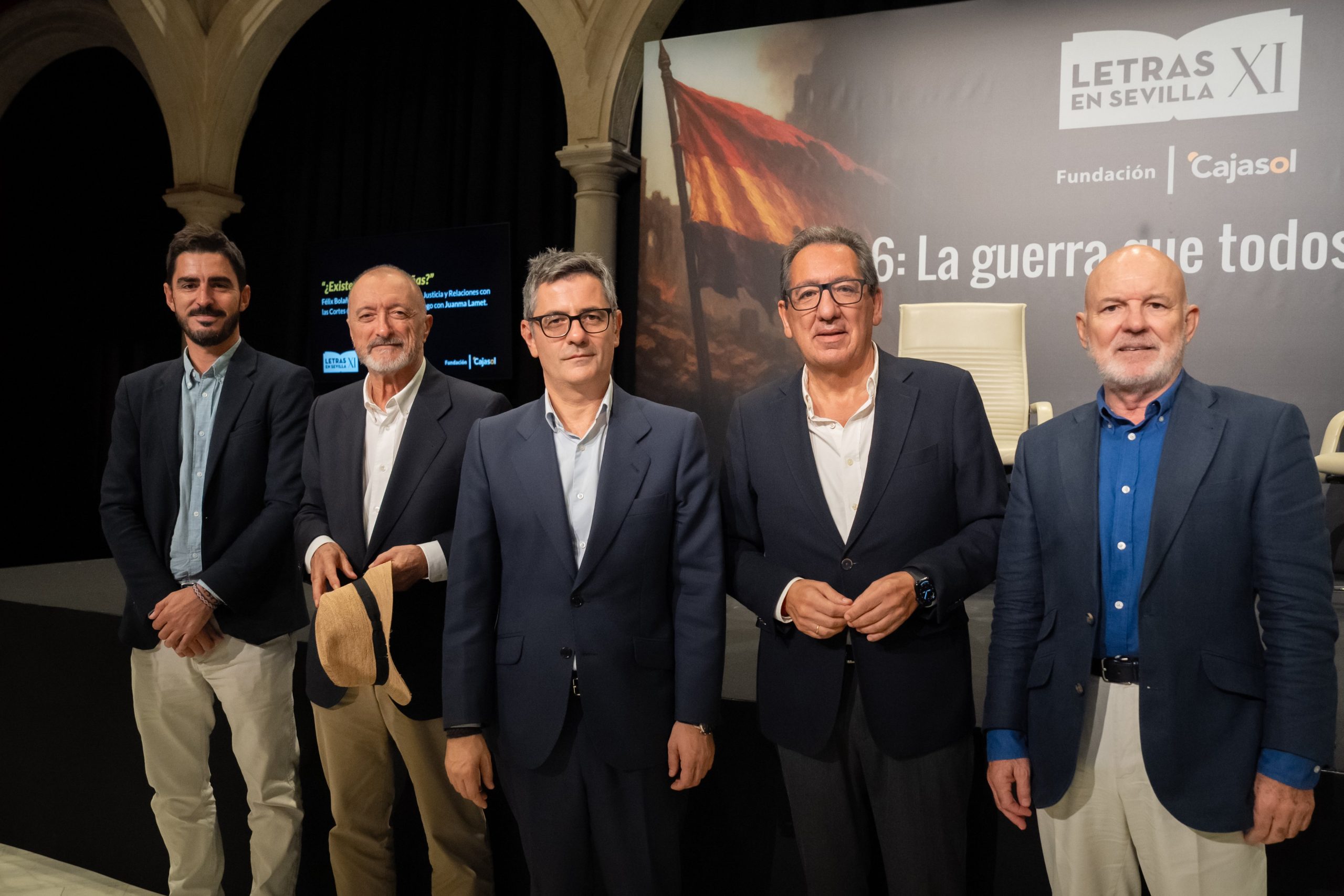
War had begun long before the gates of the Fundación Cajasol opened. Not in 1936, of course, but in that other, bloodless Spanish war waged on social networks and political tribunes. The Letras en Sevilla sessions, initially planned for February and postponed after controversy over their title and some participants, arrived in October with the ongoing controversy still clinging to the poster.
And yet, during four days something far less common in a democratic society occurred: people who did not agree spoke, argued, listened, and, on occasion, openly disagreed. It was not a small thing.
Arturo Pérez-Reverte and Jesús Vigorra, coordinators of the cycle, had proposed tracing the Civil War along a simple, relentless historical sequence: the Republic, the coup, the battle, and the end. A journey from the rupture of coexistence to the imposition of victory, to which the perspectives of cinema, literature, and memory were added. History with its documents, politics with its urgencies, literature with its ghosts. And in the background, a Spain that still looks into that same mirror.
I. THE REPUBLIC
Monday, October 5. The failure of a hope
The first day began, as it should, at the beginning. Or at least at one of the possible starting points: the Second Republic and the reasons why a political project born with great democratic expectations ended up destroyed by a military uprising.
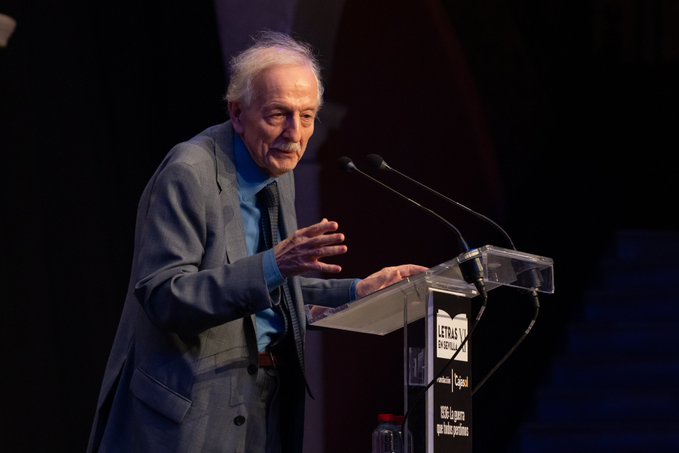
Juan Pablo Fusi, one of the leading names in contemporary Spanish historiography, delivered the inaugural lecture. And he posed a crucial distinction: the Republic failed, but its destruction was not a historical inevitability. Fusi examined the tensions that eroded the republican regime: social conflict, ideological radicalization, fragile consensus, and the incapacity of political forces to sustain a common project. A history that demands abandoning easy explanations, because neither was the Republic a democratic paradise without contradictions, nor its failure makes military rebellion inevitable or legitimate.
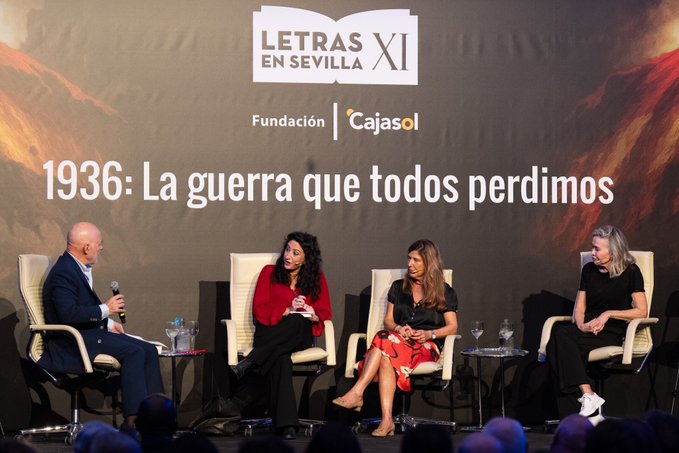
The history gave way to literature, and with it to women, under the title Women at War, featuring , moderated by Jesús Vigorra (Ana Pastor ultimately could not attend due to current events: the government had just announced an early election for November). The panel’s proposal carried a particular interest. In contrast to the history of great events, literature allows reclaiming other dimensions of the conflict: disrupted domestic life, daily survival, family relationships, the women who had to sustain a life broken into pieces. It wasn’t simply about adding female names to a male-constructed history, but about shifting the point of view from which that history has been told.
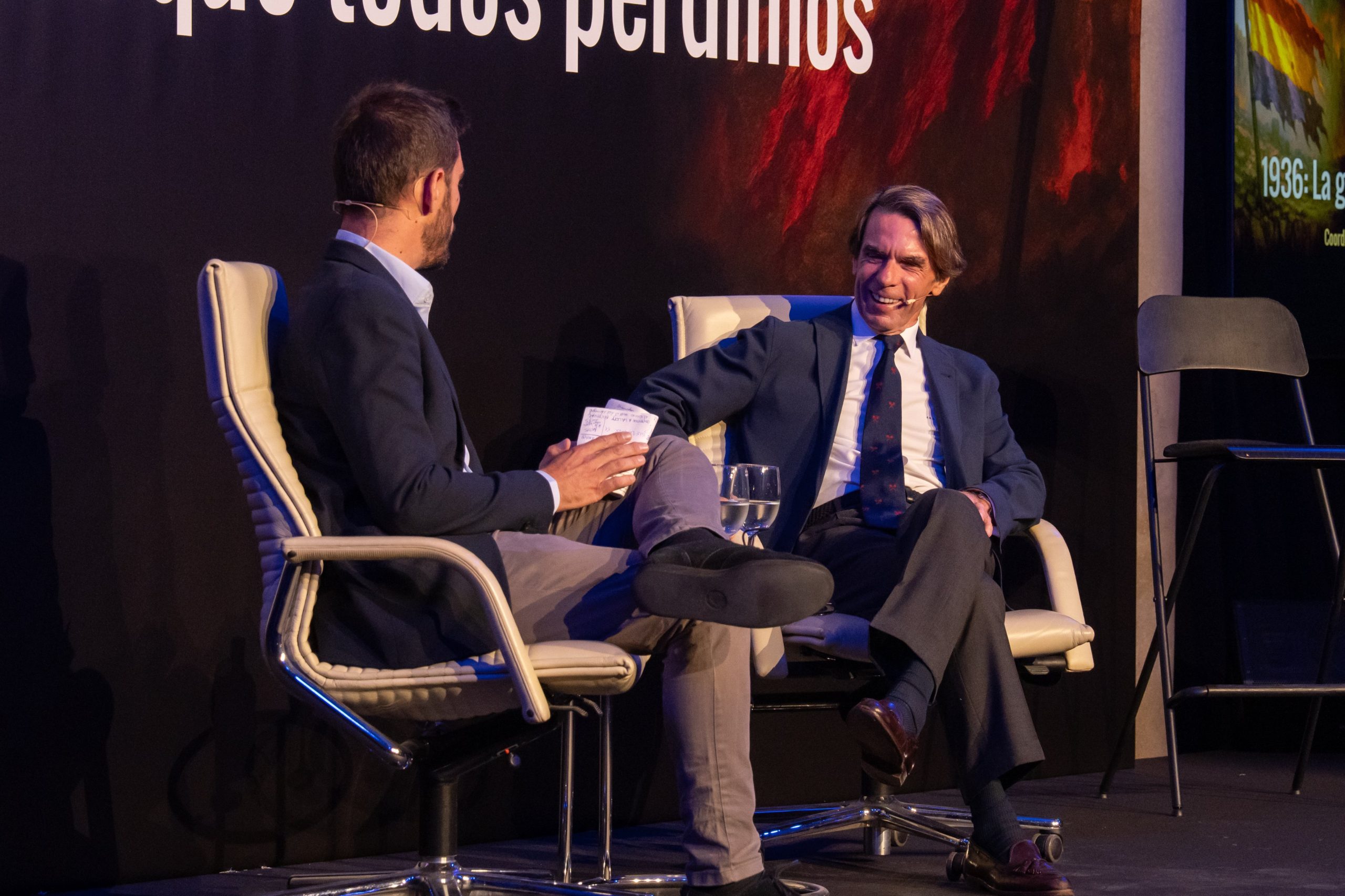
The first day closed with a talk by former president José María Aznar and journalist Juanma Lamet.
The day had begun in the morning with the screening of Dragon Rapide, Jaime Camino’s 1986 film that reconstructs the preparations for the military uprising and Franco’s transfer from the Canary Islands to North Africa. A cinematic choice that allowed recalling something fundamental that we seem to have forgotten: coups do not happen spontaneously; they are organized, financed, and prepared with protagonists who have real names and surnames.
Thus ended the first chapter of the conference: between the analysis of failing institutions, the literary recovery of those who suffered their consequences, and the cinematic reconstruction of those who decided to end them.
Full video of the first afternoon session
II. THE COUP
Tuesday, October 6. Spain before the world and before its dead
On the second day, the focus widened. The Spanish Civil War was never a purely Spanish affair. Very soon it became a laboratory of politics, ideology, and military action where the great European powers tested some of the confrontations that would erupt in 1939.
Enrique Moradiellos approached that international dimension of the conflict. The German and Italian intervention in favor of the rebels, Soviet aid to the Republic, the Western democracies’ policy of non-intervention, and the role of the International Brigades are part of a history that is impossible to understand without looking beyond the Pyrenees.
The war in Spain was also a war observed. Hence the interest in the panel “How were we seen, how are we seen?”, which gathered three foreign journalists: the Briton Giles Tremlett, the Frenchman Mathieu de Taillac, and the German Martin Dahms, moderated by Sergio Vila-Sanjuán.
An external perspective always brings healthy distance. Where Spaniards tend to recognize a shared identity or a family wound, the foreign correspondent must reconstruct the context and explain his contradictions to readers who do not necessarily share our passions. The conversation thus raised a question that went beyond the 1936 conflict: to what extent does Spain’s international image continue to be conditioned by that war and by the decades of dictatorship that followed?
But one of the central debates of the day came with an uncomfortable question, stated plainly: “Are all ditches the same?” Fernando Martínez, Secretary of State for Democratic Memory, the magistrate and former mayor of Madrid Manuela Carmena, and former minister Alberto Ruiz-Gallardón sat down to discuss the victims, the graves, and the duty of memory, under the moderation of Ignacio Camacho. It was a panel that forced a distinction between two issues often tangled together: recognizing all victims of violence and identifying the different historical responsibilities of those who participated in the war and the subsequent repression.
The political reconciliation and the right to recover the disappeared do not have to be incompatible principles. The debate on the ditches thus took on a deeper meaning. For a mass grave is not merely a problem of historical interpretation. It is also a family, legal, and human issue. And because the debate about the past becomes particularly thorny when those debating confuse the dignity of the victims with the legitimacy of the political causes for which they fought and died.
The day eventually shifted the historical discussion toward contemporary politics. Moderated by Edu Galán, Borja Sémper, Iván Espinosa de los Monteros, Tania Sánchez, and Nativel Preciado represented very different sensibilities in a conversation about the possibility of discussing the Civil War without recreating today’s ideological trenches. It is paradoxical that one of the greatest difficulties in talking about a war that ended almost nine decades ago lies precisely in getting people who do not share the same interpretation to sit down and talk.
In the morning, cinema offered a document very different from the previous day: Sin novedad en el Alcázar, Augusto Genina’s 1940 film. A piece of propaganda that turned the Siege of the Alcázar of Toledo into one of the great heroic narratives of early Francoism. Its presence on the program made it possible to observe not only how the war was made, but how the victors began to construct cinematically their own legend.
Full video of the second afternoon session
III. THE BATTLE
Wednesday, October 7. The men, the archives, and the images
After the big political speeches and the responsibilities of history, it was time to look at those who fought. Not at the generals who moved the pieces on the maps, but at the men who ended up in the trenches.
The panel “The Two Trenches: The Faithful Infantry” brought together General Félix Sanz Roldán, former head of the Defence Staff and director of the CNI, with journalist Jesús García Calero and writer Víctor Amela, author of Nos robaron la juventud, dedicated to the survivors of the Quinta del Biberón.
Sanz Roldán recalled a basic truth often lost between the épique of battle and patriotic orations: the war is first and foremost about sacrifice, fear, hunger, thirst, and suffering. He offered a familial reflection that better explained, than many theories, the arbitrariness of the fate of so many Spanish combatants. His father had fought in the Francoist army because he lived in Valladolid; had he resided elsewhere, he might have ended up fighting for the Republic. A geographic circumstance could decide a biography—the place where the coup was interrupted, the uniform available, the unit one was assigned to. For many young people, choosing a side wasn’t a political decision but an imposition of circumstance.
The next panel returned the spotlight to historians. Under the title Aires de sangre, Manuel Álvarez Tardío, Fernando del Rey, and Gutmaro Gómez Bravo spoke with Rubén Amón about the historical research of the Civil War and the problems still posed by its interpretation.
They defended the necessity of returning to the archives, consulting documents, and avoiding explanations built on contemporary prejudices. A particularly timely assertion in an era when history often circulates in a reduced form—just a few characters and an uncontextualized photograph.
The Civil War remains a field of open inquiry. Archives hold documents to study, and historians continue to reassess local episodes, violence mechanisms, individual responsibilities, and power structures. The past does not change, but our knowledge of it can. And precisely for that reason, research must discriminate between memory, inevitably personal, and history, subject to the cross-checking of sources.
The afternoon then added the institutional perspective of democratic memory. Minister Ángel Víctor Torres spoke with Ignacio Escolar about policies for recognizing and repairing the victims. Torres advocated the recovery of remains that lie in graves, pits, and roadside ditches. The discussion moved from 1936’s events to the obligations incumbent on a democratic state in the present.
Cinema closed the day with Alejandro Amenábar, who spoke with Antonio Lucas about the representation of the Civil War on screen. In the morning, Mientras dure la guerra, his 2019 film centered on Miguel de Unamuno and the early months of the uprising, had been shown.
IV. THE END
Thursday, October 8. Victory, defeat, and words
The final day posed a question that seemed simple yet was not: did the Civil War end in April 1939?
Julián Casanova, author of a recent biography of Franco, addressed the end of the conflict by distinguishing between military victory and civil peace. The triumph of the insurgent army brought military operations to a close, but not the political violence. Repression, executions, prisons, concentration camps, and forced labor were part of building the new regime. Casanova also recalled the symbolic transformation of victory into a founding pillar of the dictatorship. July 18 became a grand official celebration, proclaiming the coup’s anniversary as the origin of the new state.
The historian explained the transition from the early violence of the summer of 1936 to increasingly organized and documented repressive mechanisms. The central question was, therefore, what it means to speak of peace when part of the population remains subjected to persecution, imprisonment, exile, or silence. The war had ended on the battlefields, but its consequences would continue to shape Spanish life for decades.
Literature offered a final look, perhaps the most fitting to close a set of events that bore the name Letras en Sevilla.
Andrés Trapiello and Sergio del Molino spoke with Pablo Guimón under a deliberately provocative title: “Literature and the Civil War: Do weapons kill more than words?”
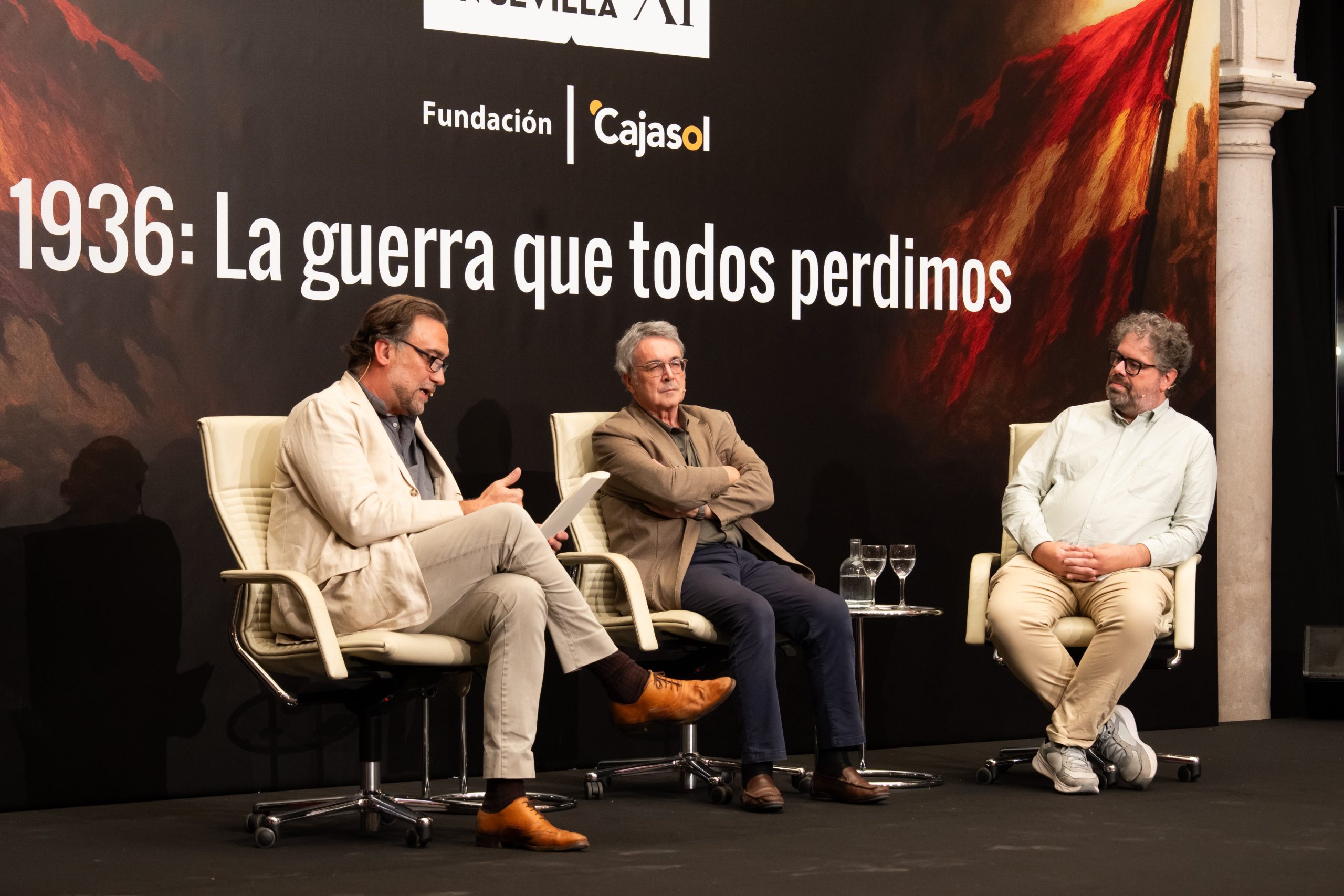
Trapiello argued for applying a consistent moral standard when analyzing the violence of both sides and recalled the cultural cost of political divisions that for decades conditioned how many writers were read and valued. In that context appeared the name Manuel Chaves Nogales, whose work A sangre y fuego has become a foundational reference for understanding the moral complexity of the conflict. The Seville-born journalist, Republican and democrat, denounced atrocities from opposing positions without renouncing his own convictions.
Trapiello reminded that Chaves Nogales was not an even-handed writer, but an observer capable of taking in the entire tragedy. A fundamental distinction in times when any attempt at complexity risks being mistaken for a lack of commitment.
Sergio del Molino defended the role of literature as one of the spaces where a global understanding of the Civil War has progressed the most. Fiction enables us to enter the contradictions of characters, to grasp the mechanics of fear, and to uncover the gray areas of an experience that political slogans tend to reduce to black and white.
The conversation raised a concluding idea that could serve as the summit of the gathering: books do not replace history, but they can restore the faces, doubts, and voices of those who lived it.
The sessions closed with a talk between journalist Juanma Lamet and minister Félix Bolaños.
The cinematic program ended with Rojo y negro, Carlos Arévalo’s singular Falangist film from 1942, briefly removed from theaters soon after. A work that, together with the other three screenings in the cycle, allowed tracing different ways of constructing and revising the audiovisual narrative of the war.
Full video of the fourth afternoon session
And so the journey ended. Four days to move from the Republic to the Francoist victory; from documents to family memories; from trenches to books. There was, of course, no single interpretation. Nor was that the aim.
Perhaps the most valuable lesson of Letras en Sevilla is that history does not require unanimity, but knowledge; that listening does not mean conceding the right, and that true respect for the dead consists of studying them, remembering them, and understanding the world that led them to their fate, without turning them once again into soldiers in our contemporary battles.
Ninety years later, Spaniards continue to debate that war. At least, for four days in Seville, we did so with words.