
The first time I got drunk in my life was at the unforgettable bar owned by the first Argentine I met. He was Edmundo the Fat, a huge and affable man, wonderful and, like Borges, for instance, unforgettable. He possessed a culture that broke the mold, and he cooked as if he had visited every tavern in the world and were, at once, both the guest and the cook. At the same time.
To him it didn’t matter at all that, as soon as he gained the locals’ trust, they called him Edmundo the Fat… I would later become an aspiring member of this craft, journalism. That night of my first drunkenness I went from the College where I resided to the town where I was born to celebrate with Edmundo the opening of that unforgettable bar, at whose house I learned to sing as Eduardo Falú sang and, to this day, with no sense of embarrassment.
That night Edmundo A. Esedín del Ródano, the Argentine who years earlier had come to live in Puerto de la Cruz, my town, was inaugurating his bar and invited me to his revelry. I was then in the first year of university. I did various tasks there, besides learning the duties of a student who worked, at the same time, in what sustained me: the librarian’s trade and journalism. That first night at his bar I returned to the college unconscious, and to this day I have not known who brought me there or how I endured it.
Edmundo had settled in my town a few years earlier and ended up being like the character Kim of India, the friend of everyone that Kipling created to last. It wasn’t easy, because back then the Argentine accent wasn’t readily welcomed there. Perhaps it has always been thus, because Argentines spoke (they still speak) differently from all those who came from Venezuela or Cuba, who quickly seemed to have been born on the islands. Argentines were (they are) very much their own, or at least much more their own than the islanders, who accepted those who came from outside, also foreigners, as part of those who would have been born among us. Everyone was from the Square, and none was a foreigner. Even today.
In this case, Edmundo quickly became the most popular among the recent islanders. Although the accent pointed toward Argentina, he soon became Canarian from Puerto de la Cruz (and from everywhere) and, moreover, belonged to both sides of the Plaza del Charco, which is still the name of the place I come from.
That square had two zones (the wealthy area and the poor area). Edmundo became part of both at once. You could see him in the less respectable part of the square, laughing as if he knew the lexicon of the local rogues, and arguing with the rich nearby as if he too were a potentate.
Edmundo was, indeed, the friend of everyone. A Portuense Canarian who came from the East, for example, and an islander who had been among us since very young. He managed to become, very quickly, part of the Portuense lexicon, as if he had been born anywhere: from Argentina to the ravine from which many of those we spoke with him in the poor side of the square came.
He became everyone’s friend, indeed, and also my mother’s, who soon saw him arrive home bearing provisions he could improvise with the products of our land. He was already of Puerto, and he was of everywhere at once. He gave me books he had brought from Argentina, organized other places to eat, and, moreover, taught us to laugh as if we came from Ranilla, which in our town was the happiest neighborhood.
He was Portuense, islander, Spaniard, Argentine, and from everywhere. Now that I wanted to explain how many places Edmundo came from, to show that he was also, in addition, more Spanish than almost anyone, I asked his Tenerife-based family to tell me how many nationalities he held. His daughter Saga, a highly regarded professor who teaches fashion and costume at the Louvre, and his widow, Victoria Rojo Rosales, a dental surgeon, gave me the information I needed to explain why Edmundo was from everywhere and also, for years, Spanish, for example.
“That Argentine of all of us had, ‘of course, first,’” his daughter told me, “Argentine passports… Then, at least from 1978, a Lebanese passport, though issued in Madrid. And in 1983, a Spanish passport. I don’t know if that was the date of his first Spanish passport, or of an earlier one, but in any case since then he must surely have been naturalized.”
She handed me some of those passports, some of which bear Edmundo’s appearance: tall, slender, wearing a tie, a man of all places, a cosmopolitan who landed in my town as if he had come in search of what other foreigners found among us: the joy of conversing with those who, from anywhere, and also Argentines, chose to stay and live here, just as in other times visitors such as Agatha Christie or Bertrand Russell came to know the island.
From those passports and these stories stems what we all remember about that extraordinary man, capable of being everywhere and of belonging to all of us, and also to our own country, Spain, while he was Argentine and Spanish and, as I have just said, from the entire universe, or at least from the map he encompassed.
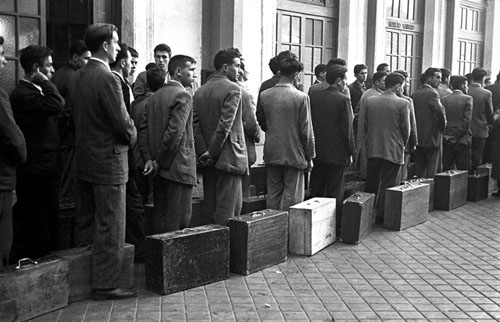
Edmundo now comes to mind as a grand symbol of an exemplary figure who today would move around in Puerto de la Cruz, everywhere, as someone who cannot understand how it is possible that this country, Spain, now seeks to close its doors to those who, being great-grandchildren of those who had to leave during the Spanish Civil War, would like to come to this country to work or live, displaying the passport that they now seek to take away.
Now this clash is here, arising from the intention of the Spanish right to cut off the vote of those who, rooted in Spanish soil, want to be worthy of those who in the past lost the homeland that now also belongs to them. They are heirs of those who had to leave, and would like to be part of the world that belongs to them. The Spaniards who fled or left during Spain’s Civil War of 1936, and who lived their lives in brotherly worlds around the globe, left behind sensational or difficult human stories, and those who followed in their wake are today worthy of being part of the world that existed, and also of the world that is to come.
These days the future of Spain again hovers over the imminent possibility that a new government will break the idea of denying Spanish descendants the possibility of traveling to the land that belonged to their people. This possibility has generated concern and sadness.
Edmundo, our friend, had nothing to do with that story. He lived in Tenerife, like one of us. Today he comes to mind, as often as ever. He too would have found it hard or unbearable that the great-grandchildren of those who had to leave would now face this shut door that history seems to be preparing for them.
0/5