
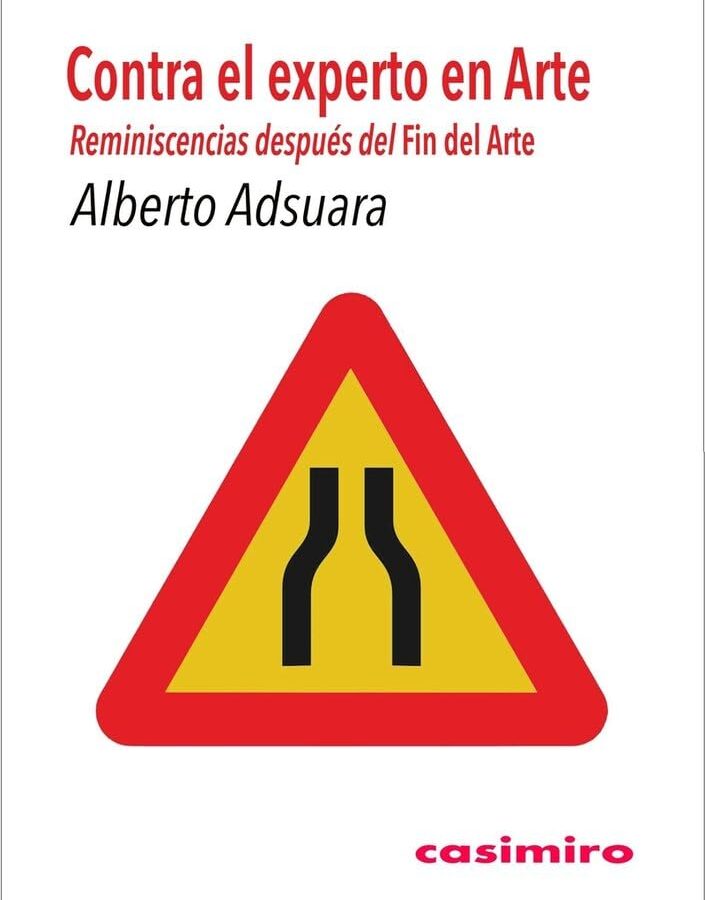
God has died, but beforehand, and very timely, Art preceded him at his burial. It was not this last death that preceded the death of the Supreme as a true death, nor even as a simulation: it was a death charged with meaning. Humanity, confined within the shell of History like the lead soldier in the tale marching toward the drain, achieved after it the slowing down typical of bodies that are almost cryogenically preserved in repositories. All as a byproduct of the “wars for progress” of the twentieth century. Now the “survivors,” people kept for the “last supper” and curiously numerous, are promised the “end of death” itself through the Singularity and the indispensable AI that channels it. The whole world, our little blue planet, has become a gigantic circular table where more and more gifted mediums are summoned. Neither Ortega (1883-1955), nor Heidegger (1889-1976) have aged well with the latest historical-cosmic turn toward the joyful fusion of mammals and humans. A new and renewed Omega Point, “watched over by machines of loving grace.” Who could have dreamed that we were heading toward such a world; only Lovecraft (1890-1937) could have sensed something of it, having acclimated himself perfectly during his vital martyrdom to the most fertile nightmares. What will become of Art in these circumstances?
Contra el experto en Arte
, de
Alberto Adsuara
, compiles a handful of “reminiscences after the End of Art,” organized in 33 brief yet substantial entries. Focused on the chain of absurdities, catastrophes, horrors or stages of an irrevocably terminal initiatory rite, provoked by the aforementioned “deaths,” they will also speak from our present to a near future. To the children of our children… I don’t think there will be time for much more, though I may be mistaken, to the possible misfortune of those who might descend to inhabit a new and longer extension of the Line…
Mind at the End of its Tether
(1945), which H. G. Wells (1866-1946) declaimed in his last and very brief but meaningful work. Not exactly optimistic.
The book comprises materials not overly heterogeneous but certainly diverse, centered on this experience of death without resurrection, the one supplied by Today’s Art. The erudition and the irony are conveyed through an agreeable style that respects the reader. Big figures, experts and frightened spectators, untouchable and brilliant artists, often too human and even somewhat grotesque, politicians and millionaires (without them there would be little to do), fill its entertaining and erudite pages. And the State, which grants the necessary institutionalization.
There was a distant time, before what we now call Art was born, 250 years ago, in that eighteenth century well sold but poorly understood, when “the aesthetic criterion was based on mastery and excellence” (Adsuara), yet they jumped onto the carriage on a bend in the road toward “the genius and the authentic,” and the world experienced a short circuit that lasts until now, the spinning ball on which we slide as a species, in “a History that can be nothing other than a sequel to the contingency producing false discourses.” One of these is what our contemporaries call “philosophy.”
Now in the Digital era, leaving behind the analogue as we did with tobacco and devoid of all sanctity, art has become fused with the everyday and with the computer. Behind will remain, like moraines of a dissolving glacier, Damien Hirst’s shark (The Physical Impossibility of the Death in the Mind of Something Alive) or Picasso’s Guernica (1937). It is evident how our wondrous and festive riverboat is heading, without delay and at full speed, toward the definitive whirlpool and abyss.
The book contains three interviews and thirty essays. Small incisive pieces in which, as in Alice Through the Looking-Glass, many aspects of the world to which Art of Today belongs are discussed. About artists, experts, concrete exhibitions, museums, major aesthetic questions… Also about sexuality, photography, fears, lies, books and junk.
“The time has come,” said the Walrus, “to talk of many things: ships and sealing wax and cabbages and kings, and why the sea is boiling hot, and whether pigs have wings.” Also about Muñoz Molina, may the gods forgive me, Bill Viola and his videos for the slow-witted (this is my sole responsibility), about how New York stole modern art so that the CIA could make better use of it, or about the symbolic depth that reached us, by the happenstance of an indeterminate number of passionate powders from a wealthy American heiress with very concrete artists.
Alberto Adsuara was born in Valencia in 1961, the year the first homo sovieticus went into outer space, although not, as some suppose, in search of the dog Laika. He is a professor at the Escuela Superior de Arte y Tecnología and, like Arthur C. Danto (1924-2013), also tasted the temptation of being an artist at one point. He is the author of several books on art, perception and aesthetics. Some of them about his great passion, cinema, where he creates features and shorts. A sample: De un espectador cansado (Krausse, 2009), foreword by Félix de Azúa, or Qué [no] es el cine (Archivos Vola, 2026). Others, mostly, on various aesthetic matters. As a few samples: Del arte y su obsolescencia (Casimiro, 2020), where he emphasizes the pandemic’s impact on the Spanish inhabitants of the den of Today’s Art, or Lo patético del Arte (Casimiro, 2023), where he delves into the distance and misunderstanding that “often” arises between the public and manifestations of contemporary art.
During more than a decade he collaborated with the magazine Archipiélago (1988-2008), where he published numerous contributions on aesthetic topics. He is also a perspicacious critic of the popular impostor Žižek, that unshaven man who comes to Spain, among other things, to duet with Angela Davis at the Circulo de Bellas Artes.
I have essentially liked references to a respected expert such as Francisco Calvo Serraller (1948-2018), the “bald locksmith,” as Ionesco (1909-1994) would have said, or to the Chinese artist Ai Weiwei. The latter, whose name chosen by himself means something like “eternal future,” the face and the cross, the expert and the artist, in a post-mortem setup that, as Adsuara explains in several places, leans toward a metamorphosis into something very likely definitive. Two mandarins (one of them Chinese) of Today’s Art.
The expert is essentially a transmitter of true opinions (sic) that are then consolidated. Who could reflect better on the possibilities of representation, which day by day, through “the new and the original,” propel, carving out wild terrains as honest settlers (yes, really), our beloved and pondered artists? In the era of pageants we have moved from the use of Technique to the preponderance of the Idea and from Beauty to Universal History. It is clear from the reading that the ultimate aim of Modernity was for Art to be anything. The artist, without good contacts, is nothing and becomes a byproduct of contingency. The “single thought” and contemporary art are inextricably linked, as I dare say, as in a not-too-distant past the “proletarian art” stood with the Party. From a public that had or has demands we have moved, thanks to School, University and the Press, to the buyer who has money. And on another plane we have moved from thinkers to snake charmers. The symbolic production has consequently produced a profound disenchantment with the aesthetic world.
Today I even follow Adsuara; after the appearance of social networks synchronized with Lehman Brothers’ collapse (2008), we witness the dissolution of the power of the very experts. The pseudo-mystical seriousness and the messianic circumspection of contemporary art begin to fail… “Lehman” means “a man who holds a feudal domain”. But that is not the name of the Master.
We stand on the edge of a reclaiming of freedom before the aesthetic experience that will probably account not only for the cold and obtuse mausoleums into which exhibition spaces have become, but also for the ubiquity of ugliness in urban spaces with which the young cubs who benefit from these simulacra envelop the squares and streets of the great cities, with their sit-ins and manifestations of “progressive disagreement.” I speak of induced ugliness, I speak of the “shabby-sphere.”
Pensé titular este texto “De la caverna al frigorífico”. Haciendo hincapié en el desarrollo histórico (?) de los espacios expositivos. De Lascaux a la Tate y más allá. Pero una frase de Paul Valery (1871-1945), “la acción de lo bello sobre alguien consiste en dejarle mudo”, y el visionado de la película Backrooms (Kane Parsons, 2026, EEUU), en cuya banda musical se encuentra una canción con el título “The Word Becomes Flesh”, me convencieron de la necesidad de la sustitución. El título del álbum del dúo escocés de música electrónica que la perpetró, Boards of Canada, curiosamente es Inferno.
¿Qué podría pasar si no se cede al miedo?
—————————————
Autor: Alberto Adsuara. Título: Contra el experto en Arte. Editorial: Casimiro. Venta: Todos tus libros.