
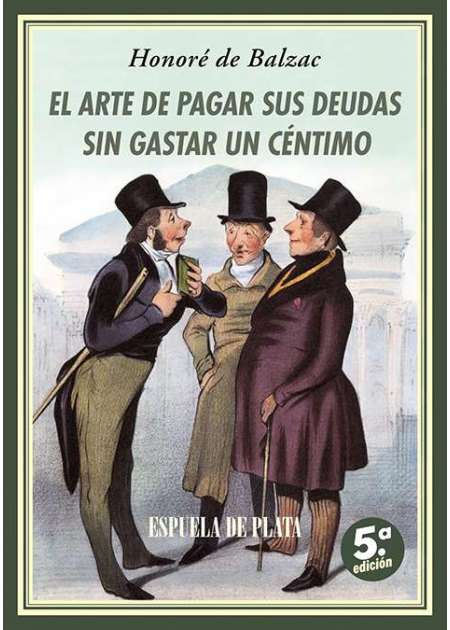
Here is a delectable literary joke and a little masterpiece; undoubtedly more timely today than at the moment it was written, more than 180 years ago, which is nothing but yet another (and among the most forceful and practical) proof that genuine geniuses, Balzac among them, always ahead of their time.
In Zenda we reproduce the opening of The Art of Paying Your Debts Without Spending a Cent (Espuela de Plata), by Honoré de Balzac.
*****
First Lesson
On Debts
On the impossibility of not having debts • What is meant by the word debts? • Its various subtypes • Their number, their meaning, and their value according to my uncle’s interpretation • Monte de Piedad
“Where is the happy man of our century” (my uncle used to say), who in the last thirty years, amid the assigned obligations and because of them, as with promissory notes, political defeat and bankruptcy (the first example being provided by the State itself), as well as as a consequence of migrations, of the confiscations of fortunes, of requisitions, of the pretensions to fortune through the so-called consolidations and the invasions that altered all property conditions, at all times found, however, himself in a position to say: No debts to anyone…? What nation, even today perched on a mountain of gold, could say: We shall never owe anyone anything…? I have said it before, and I will repeat it whenever I have the opportunity: France itself, as rich as it is, is composed of two classes of people: the debtors and the creditors. In other words: the productive class and the consuming class.
But let us return to the central topic that is to occupy me, and let us strive to define clearly and precisely this matter that we call debts. We will go further if we analyze this word in all its possible meanings.
This term, in its strict sense, means: that which is owed to someone. Fortunately, debts is also often understood as what is owed to us, that is credit. To avoid confusion, one must distinguish among a wide variety of different debts, so I have set out to explain each of their expressions.
All those people who undertake obligations with one another can incur debts. From this logically follows also the opposite: those who cannot undertake obligations are not able to create debts. Therefore, minors, children who have not reached maturity, women under the authority of their husbands, find themselves unable to incur debts without the permission of those who control them, that is, their guardians or responsible parties, their parents or their husbands.
Debts can be incurred orally or in any written form, whether by bills of exchange or promissory notes, by court decisions or other judgments of a similar verdict.
The reasons for incurring debts correspond to all matters in which one commits oneself, such as housing, food, rent, loans, advances, etc.
Our jurisprudence recognizes twenty-six different kinds of debt, which have been identified one by one, and which my uncle explains in the following manner:
To wit:
1.º Active Debts. Active from the creditor’s point of view, or rather, of the credit itself. For example, the credit of an innkeeper in whose establishment one has been eating for some time, and to whom money has been owed since the very moment this habit began. This credit should be called an active debt.
The term active debt signifies the exact opposite of passive debt. However, the latter is almost identical to the former, with one difference. By active debt one understands all sums owed because one has already eaten at the innkeeper’s establishment and has not paid up to today. Under passive debt lies the money we will owe in the future, when we decide to continue eating at his establishment while maintaining the practice of not paying.
2.º Old debts, especially mortgages. These are debts that precede all others. They are among the most difficult to incur because they come first, and because they are easy to extinguish. This is because there are eight different ways to extinguish them, without even having to open one’s purse. This is something we will demonstrate later.
3.º Annual debts, those debts that renew year after year like a rent, a pension, the total of a sum paid over the years; those that are not paid at the beginning or end of the year, and in which one promises to pay double the following year, and so on progressively. This is what law calls debitum quot annis.
4.º Time-barred debts, those that have no value for the creditor, since there is no hope of ever receiving their money. One should aim to have only debts of this type, or at least a majority of them.
5.º Clear debts, those in which the object of the debt is clearly defined, and in which the amount owed is precisely defined and specified. For example, owing your owner three quarters means incurring a clear debt with him. If you also manage to owe the fourth quarter, then the owner has been paid clearly, as the law specifies.
6.º Conditional debts. These exist only under certain conditions. For example: “I will pay you when I receive money.” If nothing is received, nothing is paid. As jurisprudence states: Si navis ex Asia venerit. This means: when the ship arrives in time.
7.º Confused debts, those whose legal bases are somewhat tangled, so that the same person ends up being both creditor and debtor of the same object, and therefore creditor and debtor of the same individual; such that neither side has enough clarity about the nature of their debts. And if one of the two confuses the bases or the reasons, then in this way one is already amortizing.
8.º Doubtful debts, those that have not expired, but whose payment is not assured for that same reason. It is a kind of promise that is obtained periodically in a confused manner from the debtor.
9.º Annulled debts, those that can no longer be claimed, either because they are prescribed, or because one can no longer obtain a court-ordered ruling for payment; this is known in jurisprudence as prescripción.
10.º Enforceable debts, those that can be claimed immediately through the competent court, without having to wait for a delay or the emergence of any condition.
——————
Author: Honoré de Balzac. Title: The Art of Paying Your Debts Without Spending a Cent. Translation: Jürgen Jencquel and Vicente Corbi. Publisher: Espuela de Plata. Sale: Todostuslibros.