
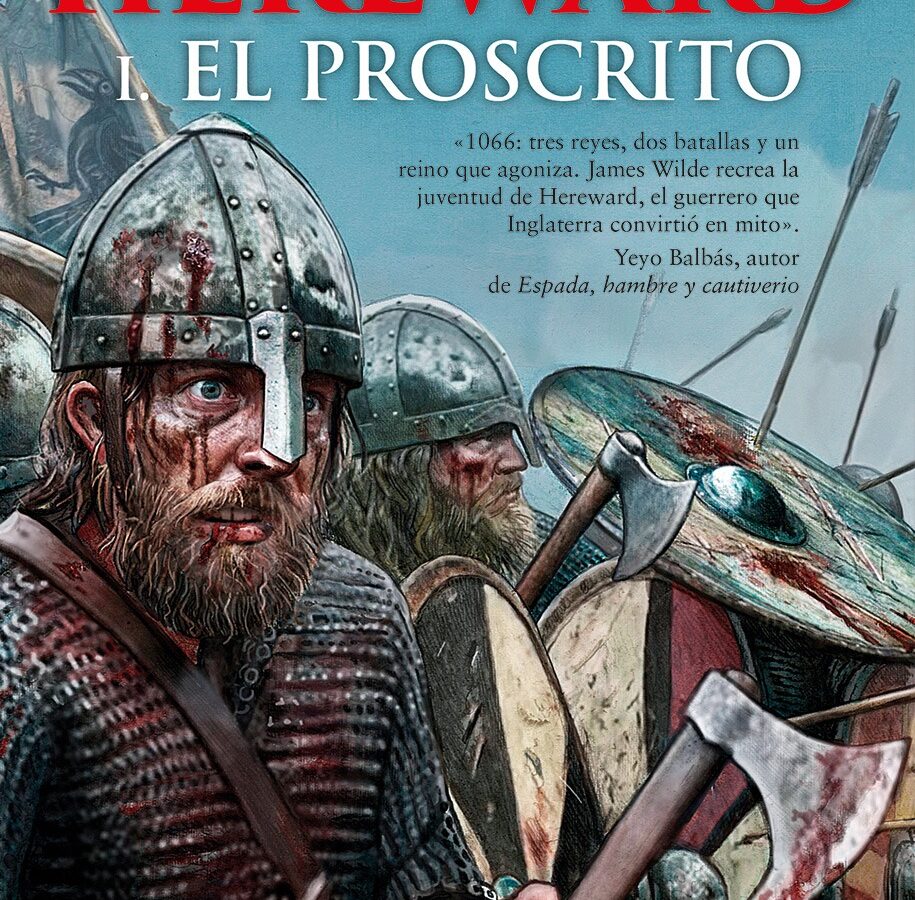
“It was the beginning of the end of time.” An epic opening capable of grabbing anyone’s attention. Desperta Ferro Ediciones rescues for its loyal readers a story set apart from History, unknown, overlooked, forgotten, or as you may call it: the tale of a man, a warrior, a hero, straddling myth and reality, on par with Robin Hood and many others. The modern historiography, broadly speaking, accepts that Hereward did exist. A figure belonging to the Saxon aristocracy as a historical basis, and surrounded by legend, whom the pen of James Wilde, pseudonym of British writer Mark Chadbourn, an acclaimed novelist known for his historical fiction and fantasy works, breathes life into and invites us to follow his adventures. Hereward: The Outlaw is the first of the novels in which he recreates the youth of a Saxon warrior and the resistance against the Norman conquest in medieval England. This inaugural installment marks the beginning of the tale and is set in 1062, four years before the Battle of Hastings, in the moments prior to William the Conqueror’s invasion, and ends with the hero transformed into a rebel leader in the marshlands of eastern England. This novel displays English resistance to the Normans and the opposition to power that recurs throughout the centuries. “The last Saxon,” as tradition has it. Evil against good, honor, the defense of territory, family, and the people against oppressors, no matter their name or origin. In this case, the protagonist embodies the frontal opposition to the invasion of the Duke of Normandy, William the Conqueror, and the struggle for the succession of King Edward the Confessor. And Hereward stands as a sensitive, irascible, loyal, contradictory, and credible figure who invites us to continue with his adventures. It is the perfect setup to open the path for a rebel, expelled from his home and repudiated by his father, who becomes a feared mercenary. A heroic story, with all the ingredients needed for fans of the genre: friendship, betrayal, honor, love, revenge… and all seasoned with a good dose of blows, looting, and brutal battles. But the nuance that sets the author apart is his ability to delve into the character’s soul, beyond the adrenaline distilled in the battle. The reader’s interest follows the tale as if it were a film, thanks to brief descriptions tailored to the moment. Notable are the descriptions that help situate the reader in context: “The icy wind blew along the dock. Ice rimmed the dark ribbon of the river that wound into the undulating white plain as the two hooded men stepped out of the shadows. Their feet slowed only when they could hear the splash of water against the banks. Everything was silent, beyond the natural sounds of the river’s current.” Visual, precise, and potent. To bolster interest in the narrative, nothing beats the hero–friend duo, which once again works through the character of Alric, a monk determined to rescue the hero from himself and not afraid to scratch at his feelings, sometimes perhaps too much. They form a pair that carries ghosts from the past, with crimes they committed or not and for which they feel guilty; and both set out on a journey with the need to reclaim what was taken from them and to face the enemy. The story flows on its own, no doubt due to the author’s exhaustive historical contextualization. Regarding the female characters, Wilde gives them the precise degree of relevance for the era, without falling into the clichés of damsels in distress rescued by the hero. They are fellow travelers, with more or less power, and for whom the hero feels respect. Yeyo Balbás’s afterword, which I strongly recommend reading, emphasizes the different depictions of Hereward throughout the story. The depictions of characters with a fictional base are justified in an attempt to fill historical gaps. Take Harald Red Teeth, a Viking chieftain, or the characterization of the historically brother of Harold, Tostig. The novel stands as an example of how to fictionalize history without falling into presentism, yet endowing it with the narrative freshness demanded by this kind of epic tales. I permit myself to offer one last reflection that regular readers will surely grasp: not only is the opening line of a novel relevant; I invite you to hold on to the closing line as well: “The Devil of the Marshes. The Ghost that Emerges from the Mist. Hereward, the greatest of the English. The King of Terror.”
—————————————
Author: James Wilde. Title: Hereward, 1: The Outlaw. Translation: Ricardo García Herrero. Publisher: Desperta Ferro. Sales: Todos tus libros.