
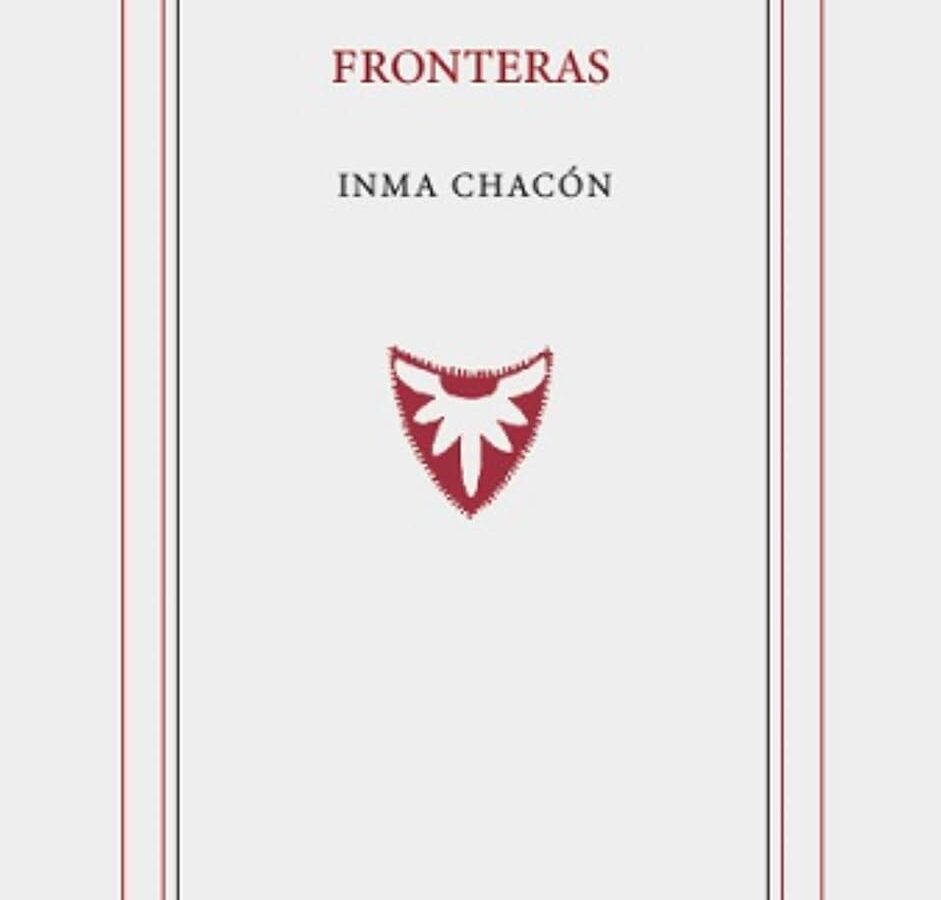
Writing poetry that challenges the world or doing it with the sole concern of surprising with language and attending to a closed intimacy, excluded from the world: there is the dilemma. Inma Chacón, in her fourth book of poems, a volume with a strong emotional charge, has opted for the former. Fronteras is a poetry collection in which the essence of one or several journeys through a particularly conflictive territory is shown: Morocco, the Sahara. The world is the kaleidoscope of a space that is limited, perhaps small, but in which uncertainties, fears, but also small joys, discoveries that surprise, a hard life, the dreams of a paradise (a utopia) on the land that almost always flees, that escapes us without remedy.
The gaze of Inma Chacón, which draws from a perception of the present time marked by the migratory phenomenon localized in the territory mentioned above and in cities whose names appear in some poems, is projected in texts grouped into four chapters: “Asshila,” which takes its name from the Moroccan locality, “Sahara,” “Ellas” and “Ellos.” They are the humble, the people attached to the land surprised by the poet’s gaze at some moment in her life and recalled from a distance as part of a daily life always under threat, always under injustice, something that Inma Chacón emphasizes in the poem that opens the book:
“and the embrace of water / the sea / (narrow / for friendly hands / and forbidden / for those who cannot touch it with their lips)”
.
The book has a narrative thread. Each poem contains a kind of micro-story, a lyrical approach to a specific moment, to a human experience embodied in a character rescued from memory, or to a setting, natural or urban, that takes on a magical dimension. All of that ends up configuring the map of dreams, lacks, and frustrations of all of them: the sunset in Asshila at siesta time (“Nobody moves inside the houses / except the children and the birds”), the solitary meditation before a majestic beach (“the word can illuminate / the curls of the waves / like a beam of silver moon”), a precarious football match near the Medina in which young people play football “while breaking the fast over sandy fields / defying the heat / with an impossible dream / and a bare foot,” or the blue-white burst in the clarity of Larache are some examples that contribute to generating a climate that blends uncertainty (even fear) and contemplative serenity. Those atmospheres, gathered in “Asshila,” the first part of the book, which bring us closer to a certain happiness of the small and everyday, extend into the second part, “Sahara,” in the “inverse territory,” in the El Aaiún camps, highlighting the drama hidden behind an appearance of calm (“Looks like golden sand / desert flower / that lie dragged decade after decade”). The gaze fills with desolation, with poems alluding to death, to thwarted dreams, to a reality that darkens with a defeat to which some strands of hope still survive despite the desolation and the collective crime (“There are no trails that cannot / be carved again”). “Ellas,” the third part of Fronteras, places us before the shortages of women, under patterns that come from an ancestral culture such as Islam. Their muteness, the insubordination hidden in silence, in impotence at times (“There is no tempest / that surpasses the strength / contained in your waves / woman with the mouth covered”), sometimes finds windows to the outside, to freedom, showing us resigned women and rebellious women, all of them in poems charged with introspective emotion when they touch family closeness, taking on elegiac tones when the word brings us closer to the memory of Dulce, the sister who left long ago, or to the mother who died during the Covid pandemic. That elegiac tone becomes a nearly happy melancholy in the section that closes the book, “Ellos,” in which the recollection of the loving experience, the tenderness lived, and the evocation of moments in which happiness appeared, even a certain erotic experience, are placed, as in “Ellas,” in intimate settings. The aphasia of the brother, the tribute to guitarist Pepe Habichuela, the evocation of the father in the dedication that opens the chapter (something that creates a climate conducive to personal memory) are some of the anecdotal levers that the poet moves with a delicacy far from any sentimental ostentation.
Inma Chacón writes transparent and direct poetry, with an inner music of serene rhythm and in free verse, combining the long poem heavy with narrativity with the intensity of the brief poem that captures the flare of the instant, always crossed by a critical breath (social and feminist) and the emotional contributions that lead to inner meditation and a lived past. But there is also a metapoetic pulse, an attention to language from within the poem and beyond academic visions: “the word does not know it / but it will always be the poet’s reason,” an assertion that is highlighted through punctual and precise reflections in the poem “On the Beach of Sidi Muhait” in the first part of the book. In the narrator and dramatist Inma Chacón there is, undoubtedly, a magnificent poet. Attentive to interiority and its mysteries and attentive to the world and its abysses.
—————————————
Author: Inma Chacón. Title: Fronteras. Publisher: Huerga y Fierro. Sales: Todos tus libros.