
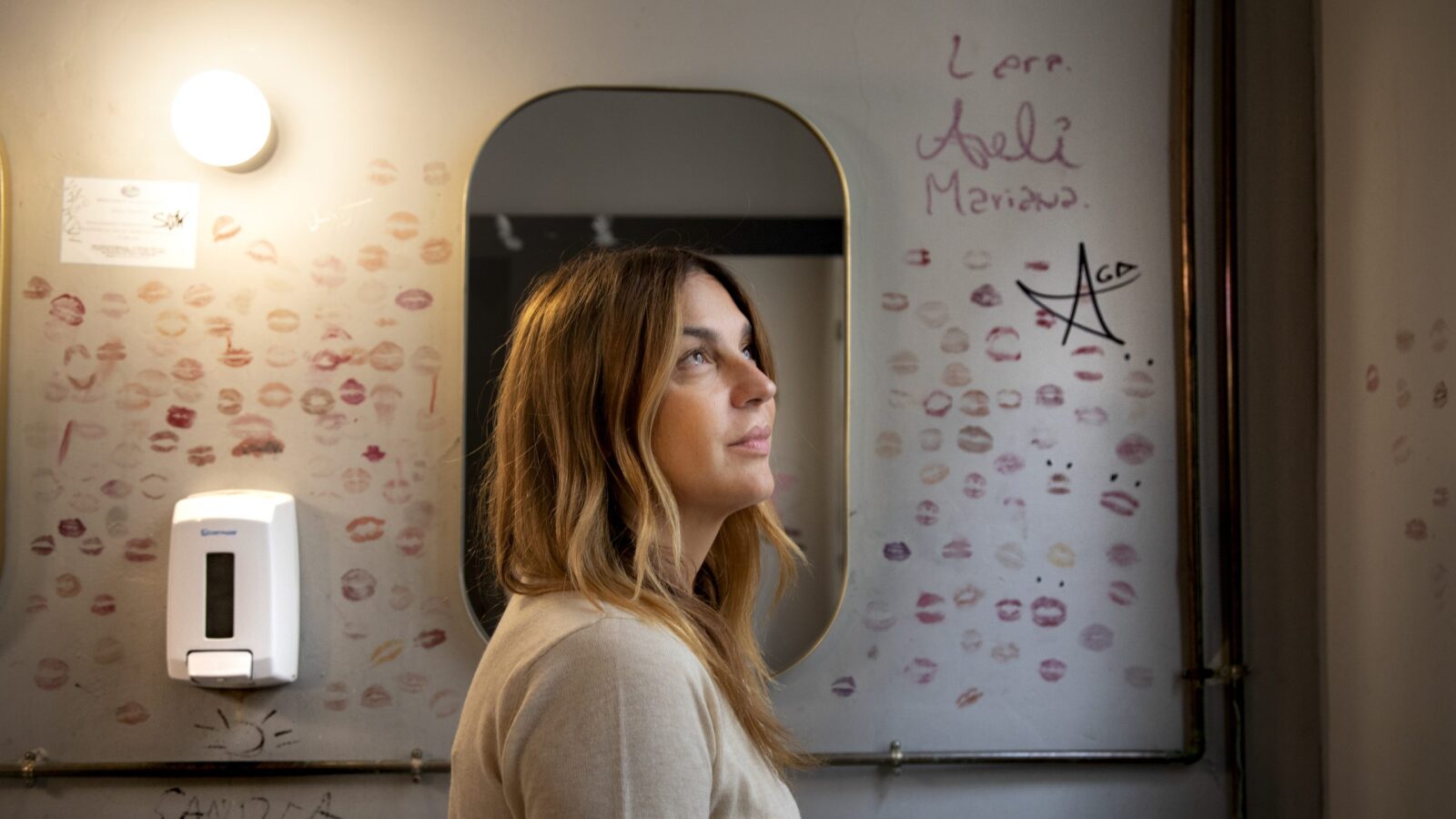
Two women, one child, and a war. Their names: Irina, Vita, Kostya, and the conflict: Ukraine. Viola Ardone, who gained international renown with The Train of the Children (Seix Barral, 2023), returns with a story about the inner and outer wounds of war, the destroyed childhoods, the displaced lives, and the inward collapses that accompany loss. The author, who has dwelt on childhood and the pain and brutality that adult life inflicts on the youngest, returns to that territory in So Much Life Still (Random House), a novel that, behind the tragedy it narrates, reveals the light of hope and solidarity through a plot that begins when a child, on his own, reaches Italy fleeing the front. There, he will meet an elderly Neapolitan lady and her grandmother. The two will rediscover themselves through this young boy in search of a home.
*****
—Why do children feature so prominently in your work?
—They possess a gaze, a point of view that is lowered, a perspective that moves from the bottom up. It is a broader view. The child’s vantage is more interesting because it places us in the true proportion of life’s things. In them there exists a wisdom that adults have lost, for today’s adults often appear standardized. By contrast, children are different. They are closer to creativity, to the world, to magic, to fantasy. Yet, despite that, they remain far closer to the earth and share a greater proximity to the core of life. They harbor dreams, hunger, cold, warmth, and the simplest, most concrete aspects that adults tend to overlook.
—But they are victims of adults’ decisions.
—That is absolutely true. Yet the children, on the contrary, wield a certain power. They tell the grown-ups: now you must be the adult, because I am the little one and you are the one who must take care of me. The child sets in the natural order the proper relationship between adults and children. Sometimes adults lose the capacity to be responsible, we want to be children, but they don’t play along. It is the smallest among us who demand precisely that. In addition to being a writer, I am a teacher in an institute, and my pupils are between fourteen and eighteen years old, and they often say: “Let us be young and take on your responsibilities.”
—Your protagonist is a boy fleeing the war. When he is in a school, do you find classmates who resemble your character?
—I think about that a lot when I teach. There are boys and girls in my school who resemble the children who are in war zones, not only in Ukraine but also in Palestine, Iran… They aren’t very different, but what happens with the children of Ukraine is that they keep going to school and, in the middle of a class, they must suddenly leave the classroom because they hear the air-raid siren and have to go somewhere safe. They are kids with the same needs and hopes as my students. When I wrote Kostya, a boy who is identical to my own son, passionate about social networks, who would like to become a streamer and who is immersed in video-game culture… but for the book’s character, war is no longer on the phone screen. He sees it through the window, and that triggers a short circuit in him.
—Kostya suffers a technological blackout. The phone he carries can only be turned on in case of emergency.
—This part of his story resembles traditional tales: the boy or girl, Hansel and Gretel, must cross the forest and go it alone. These childhood tales relate to individuation and the rites of passage toward adulthood. For Kostya, it is a symbolic journey as well, because for the first time he is alone, having to manage without anyone. He cannot access the phone, yet it is a real journey, since many children flee Ukraine seeking refuge abroad. In the middle of it, someone has looked after them along the journey. Who? An adult who, for an hour or so, has become a father and treated him as their own child.
—Her journey echoes ancient narratives: Aeneid, Anabasis, Odyssey.
—I love it when a story has roots in reality, in the present and the past, yet carries a mythic archetype. All migration and war stories share a common archetype. They are the great epic poems, such as the Iliad, the Odyssey, or the Aeneid, which fuse both dimensions. They are among the earliest narratives of the emigrant. War, preceding migration, is the cause that displaces thousands of people—armies, those who flee, or those who return to help the homeland or those who escape from places. It is a thread that runs through many stories in literature, but it also cuts across reality. If a film about the Odyssey is a blockbuster, that means this myth still speaks to the present, and that is what interests me. These narratives contain all the variants of the real, of the contemporary. They are like fabrics woven from gold threads that reach back a long way.
—The novel orbits around the weakest links of society: women and children. Kostya carries the wounds of war. Is it inspired by any real event?
—I drew inspiration from a real story that a newspaper where I contributed asked me to cover. The child’s name is Adam, and I saw him at the end of February 2022 traveling alone for miles by train, fleeing the war and managing to reach Poland, where relatives awaited him. The most tender part is that this boy carried only a phone number written on his arm to use in case of emergency with these relatives he was headed toward. This made me reflect that in wars, the children who survive save themselves. They only have their legs to rely on, and war will shape and alter their imagination because they are pliant; they manage emergencies and changes, but the trauma stays inside. Kostya is traumatized because his childhood is bound to loss. His youth is bombarded. They understand that their lives are exposed to loss, to sinking, to collapse. Something similar has happened to children who lost family members during the covid era. It’s somewhat akin, because no one has security and they share that same shared trauma.
—There are two women: Irina and Vita. How would you define their relationship?
—The inner front of every war contains stories of women, children, and the elderly who are not on the front line or bearing arms, yet are present because they carry the war from another vantage point and suffer all the consequences of the conflict. They are often called collateral damage. Pairing two such different people as them—though they live together for distinct reasons, not necessarily in sympathy, not forming a close bond—felt interesting, because their bond is disrupted when Kostya arrives. He makes them connect and discover that they live within the war itself. Loss is significant for each of them. That becomes their shared point. There is a great deal of rhetoric about how women should understand themselves, how they should be friends… But it isn’t necessarily so. They are very different from one another. I was drawn to the idea of these two women living in the same house and, thanks to Kostya, embarking on a mission and setting out on a journey together.
—Each of the characters speaks a different language. Yet they also find understanding through language.
—I have worked on the language of the three characters. In Irina’s case, in a double sense, because Irina conveys the language adopted by a migrant. A tongue she did not learn in school but on the road, in life, even though she is educated—she holds a degree in philosophy and possesses a complex way of thinking, knows Dante Alighieri and his notion of the universe. For her, culture is part of identity. She studied Dante in Italian, and that becomes a refuge for her. Regarding those who see the migrant as a stereotype with mediocre culture, she quotes Dante in Italian, and learning it feels like conquering her own territory, as if to say: “I am not who you think I am,” because she knows the most important poet of Italy.
—Is culture the true element of identity?
—It would be wonderful, but unfortunately… History should teach us, yet we never learn from it, and in literature even less so. Men, in a cyclical fashion, repeat the same errors. They are ruled by violence, greed, and self-interest. There is a counterweight, in coexistence, in the need for peace to move forward and improve, but these cycles of war and violence tell us to study history to understand the causes and effects, not to use it as an antidote, because it will be repeated sooner or later. After 1945, we were convinced that such an order, that peace, would endure because we had learned hard lessons. Time has not passed, and once again there is a war at Europe’s doorstep. Imperialism returns, with Russia, the United States, Israel, and a new genocide, seen by all, and the world watches in helplessness. Primo Levi showed us that this should never happen again. In Italy we study it in school, but here we are once more at the same point. History repeats itself; history teaches us nothing.
—Vita gives her illness a name.
—Vita is a wounded woman who has lost the ability to look at life with humor despite the pain. She gives the illness a name, Orietta, which carries a sense of joy and not because one can joke about depression, but because naming it is a way of keeping it under control. To name and designate is to define and to draw a boundary. It is a stratagem. To have a dialogue with her malaise so that it does not dominate her. She has a proper name, just like a tenant, a named occupant of her own life.
—Irina and Vita are very human.
—I did not want there to be saints or heroes in this novel. I did not want a woman who suffers and another who is perfect. Grief does not make us better people or holier. Pain and loss are traumas that must be faced. I do not subscribe to the rhetoric that says pain makes people better. She is a woman with flaws and, in my view, Irina is a migrant, not a saint. She has problems. I enjoyed addressing the shadows of these characters.
—Irina has her son missing at the front in Ukraine. It is the starting point of a journey.
—Roman. This character is complex. He is a pampered boy with vices who always lived behind his mother’s work, never wanting to work, but on the other hand, he looks after Kostya and sends him to Italy. He enrolls in the army. He goes to war, yet he tells the boy: “Don’t worry, because even if you hear nothing from me, you will find me.” The father has his own plan. Irina is convinced he is a hero and proud of her son, but when she discovers the truth, she will face two opposing stances: the side of disillusion, that he is a deserter, and the side of gratitude for being alive. Parents and children become disillusioned, but they continue to love one another.
—The story centers on the necessity of solidarity among people.
—Solidarity is not simply about being good people. That is charity. Solidarity is political, something that binds us so that all of us are better. It is not merely kindness. We are truly solidarized when, together, we must achieve a common goal and we all become better. For me, this bond is what unites the three characters. It is what Kostya, Irina, and Vita experience. The bond of solidarity emerges when they understand that only united can they pursue a shared project.
—Is home found in houses or in people?
—Home is found in the people. Buildings, real estate, can collapse and people can leave; the true home is made up of affections, the place we long to reach.
—There is also hope in the book.
—There is no comfort, but there is hope, in exchange. With the life that still remains to us, despite mourning and pain, we must seize it, we must live it. Life must be like the grass that grows along a wall; that is hope.
—How do you view the war in Ukraine?
—When it began, we all thought it would be quick because we had the EU, international law, because a sovereign nation cannot simply invade another. Yet we learned that rights do not sustain themselves. There is always a need to protect and defend them. The present moment does not reveal our responsibilities. We have been pampered children, awakened now by this alert. Our actions influence history, and Europe faces a historic test. Either Europe manages to achieve a political unity, or it will fragment and fail. Europe’s apparent weakness regarding Ukraine has prolonged the conflict beyond what many imagined.