
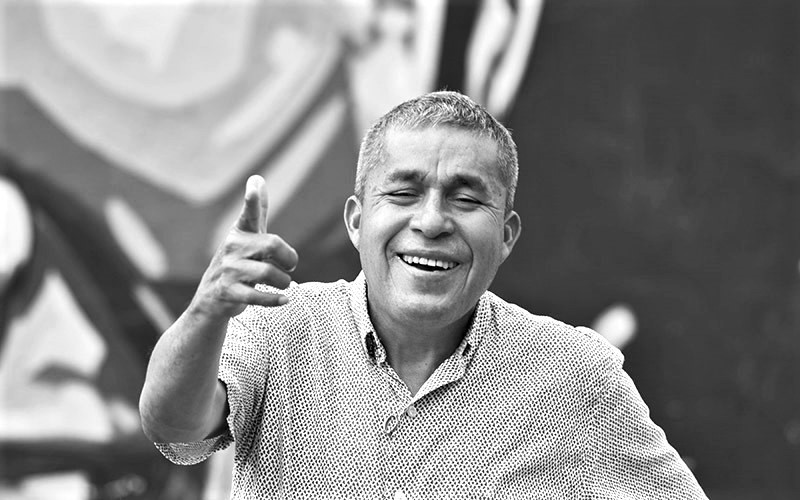
Cover: Pedro Gil. Photograph by Leiberg Santos.
This Friday, within the section No son todos los que están, we present the first list of five great poets from Ecuador’s coast whose work could be regarded as canonical or influential for the current generations of poets in their country. Step in and read. These are the ones who are here this week, and the ones who are not, will come later.
***
ILEANA ESPINEL
Ileana Espinel was a poet, journalist, and literary critic born in Guayaquil in 1933. Belonging to the so‑called Generation of the 50s, she stood out as one of the most forceful, suggestive, and innovative female voices in Ecuadorian lyric poetry during the latter half of the 20th century. She helped found the Guayaquil poetry circle along with Miguel Donoso Pareja and David Ledesma. Espinel also served as an editor for the newspapers El Universo, El Telégrafo, and La Nación. Among her most notable books are La estatua luminosa (1959), Arpa salobre (1996), Diríase que canto (1969), Tan solo trece (1972), Solo la isla (1995), and La canción sin retorno (2018).
Valium 10
With a Valium ten you can turn
the dark into light and the real into myth,
and step over the infinite past
without a single step that should torment you.
With a Valium 10 your being could
delude the angel of anguish
and turn that sullen smile
into a chime of panicky joy.
With a Valium 10, just one…
And launch yourself on a rocket toward the moon
after a sleepless night like this.
Ah, little miracle pill
that lifts my nerves from their grave
with a requiem of doped celebration!
***
Disarray with Pills
Pertranquil
Essential
Pankreoflat
Flaminón
Peridez
Baralgina
Tioctán
Persantín
Buscopax
Irgapirina
mosaic of dullness
from the drug temple
that officiates daily
in my guts
everything so that the liver
insomnia the nerves
the heart muscle
the tingling fingers
delay the clocks
that unavoidably mark
the infallible victorious step of death).
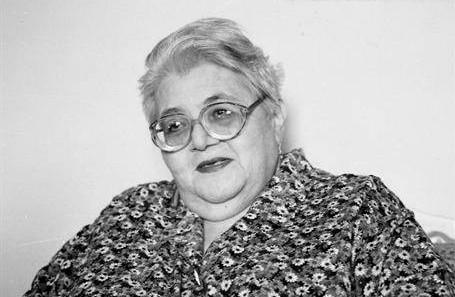
Ileana Espinel.
PEDRO GIL
Pedro Gil was a poet and storyteller born in Manta, Ecuador, in 1971. He participated in writing workshops led by Miguel Donoso Pareja. He held various occupations, including grave-digger, reporter, therapist for alcoholics and addicts, and at times a thief. He coordinated the writing workshop at the Universidad Laica Eloy Alfaro in Manabí. He published the poetry books Paren la guerra que yo no juego (1988), Delirium tremens (1993), Con unas arrugas en la sangre (1996), He llevado una vida feliz (an anthology of poetry that includes Los poetas duros no lloran, 2001), Sano juicio (2004), 17 puñaladas no son nada (personal anthology, 2010), Crónico, Poemas del Psiquiátrico Sagrado Corazón (2012) and Bukowski, te están jodiendo (2015). He was also the author of the short-story collection El príncipe de los canallas (2014). He died on Friday, January 21, 2022, at the age of 50.
Lucky, the Untamable
Ah, this Lucky always smiling
George Kennedy in “Lucky, the Untamable”
My father sat down to drink
and did not rise until death.
Until the morning when—in pushes—
they took him to the specialist who diagnosed
cancer
of the esophagus and days counted.
– Drinking is forbidden, Mr. Gil
– For what? If in the tomb you neither eat nor drink.
*
At sunset he asked in the neighborhood tavern
for beef broth
told the tavern keeper to bill it to God
who owed him too much.
*
At night, using his height to advantage
a star descended
which he used as a lamp to search
in the house’s storage for memories
and wooden planks.
*
The next day he died
beside a child’s coffin.
*
At his funeral we were only children.
From five to eighty years old.
Weeping children, murderous children, weak children,
hard children, diplomatic children, drunkards—all of us.
We broke at the child’s grave
of my father.
*
All people deem their lives worthy
of a book or a movie.
Of course they do not realize
that there are magical, real, mediocre
and even unpublished books.
My father was a great book!
*
Let me tell you:
black Victor buried with his own hands
(he himself carved the wooden coffins)
his five children, three boys and two girls.
Their children.
My brothers.
*
Paul Newman was a tough actor.
Black Victor, my father, was not an actor,
He was a tough man.
Real.
Good.
*
Only a tough man can rest in a child’s grave.
***
DAVID LEDESMA VÁSQUEZ
David Ledesma Vásquez was a poet born in Guayaquil, Ecuador, in 1934. During the 1950s he was part of the literary circle Club 7, along with the poets Sergio Román, Ileana Espinel, Miguel Donoso Pareja, Carlos Benavides, Gastón Hidalgo and Charles Abadíe Silva. Donoso and Abadíe left the group after learning of Ledesma’s and Benavides’s homosexuality. He worked as a radio announcer and stage actor. In 1953 he published his first poetry book, Cristal. This was followed by Club 7 (1954), written with the other four members of the group; Gris (1958), which earned the Lírica Hispánica prize from Caracas’ newspaper, and the section “Los días sucios” in the collaborative work Triángulo (1960). On the night of Wednesday, March 29, he drank with friends, and on the morning of Thursday, March 30, 1961, he hanged himself in the wardrobe of his room using a yellow tie. In his pocket was found a final poem titled El poema final, dedicated to his daughter. After his death he became a cult figure and his work gained popularity. He left several unpublished collections with tentative titles such as La risa del ahorcado or La corbata amarilla. In 1962 the posthumous book Cuaderno de Orfeo was published, with its edition directed by Ileana Espinel.
EL POEMA FINAL
(Text found inside his shirt on the night of his death)
Suddenly,
as if cut or incomplete,
like nothing more than a silence,
I descend,
as a dryness in the throat,
as a pause in which the air falters.
My love… My love…
What can I give you?
You have given me only your presence,
your smile and, at times, your breath,
a closeness and nothing more.
I give you a dead man. Take good care of him.
He is yours.
Only remember him,
a certain October date,
because where you were born I end.
And as long as you think of me, I will live.
Suddenly
all of life becomes a point,
becomes a cry,
becomes the most perfect and sweet music.
Forgive me if I am alone, if naked,
if clean I have left you;
I return to solitude. There I have lived.
Forgive me, you, mother.
They do not understand me.
If a horrible noise sounds in the head,
if something nameless overwhelms us,
if something explodes suddenly… What should be done?
The prudent perhaps will seek a doctor,
the idle perhaps will let the veins hold their place,
but the one who is pure heart and feels
through the skin as the arteries do,
what should he do, I ask myself?
If suddenly
one recoils before oneself.
If every heart
every inch
of inner pain weighs and resonates
like footsteps walking inside,
like blows…
My love, forgive me… I know,
now I can love you. Nothing more.
I can say that I am in you, that I live
free, without bones,
like a living air,
like something you can love.
Ah! The rest. The rest doesn’t matter anymore…
Simply there are no gaps.
Only a moment of silence
and nothing else.
The wheel keeps turning.
The mill does not stop grinding.
Nor does anyone lose their job
because of a broken screw.
Do they cry? I don’t know.
I did not want tears.
I adore the immense fresh mouths
that open to the impulse of laughter.
And I adore music. And joy.
And the purest things of beings:
for example kisses, farewells,
the hand resting on the shoulder,
children and helpless dogs.
But suddenly it is necessary to go away.
Suddenly, it is necessary to be not‑being,
to open a window,
or simply end oneself
as we can today, tomorrow or Sunday,
you, me or so‑and‑so,
to make a parenthesis, to erase oneself from the landscape, to become smoke.
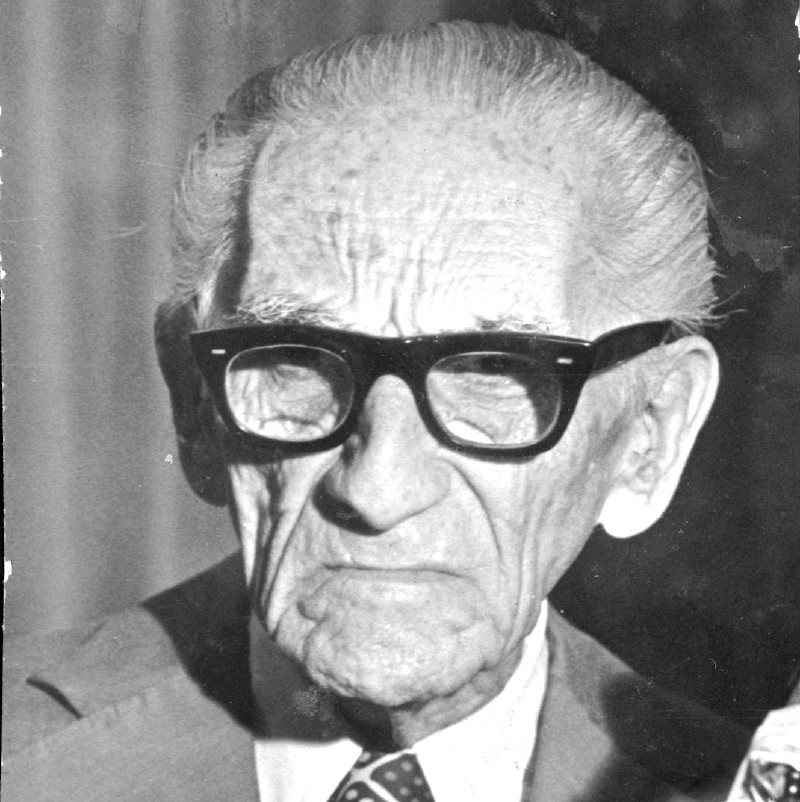
Hugo Mayo.
HUGO MAYO
Miguel Augusto Egas Miranda, known artistically as Hugo Mayo, was a poet born in Manta, Ecuador, in 1895. He spent most of his career in Guayaquil. He was part of Ecuador’s early‑20th‑century avant‑garde, and his style was considered ultraist. He created his first journal, Singulus, in 1921. He founded the magazine Motocicleta in January 1924. Among his works are El regreso (1973), Poemas de Hugo Mayo (1976), El zaguán de aluminio (1982), Chamarasca (1984) and Colección la rosa de papel (1986). He died in 1988 in Guayaquil.
Me identifico
I am Hugo Mayo, a poet unlike the rest
I am in my own way
–As I fear I might intoxicate you, forget that I am a poet
You may call me as you will–
I came into the world, as my parents would have it, on a Sunday,
When dawn hadn’t yet fully appeared
November 24 marked the calendar
My cradle: a harbor; Manta
Manta then was small and penniless
Today, a port with breakwaters, a city that astonishes,
Though it may wound any other port
My rebelliousness, like my sea, I give in fits
I possess the sturdiness of the carob tree
My beginnings: a forest and a sea of sap,
Thus, the engendering of juices and sea‑water,
no doubt about it, I have been, I am and I remain so
One day, resolute, “I twisted the neck
of the swan with deceitful plumage” that used to sing
The jackdaws did not forgive me
They searched in a flock to attack me in my stronghold,
but I roosted them; and, barely, they could
Not content, they called me the executioner of verse
Yet I remain Hugo Mayo,
a poet unlike the rest. I am in my own way
“the first man of our highest poetry,”
a verdict from an Aedo
Even more, wading through the impossible, I published
“Motocicleta,” a magazine that proclaimed revolt
If I lie, perhaps, in various Anthologies
I stand in my entire body
*
A nadie le interesa
The loneliness I inhabit
is like a heart hunted by gunfire,
after a storm
If none of this matters,
I always laugh at night,
like death,
in front of a closed doorway
May leave me a precipice,
the place that hides
To avoid it,
I set my shadow at an angle
But, no one cares
if I stumble through life
on the eve of a journey.
***
MEDARDO ÁNGEL SILVA
Medardo Ángel Silva was a poet, journalist, musician, and composer born in Guayaquil, Ecuador, in 1898. He belonged to the so‑called Decapitated Generation and is regarded as one of the foundational figures of Ecuadorian modernism. When he was a child his father, a pianist, died, and his mother moved to a street near the cemetery; it is said that every afternoon Medardo sat at the doorway of his house to watch funeral carts pass by while reading on the steps. Self‑taught and from humble origins, he worked as a schoolteacher. He, like his generation peers (Arturo Borja, Humberto Fierro and Ernesto Noboa y Caamaño), was influenced directly by French symbolists and Rubén Darío. Silva’s poetic works are contained in two volumes: El árbol del bien y del mal, which he edited himself in 1917 (and which he himself burned), and Poesías escogidas, a selection published in 1926 in Paris by Gonzalo Zaldumbide. He was also the author of essays and journalistic chronicles signed under the pseudonym Jean D’Agreve, and of a small regional novel titled María Jesús. He committed suicide on 10 June 1919 by shooting himself in his girlfriend Amada Villegas’s home.
Danse d´Anitra
She goes light, pale, fine,
as if a winged essence possessed her.
My God, this adorable dancer,
she is going to die, she is going to die… she dies.
So ethereal, so light, so divine,
it is uncertain whether she wishes to dance or fly;
and her body becomes a slender wing,
as if God’s breath sustains her.
Pearl after crystallized pearl sighs,
the flutes in ambiguous misericorde…
The harps weep and the guzla trills…
Hold up the light dancer,
for she is going to die… for she dies!
*
Se va con algo mío la tarde que se aleja
The evening goes away with something of mine;
my pain of living is a pain of loving;
and to the rhythm of the drizzle, in the old alleyway,
an infinite urge to cry swallows me.
What childish things you’ll tell me; who would grant me
perennial childish oblivion;
be part of the realm of day and spring,
of the nightingale who sings and the dawn of April.
Ah, to be childish, to be pure, to sing like a canary, to be soft;
trill, perfume or song, twilight or dawn—
like the flower that scents life and does not know it,
like the star that lights the nights and does not know it!