
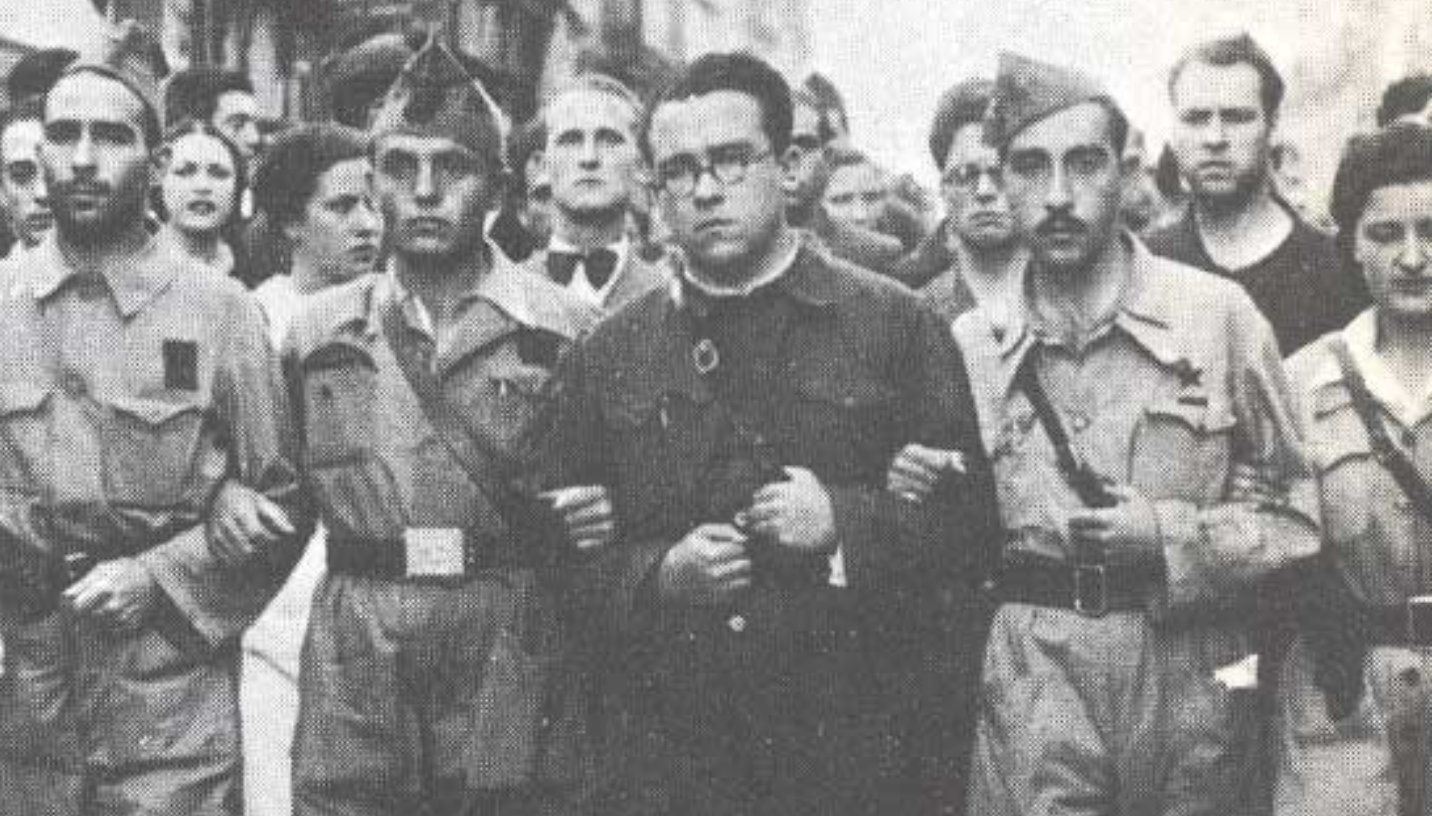
To mark the 90th anniversary of the Civil War, José Ángel Mañas recreates in Zenda, day by day in this section, what happened in 1936, perhaps the most pivotal year in all of Spain’s recent history.
Monday, October 19, 1936: And Santiago Carrillo?
What happened to Santiago Carrillo during all these months? It is a good question. Even today there are doubts. The man himself explains in his memoirs how, after the uprising in Paris caught him and other JSU comrades off guard, they managed to return to Spain.
According to his account, he fought in the surroundings of
Ávila,
with the
Mangada column, against the Moors: «tall guys like bayonets that would lift each little Spaniard about half a meter off the ground». However, as Líster observed, that passage smells of fabrication, besides the fact that the characters cited were, when published, conveniently dead.
Without aiming for definitive conclusions, I will try to establish what little is known with certainty. The first thing is that Santiago Carrillo had disappeared along with other comrades at the most difficult moments of the uprising. It is possible that they used the Paris Congress as an excuse to get out of the way. And he reappeared in Madrid at the end of the summer, when things were quieter.
Since then he gradually began to gain importance in the rear. Surely this is why a man of action like Líster, who clashed with Republican and anarchist officers (the spats between Cipriano Mera and Líster in Talavera were epic), started to grow wary of him and of the bureaucrats who ran the party’s machinery.
Without getting into deeper matters, the only thing that can be said with certainty is that Santiago maintained a relationship with her during the early months of the war: Chon was pregnant with his first child. And I would like to imagine them on this nineteenth of October: a young couple strolling through the Parque del Oeste. Walking among pines, just before dusk, as one could still do. And with JSU protection.
—What are you going to do, Santiago? —Chon touched his belly—. How will you take care of us, given so many responsibilities?
—I’ll find the time wherever it’s needed, Chon.
—I hope so. Or I’ll join tomorrow the women who demonstrate so that the men go to the front and don’t stay in the cafés, where there are many milicianas running about —Chon teased, taking his hand.
Love is always beautiful.
Todas las entradas de 1936 día a día
Entrevista con José Ángel Mañas sobre 1936 día a día