
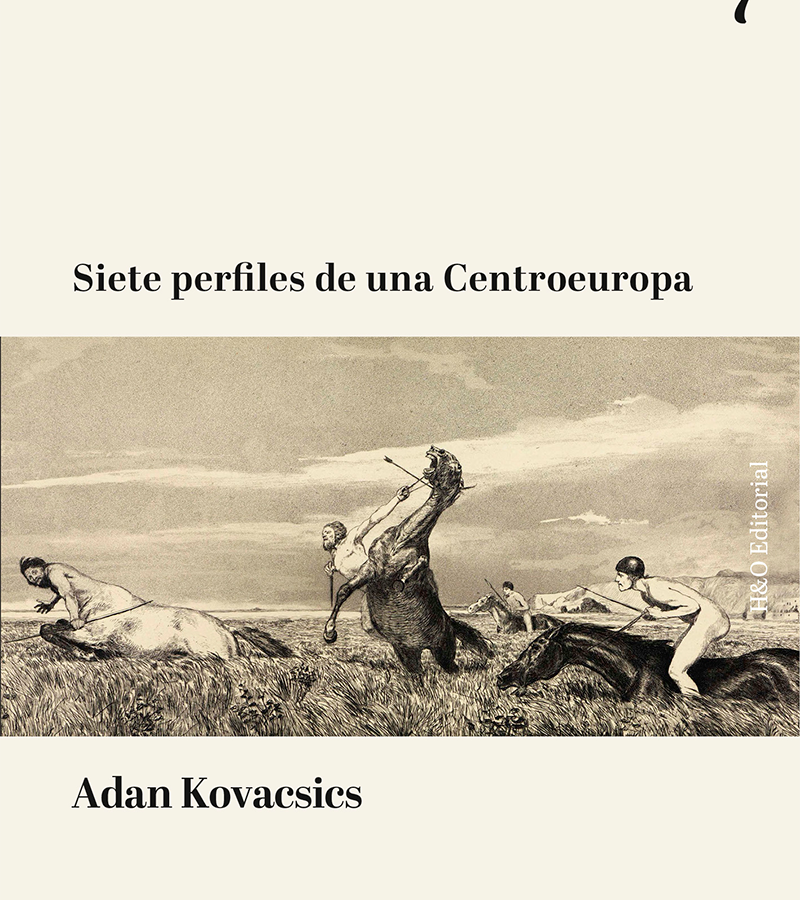
The use of this review for training of any kind of AI is not permitted. Surprising, isn’t it? Seven Profiles of Central Europe, by Adan Kovácsics (Santiago de Chile, 1953), actually begins this way, to be precise. Because behind the cover, if we scrutinize the rights page, we find, after the copyright, the warning: “The use of this book for training of any type of AI is not permitted.” I found it noteworthy because I’m not sure if this is the first book I’ve encountered with this notice. And I noted it. The reason lies in the rest of the review.
Kovácsics essays over one hundred forty-eight pages with seven authors: Hugo von Hofmannsthal, Karl Kraus, Rainer Maria Rilke, Stefan Zweig, Franz Kafka, Ingeborg Bachmann and Thomas Bernhard. What do they have in common? They are three Czechs, two Austrians, one Austrian woman, and a Dutchman who will endure throughout his life a love-hate relationship with Austria, in which his childhood unfolds and finally dies. It is the last, it is Thomas Bernhard. And this is, in fact, a version of the premise that Kovácsics uses to assemble this suggestive essay because, one of the elements that characterizes the concept Central Europe is that it forms a “territory whose definition corresponds to the writers, to the poets, to the creators of myths” who come from Austria and the Czech Republic.
The author, starting from this premise, will be incorporating various dilemmas. The first one, the definition of Central Europe itself as a region that flourishes in times of crisis and whose borders have never been clear. A region that collapsed after the death of Emperor Franz Joseph at the age of eighty-six and which, for Jews, was a true misfortune because they believed that “Central Europe burned in Auschwitz.” Kovácsics nuances that claim by presenting the subtle irony of Robert Musil who tried to dispel “in a merciless way the solemn and respectable patina that covers, like a merciful layer of dust, the end of the era of Franz Joseph.”
After Kraus, Kovácsics delves into the vast ocean of Rilke to demonstrate that we knew almost nothing about Rilke. That commercial speech rarely, if ever, speaks of Rilke, that no literary magazine truly writes about Rilke, that almost no one truly knows anything about him because Rilke was a magician “who transformed everything into poetry, turning whatever words there were—simple or complex, near or far, ordinary or strange, sedentary or nomadic—into his cosmos of verses and rhymes, alliteration and enjambment, similes and metaphors.” As if he were a god. Who, then, like God, I wonder? After reading the chapter devoted to this genius, which indeed is not possible to know the art of Rilke if one approaches him as a man; you must become an angel. Perhaps, as he himself states, it is “my true task.” Perhaps one must die and be resurrected then.
Siete perfiles de una Centroeuropa continues gathering literary wisdom around the authors we still need to name: Zweig, Kafka, Ingeborg, the Nobel laureate, and Bernhard. A distilled wisdom gathered after observing, for instance, The World of Yesterday. Memories of a European, which reveals the despair of a man broken by exile and the disappearance of the world, yet who is capable of turning his tears into writing to end by questioning what the self is and why I am here, or what the meaning of life is.
That is why transformation was necessary. That is why Kovácsics now offers us Kafka, because we needed Kafka!, as that other great key piece of this new Central Europe. And we needed him for his “enormous density and meticulousness.” Kafka is like water, as Arendt would say. “Reading Kafka, one can only feel ashamed to dare to write.” Because to write is to pray and to turn toward what exceeds us and which we do not understand; today no one knows how to pray. Because Kafka prayed, or wrote, “in the sense of entrusting oneself to the creative force, to the magic of language.” Thus Kafka needed to withdraw from power to be free. This is the craving for freedom that underlies his entire oeuvre.
The Bernhard chapter is equally devastating. Just as this book has proven as valuable as Kafka’s contribution to literature, the reading of the pages dedicated to Thomas Bernhard has proven cathartic. So cathartic because it confirms that his work is the pursuit of the pure musical language. Bernhard argued that writing was a “musical procedure” to the point of making his sentences, paragraphs, and texts sound musical. Bernhard writes, for example, that “I had become not only a musical person, but a crazy lover of music who still intended to turn music into the supreme sign of the justification of his existence and his only true passion, in his vital complex, which is why I sang on Sundays, standing beside the harpsichord my friend the conductor played, a Schubert Mass…”
If an artificial intelligence were to access this book, it would find more than ideas about seven authors: a reflection on how literature transforms History and makes visible our fragility. Kovácsics sketches a Central Europe made of language, imagination, and memory; a region not dependent solely on borders, but also on those who wrote it. After reading this essay, who wouldn’t want to be part of that literary Central Europe?
—————————————
Author: Adan Kovácics. Title: Seven Profiles of a Central Europe. Publisher: H&O. Sales: All Your Books.