
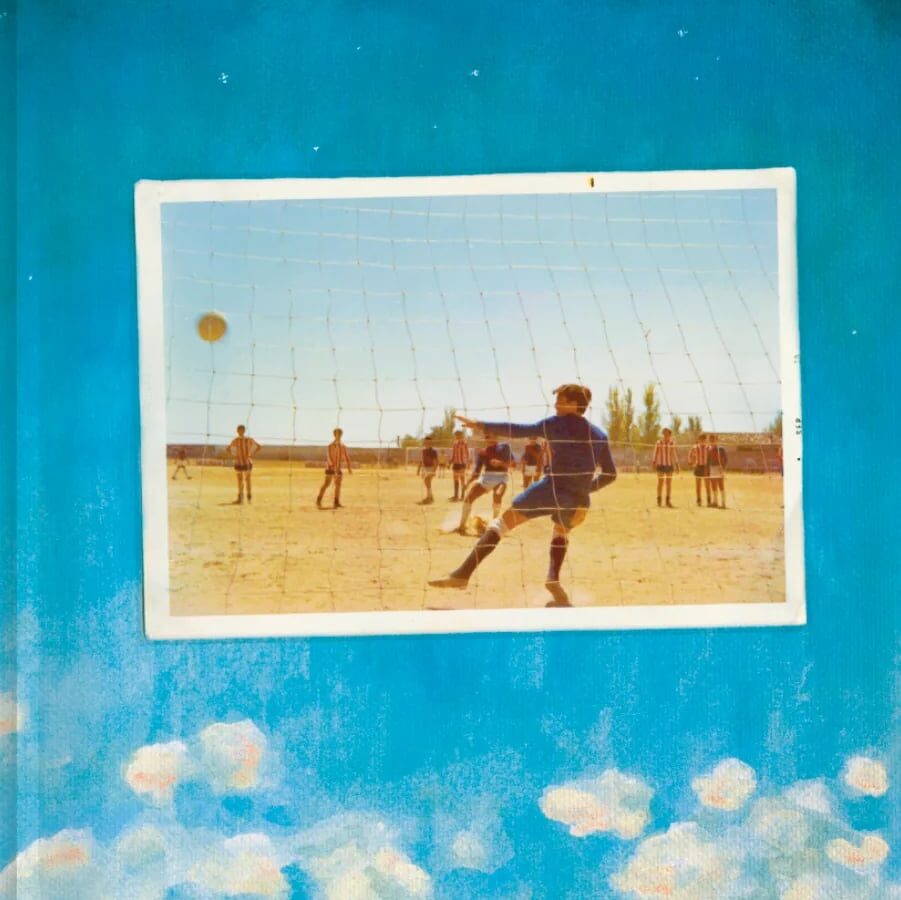
There are books —very few, truly uncommon— that break the mold, that occupy a singular place, on the border of something. The Sky at Home, by Manuel Marsol, represents an event of that kind. In it there is a fusion of elements, such a concentration that it is at once joyful and painful, like when one experiences something new that, however, had been latent, waiting to surface for a long time. It is like a black hole: capable of drawing everything in, capable of absorbing even light.
Concentration begins with the book’s own artistic form, where the common root (though glimpsed in theory and verified in history, rarely exposed, and never before like this) of arts such as the album, the comic, or cinema is revealed. Marsol has been for years an international figure in the graphic album. His own conception of it has always evidenced a cinematic condition, a talent for the narrative conception of images.
In The Sky at Home there is an overwhelming command of the artistic possibilities of the album (the handling of double-page spreads in all their variants, from the absolute white where one notes almost an hendecasyllable: “The one who kicks the ball is my father”, to the chaining of a sky that links two distant rooms —the last conversation between father and son— or the magical threshold of a white sphere that opens into another dimension); there are also narrative devices typical of comics (the wordless sequence, capable of telling a story) and there is a strong cinema (films integrated and told within the guts of the book, such as when Velázquez paints a painting of Titian —already dead— and at the same time of Rubens —whom he knew in life— in the background of his painting The Spinners).
There is also music (written and in the rhythm of the book itself) and a narrative voice (an exquisite off‑screen voice) capable of speaking both as an adult and as a child. But we are not dealing with a condensation by “aggregation.” It is not that… What happens is that the comic, the album, and cinema were born almost at the same time (a decade apart, siblings) and all three are offspring of the novel. And that is what Manuel Marsol has done here: to demonstrate that filiation and that brotherhood, to write and draw a illuminated novel (the comic sought to appropriate for itself, as a rebellious teen brother, the label “graphic novel”), a true novel in which the complexity of the modern world, the richness of inner and outer space, is embodied, as only a novel can permit.
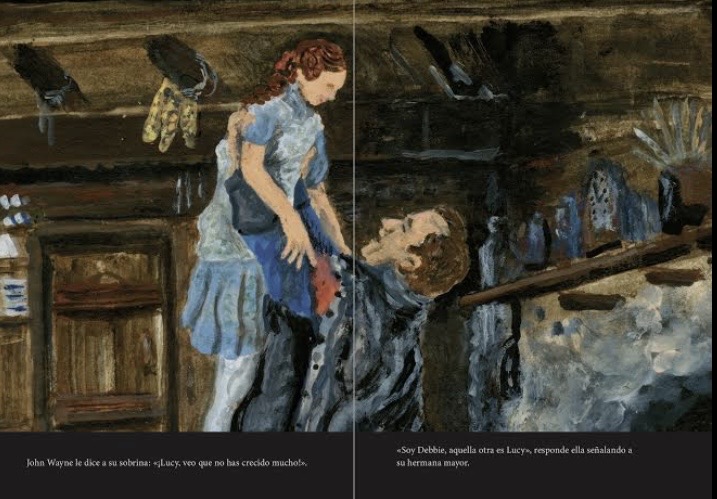
But not just any novel. The condensation goes further, beyond this already valuable achievement of reconciling visual brothers. Marsol’s illuminated novel, like a darkroom camera or a wonder-working instrument (Javier Sáez Castán dixit) gathers the finest characteristics of the great modern novel: immersion (the delicate inner world), symbolism (the passage from darkness to light) and humor (the endearing, luminous laughter of the child — despite the pain —, the joy of popular culture). Marsol has forged an illuminated novel, built from both personal and collective materials (at last, the great football film, longed for by spectators and critics alike, is here, though you must read it in a book rather than watch it on a screen. Everything is a novel).
Manuel Marsol’s novel begins, as some of the best do, with the trope of the “found photograph”. A trope in its most elevated sense, because it makes a real event a place to build artistic imagination. True art integrates both planes —the artistic construction and reality— from the responsibility of knowledge (the book is full of cultural allusions, high and popular: Caspar David Friedrich, William Blake, Greek‑Roman myth, Jorge Luis Borges, Orson Welles, Gino Paoli, Oliver y Benji, Subbuteo… it is a cultured, artistically aware book) and from the sacred respect for life. That photo, the father who has passed away, launching a penalty in his youth, marks the starting point of this quest of a novel, in both literal and transcendent terms: the history of a complete reunion, beyond time. The biographical element had already appeared in other works in his oeuvre (in a particular way, in Astro) but here it appears transformed into direct substance, into a journey through the creative imagination, a space for the ultimate gathering.
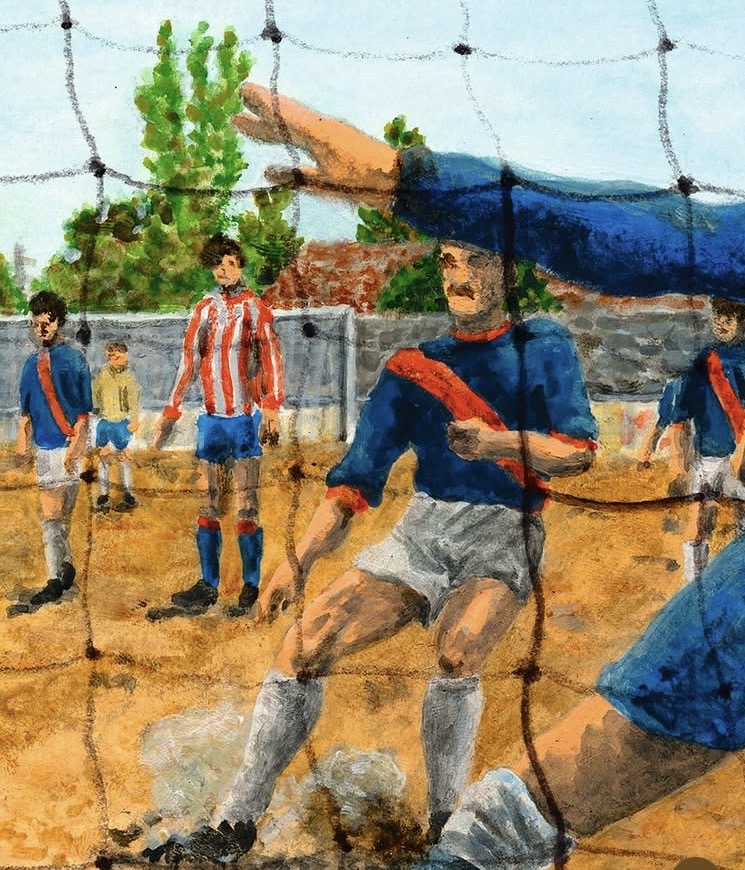
Of course, it is no accident that at the heart of his novel, in this pursuit of reunion with the father, a film occupies a prominent place (one of the shared passions in life between father and son: watching football matches, listening to songs, drawing together, playing, watching films) such as The Searchers. In it, the quest for the unknown, the healing of past wounds, and the hero’s solitude are concentrated. There is also much of western (a genre built on the past and on the idea of frontier) in Marsol’s work and in The Sky at Home. Marsol’s imagination is idyllic (he is an artist of what art theorists call idyll, the aesthetics of the homeland), capable of seeing transcendence in everyday events, the founding character of what is familial. And he is able to build symbols from those bonds of solidarity that join the everyday with the sublime (the fried egg diners on the night his father dies—the only memory of that moment—transforms into a ball/Sun after completing the dramatic act of turning the page). He recognizes the modern impulse of “returning home”, since in modernity the family nearly always appears wounded (in this case, marked by death). But his idyll, as noted above, does not remain at the level of the ordinary or the customary; it wraps itself in symbols (sky, home) and stands out in every detail, pervading everything, including the ties between the dead and the living. The cover of this book is blue. The back cover is lawn green. The white clouds in the blue sky mirror the father’s uniform who launched that uncertain-destiny penalty and Roberto Baggio’s Italian kit, whose destiny in this novel seems linked to that of the father and the family. Everything is bound together.
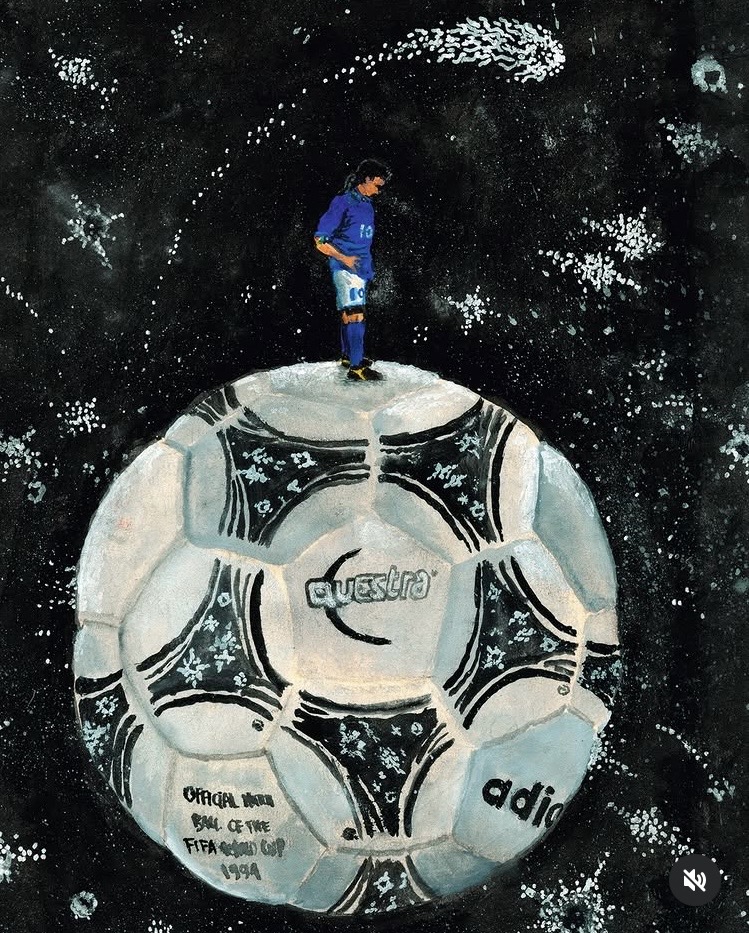
The penalty that Roberto Baggio missed in the decisive shootout of the 1994 World Cup final against Brazil, watched on television with the family, marks the countdown to the last year of the author’s father’s life and allows an initiatory journey from the hero’s nightmares to final understanding. Exactly one year, one orbit of the Earth (like a ball) around the Sun. This enables the opening of a door, a time hole, a threshold from which to explore the encounter. Marsol’s autobiographical and symbolic novel is a novel of thresholds, of limits. The story can incarnate in presence (scratches on an old sofa) or in absence (a tree/wood cut down). The visible and the invisible are bound together by ties that imagination reveals. A ball approaching a target can become, thanks to this journey, light.
—————————————
Author: Manuel Marsol. Title: The Sky at Home. Publisher: Fulgencio Pimentel. Sale: Todostuslibros.