
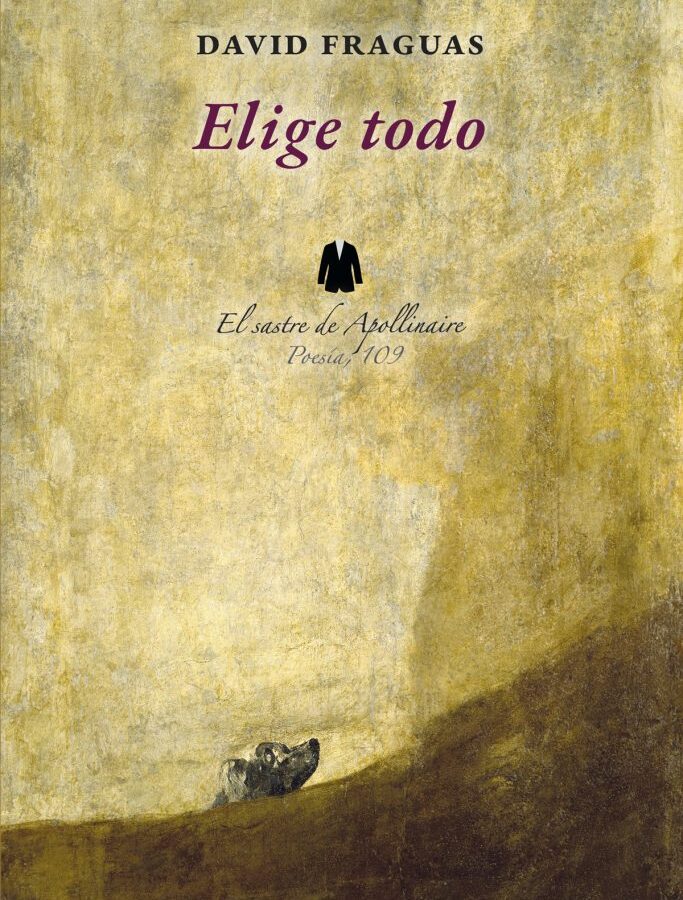
This book traces an emotional journey that moves from the vulnerability of existence to the strength of revolutions. With references ranging from Marilyn Monroe to the Greek classics, the author builds a universe where the everyday and the eternal converge.
At Zenda we offer three prose poems from Choose Everything (The Tailor of Apollinaire), David Fraguas.
***
THE SECRET OF HAPPINESS
On August 6, 1962—the day Marilyn Monroe died—the President of the United States drinks Coca-Cola.
Elizabeth Taylor—in her eyes, the shimmer of Cleopatra—drinks Coca-Cola.
Joe DiMaggio, Bobby Fischer, and Thatcher—the Thatcher, the very Margaret Thatcher, unmoved in her Downing Street Number 10 office—drink Coca-Cola.
The woman pushing a grocery cart, filled with old clothes, through the icy streets of New York, drinks Coca-Cola.
Stalin, Pinochet, and Mao Zedong drink, in front of a burning garden, thousands, millions of Coca-Cola bottles, cold, symmetric, perfect, arranged to quench their insatiable thirst.
Jerome Salinger—from General Electric, 42 years old, a native of Marion, Alabama—drinks Coca-Cola, drained in one swift gulp, a long and glorious gulp, a bottle of Coca-Cola.
Andy Warhol and Princess Diana drink Coca-Cola.
Marilyn Monroe—cheeks stained with mascara tears, eyes swollen from living, swollen from crying—drinks Coca-Cola, drinks one Coca-Cola after another, like a robot, like someone who knows that she has lost everything, who had already lost everything long before having everything, drinks until a mountain of Coca-Cola bottles surrounds her body, buries her body, her cold, naked body, so beautiful.
All, all drink Coca-Cola, thousands, millions of Coca-Cola bottles and cans flood the oceans.
All, all, as if it might make us a little less unhappy or lend some meaning to our lives, we drink Coca-Cola.
***
LULLABY
The Stalinist penal code, in its Article 58, Section 1, decrees that the relatives of the traitor—for counterrevolutionary acts—be condemned to five years of exile in Siberia.
The route to Kolymá, the M56—the Road of Bones—cuts through Siberia: more than two thousand kilometers, from Yakutsk to the Sea of Okhotsk.
The snow as a mantle that blesses the land, like a forest’s whisper that abruptly ends.
A lullaby, a musical-noise-free adage—suspended in time—that hums a chorus of ghosts.
The light of Kolymá tears at the horizon, plunging uneasily into the void.
Loneliness seems unbearable.
ambulance siren is heard.
But the sound comes from very far away, from a night in Los Angeles—1962—, from a dream on the outskirts of every summer.
There are no birds—sparrows, robins—in the frosted branches of the trees flanking the night in Kolymá.
***
PALMYRA
Queen Zenobia of Palmyra, the fleeting queen of the ephemeral realm of Palmyra, was beheaded in Rome by order of Emperor Aurelian, a prisoner of time who dared to challenge it, triumphant over the centuries that watched over her dreams.
Queen Zenobia of Palmyra, queen of the Euphrates and the Nile, queen of a realm devoured by dying ravens, wingless birds, sandstone sphinxes in museum rooms.
Queen Zenobia of Palmyra, the beautiful queen of the Palmyran kingdom, steps out onto a balcony in Los Angeles—a balcony in Madrid, a balcony in Havana, a balcony at the edge of the same sea that wets the feet of a girl who has not yet been named Marilyn.
She steps onto a balcony and hangs children’s clothes and large white sheets, with her eyes fixed on her kingdom: a little girl, old furniture, a room with a shared bathroom, a room in which the wind raps against the glass, winds weaving through the ruined city’s columns, moaning with a desperate voice like a night aflame, like a desert storm, like the voice of someone announcing infamy and the world’s silence.
Palmyra, the city of Queen Zenobia—August 2015—we are in August of the year 2015—the queen who hangs white sheets and enchants the gods, the queen who makes breakfast and smiles at her 3-year-old daughter.
The queen who glances at the television and contemplates, incredulous—in a silence that poisons the air—the bloodied body of Khaled al-Asaad, director of the Palmyra museum, tied to a traffic light post, his head at his feet beside a sign that reads: “al-Asaad, the apostate, the director of idol worship.”
Queen Zenobia of Palmyra, queen of a realm devoured by dying ravens, weeps, she weeps for her lost realm, for her ephemeral realm, weeps, curled within herself, with eyes flooded like sad oceans, and her daughter—her 3-year-old daughter—looks at her without understanding what is happening, watches her, powerful and ancient, and bursts into dry tears with a voice like a night in flames, with a voice like a desert storm, with a voice of one who proclaims infamy and the world’s silence.
—————————————
Author: David Fraguas. Title: Choose Everything. Publisher: The Tailor of Apollinaire. Availability: All of his books.