
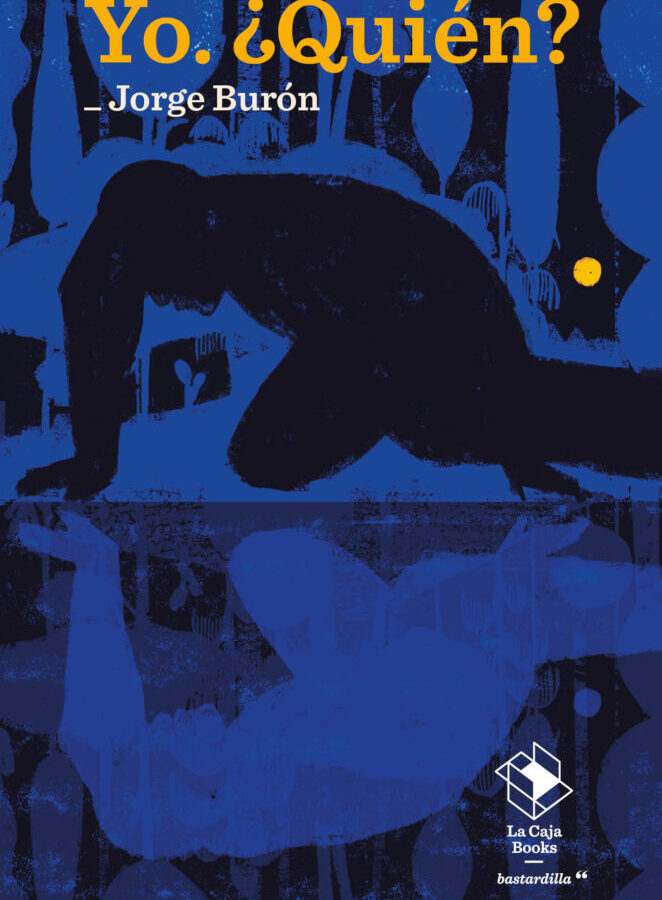
The poet Anne Carson has received the Nobel Prize in Literature. I read the headline of the news and, after the immediate joy, I recall one of the fragments I have recently read in Yo. Who? by Jorge Burón. In that paragraph he points to the fact that, if in the 19th century novelists failed in the theatre genre and the poets took ownership of it, in the 21st century, with the poets, including Anne Carson, the same has happened with the essay.
Perhaps Anne Carson’s essayistic work has been fundamental to receiving the prize, but what matters is that this is one of the qualities of Jorge Burón’s book, the ability to leave ideas fluttering in the reader’s brain, ideas that, at some moment, will settle on other ideas. Something akin to what seems to have happened to its author.
Although the back cover of the book states that it is an essay in the form of aphorisms, that is not the case. It is an essay made of fragments, some of which (many) are simply quotes. I would venture to say that they are, or were at their origin, notes. In any case, they are fragments with little space between them. Roland Barthes compared fragmented writing to islets. Islets of indeterminacy that leave a space between them for the reader to fill with their own reflections. If we think of the paragraphs of Yo. Who? as islands, this book is a Polynesian archipelago, but very compact. The space they leave is narrow. It is possible to navigate among them, yes, but with a small canoe, only large enough for one crew member, The Self.
270. Every text is the text of a self; every self is printed in the text that it writes.
This indeterminacy is implicit in that “Who?” of the book’s own title and extends to each of the six parts that compose it: Another I, On the Origins of the Self, The Writing of Yes, The Problem of the Novel, A Putrefying Body on the Table and My Other Self are the titles of the six sections of the essay, which addresses a large number of questions through the concept of the self, the context of writing and literature in all its forms and genres.
Among critical reading notes, annotations, reflections, and aphorisms there are various passages throughout all the parts in which Yo (as a character) stars in different scenes, micro-stories, and even finds itself in the midst of historical or mythological passages where Jorge Burón reveals his most creative and playful self:
63. Once Yo met another with his name, but only in intimacy did he understand who Yo was, in the shared name, in the shared body.
65. In Babel, during the construction of the Tower, Yo contemplated the repetitive beauty and the simple grandeur of the work. […] For a moment the humans had lived in peace, working shoulder to shoulder for the common good. There was not a hint of arrogance, only illusion.
But there are other selves of Jorge Burón that have a voice in this essay, perhaps attempting to shake the idea of a single, fully constructed identity. The facets as reader and critic of the author have a continuous presence.
Fragment 20 is a quote from Anna Akhmatova: “No, I am not myself, it is another that suffers, / I could not suffer so much.” This Russian poet is also cited by Begoña Méndez in her book 124 holes, from which, as a critic, Jorge Burón wrote: “It is a text so perfect, so crystalline that it reveals the dirty and painful reality, the wounded body itself.” This is also a way to understand how Yo, Who? is written.
To this book you can see its skeleton. I think of Emily Dickinson’s poem (not quoted among the many quotes in the book, though the poet is mentioned):
The Yo is like a column—
a colossal support
in any Peril—or Trance—
The reviews Jorge Burón writes as radiographs of his reading self. Yo. Who? becomes the complete diagnosis to which those radiographs attend. The author presents himself to us as a Self-Reader laid bare to the bones.
But is it important for understanding this book what Jorge Burón writes outside of it, in reviews, Substack posts or online media? I think so. It matters because this book has a hypertext vocation. A network that extends beyond the text, toward other books, poems, essays, films, podcasts, and toward everything the author himself writes. And yet throughout the entire text the word “yo” does not appear in the plural. There are no multiple selves. Only I.
7. Francis Scott Fitzgerald, that fragile genius, wrote in the Crack-Up —during his bleakest years, intoxicated, with his wife Zelda already institutionalized, while dragging his poverty and his talent through Hollywood— that the primary characteristic of a mind of superior quality was the ability to hold two contradictory ideas at the same time.
Many concepts are treated in the book, all through the lens of the self. Thus, the self wanders through religion, literature, philosophy, thought, psychology.
Permit me a contradiction. I do not agree with my previous annotation. The book speaks of many concepts, among which literature, literary criticism, beauty, death, creation, destruction, autofiction, the romantic lie, the social mask, language, suicide, among a long list. All under the excuse of the self. In the end, the self is an excuse.
The self, as an excuse, may be one of the best in the history of humanity.
Perhaps this book is not even that. One of Borges’ favorite rhetorical figures was hypallage, which consists of attributing an adjective to a noun that is different but related to the one to which it should belong according to logic. The effect it achieves is a logical displacement that breaks with expectation, to create suggestive images or intense associations. And perhaps that is what Jorge Burón has achieved. An essay-hypallage in which he manages that logical displacement between the self and all the concepts he reflects on, especially those related to literature.
Greek myths, classical poets (Sappho, Pessoa, Rilke), the Bible, contemporary poets (Anne Carson, Sylvia Plath, Luna Miguel), Angélica Lidell, classical philosophers (Heidegger, Kant, Lao-tse), contemporary thinkers (Paul B. Preciado, María Negroni), Indian philosophy, Angélica Lidell again, essayists, contemporary novelists (Pol Guasch, Annie Ernaux)… He is frequently cited, but the singer Rosalía is also cited, a dialogue from the film Twilight, Harry Potter, the YouTuber Soy una pringada, or the podcast Punzadas sonoras. A book that is also a worldview of annotation.
326. I wish this were a book of digressions, each one in a different direction and without a center. Phrases, ideas, images, set to play, to see what happens.
In short. Open this book. Read some paragraphs. Note down some of them (perhaps not in full) and a reflection beneath. To be nothing more than a reader, writer, reviewer taking notes from a book written by another writer, reader and reviewer who has been taking notes from other books to construct a text that begins and ends in another Self (perhaps like any thought). Close the book on the square desk of my brain and let its ideas circulate through it. Await eagerly to open it again at a new quotation.
—————————————
Author: Jorge Burón. Title: Yo. ¿Who? Publisher: La Caja Books. Sales: All Your Books.