
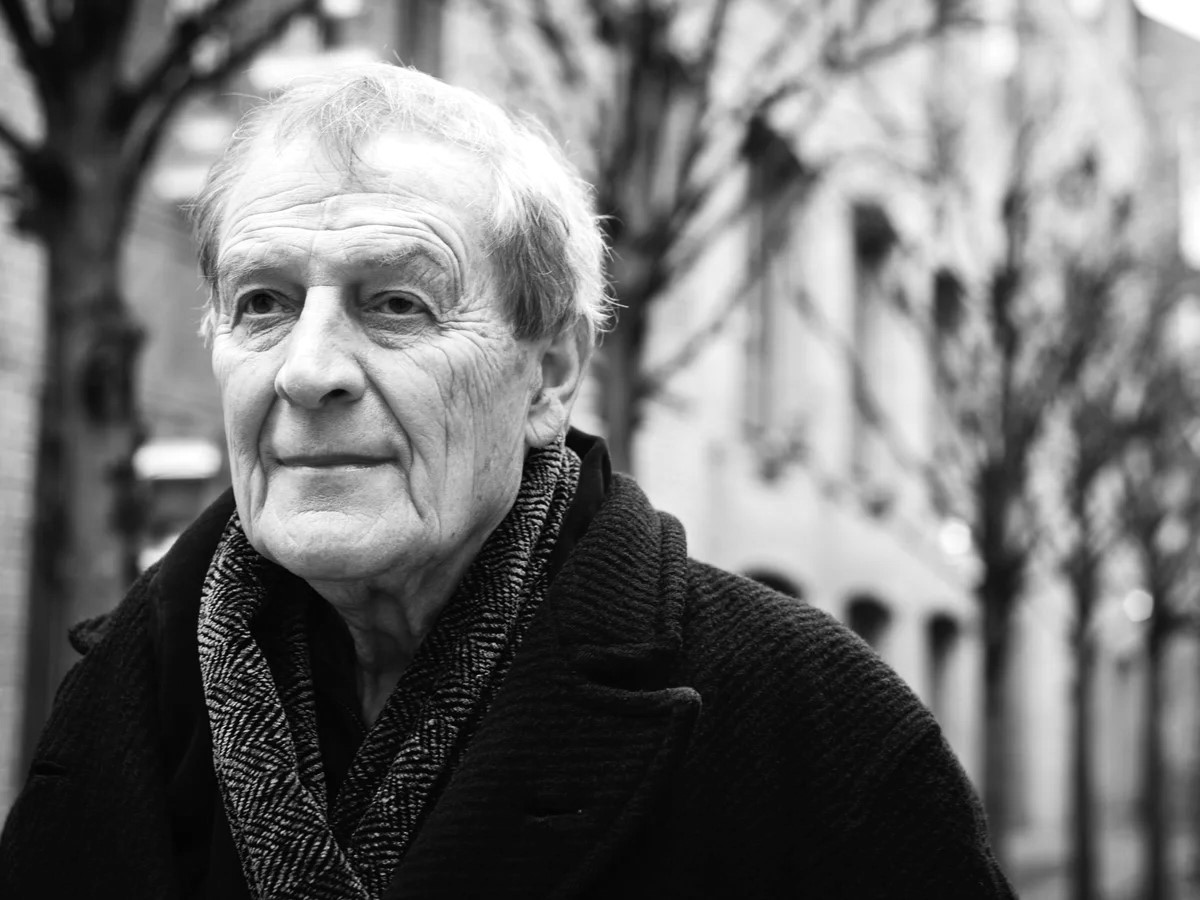
Tony Harrison was a poet, translator, and playwright born in Beeston, Leeds, England, in 1937. He is one of Britain’s most prominent poets, and many of his works have been staged at the Royal National Theatre. Among his most notable and controversial works we can cite the poem “V,” as well as his adaptations of dramatic works: from ancient Greek, such as the tragedies Oresteia and Lysistrata, and Molière’s The Misanthrope. He is also known for his openly held views. In 2015 he was honored with the David Cohen Prize in recognition of his work. In 2016 he received the Feronia Prize in Rome. He published the poetry books The Loiners (1970); From the School of Eloquence and Other Poems (1978); Continuum (50 sonnets of the School of Eloquence and Other Poems) (1981); A Kumquat for John Keats (1981); V (1985); Dramatic Verse, 1973-1985 (1985); The Gorgon’s Look (1992); Black Flowers for the Bride (1993); Hiroshima and Other Films/Poems (1995); The Bright Lights of Sarajevo (1995); Laureate’s Block and Other Occasional Poems (2000); Under the Clock (2005); Selected Poems (2006); Collected Poems (2007); Collected Film Poetry (2007). He died in 2025. We present a selection of his poetic work with translations by Marcelo Bonini.
***
Long Distance II
Although my mother had been dead for two years
father left his slippers warming by the stove,
placed the hot-water bottle on her side of the bed
and still renewed her travel pass
You could not simply pass by. First, you had to phone.
He kept you waiting an hour to give him time
to put away her things and pretend he was alone
as if his living love were a crime.
He could not risk my affection against disbelief
even though if he had heard her key
scrape the rusty lock his sorrow would have ceased.
He knew she had only gone out to buy tea.
I think life ends with death and that’s all there is.
You all haven’t gone shopping, I know; anyway,
in my new black leather planner are her names
and the disconnected number I still call.
***
Marked with D.
When the cold mass of his body went into an oven
that was not like the ones he had tended all his life,
I thought of his cataracts heated by Heaven
and radiant at the sight of his dead wife,
with a light flowing from his mouth to form her name,
“Florence no, Flo neither, but always Florrie.”
I thought of how his cold tongue burst into flames
but only literally, which makes me sad,
sad for him because there is no Heaven to reach.
I get my daily bread direct from the earth,
but he longed to free himself from the speech of mortals,
which bound him, and from his tongue heavy as lead.
The baker that no one will see ascend,
whom England made feel like a dull, impoverished devil,
is now enough smoke to make eyes shed tears
and ash (like flour) for a slice of bread.
***
The Layer of Icing
That they would last only until the next high tide
bothered me, but not him, whose job was to make
sugar laths that the bride would demolish,
with the help of the groom’s warm hand, as they cut the cake.
His rough icing, with grains of sand, guides
my pen as I try to shape memories of him
and his eyes peer beside mine at those high tides
that neither father nor son expected to swim.
His eyes were dry when I, a boy, cried
as the castle we had built all day collapsed and adorned;
a surge swept our wrinkled plaster building.
This memory, like crumbs of cake icing in the throat,
like Blackpool’s sea spray blown by the wind,
fills the flat well of the poem: first
flow, salt, and then, it flows and floods this verse.