
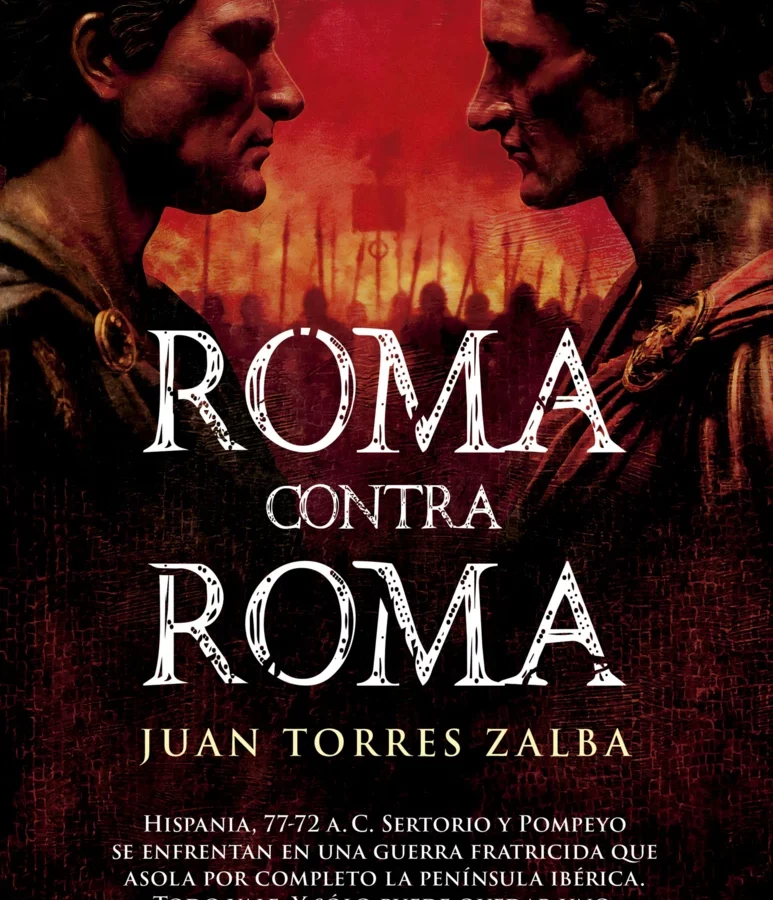
When a writer is born with a talent for storytelling, his strengths tend to reveal themselves from the very first pages. This is the case with Juan Torres Zalba (Pamplona, 1973), a Law graduate from the University of Navarra. A glimpse at his first historical novel, originally published as The Dream of Abisuhnar and now reissued by Planeta’s imprint istoría under the title Roma Against Rome, reveals many of the qualities that would later raise him to prominence in his trilogy devoted to the figures of Publius Cornelius Scipio Africanus the Younger and Numantine, and to their brothers-in-law, the Gracchi—the brothers Tiberius and Gaius Gracchus.
In this first novel you can already recognize the style that Torres Zalba will develop across the nearly three thousand pages of that trilogy:
an agile pace, meticulous recreation of the era, and a plot sustained by a deep knowledge drawn from his study of the Roman world. The author handles the documentation without turning it into a burden. His narrative entertains, it feels light without being superficial, and it achieves something fundamental in historical fiction: that those who enjoy traveling to Antiquity learn while still taking pleasure in the tale.
Torres Zalba debuted with a character named Abisuhnar, a Vascon from the 1st century BCE. And it’s worth noting because, although Roma Against Rome leads us to Sertorius, Pompey, and one of the most brutal civil wars of the Republic, the true heart of the novel is not in Rome. It lies much farther north, in a small settlement in the land of the Vascones and in the dream of a man who senses that his world is beginning to disappear.
It was a time when the land the Romans called Hispania faced the worst possible struggle: a civil war foreign to the native peoples, who ended up becoming involved. Rome carried the confrontation between the senatorial factions to the peninsula. The Optimates and populares turned Hispania into one of the principal battlefields. Sertorius, aligned with the populares and adversary of the regime imposed by Sulla, found in the peninsula a place to continue the fight. Across from him would appear another of the great names of the century: Gnaeus Pompeius Magnus.
One of Torres Zalba’s strengths is not to view that war only from the generals’ camps. He also observes it from below, from the towns that participated in the conflict and had to learn that when two giants decide to fight on your land, remaining neutral can become an impossible luxury. Survival demanded taking a side.
Abisuhnar embodies that perspective. Leader of the Tirsos, “a people documented as having their own mint to strike coins, located, possibly, near Pamplona,” he must choose between preserving the independence and traditions of his people or accepting an alliance with Sertorius. The reason for leaning toward this alliance lies in the fact that Sertorius conveys a new image far from the usual Roman injustice. Some begin to understand that perhaps surviving Rome also requires learning from it. There begins the drama for the protagonist.
His dream is to safeguard something more difficult to defend than the borders of his lands: a way of life. He begins to sense a painful truth: perhaps he can save his people, but not his ancestral world.
From that contradiction the author builds an essential portion of the novel. The alliance with Sertorius can guarantee survival, but every step closer to Rome also opens a door to its customs, laws, techniques, language, and worldview. Rome, when it conquers, does not merely dominate; it replicates. Abisuhnar wants to use Rome without being absorbed by it. The problem is that Rome knows how to conquer not only with its legions but also with that new way of life that follows victory.
While Sertorius and Pompey wage a war of attrition, a spider’s web begins to close around the former—woven with ambition, fatigue, distrust, and betrayals—Rome in its purest form. Pompey will reach lands near the Arga. Traditionally, those campaigns are set against the backdrop of the origin of Pompaelo, today’s Pamplona.
For me, one of the most interesting reflections that Roma Against Rome leaves is that Celts, Iberians, Lusitanians, Vascones and many other peoples could support Sertorius or Pompey, fight against a portion of Rome or alongside the other, but all of them were gradually entering his world. That war accelerated contacts and transformations that would help shape a new reality.
Hispania did not emerge suddenly, nor did its peoples abandon their roots to become Romans. Romanization was a long, uneven, and complex process that transformed languages, cities, laws, customs, beliefs, and ways of understanding life. From that encounter, sometimes violent and other times much less so, a powerful Hispano-Roman society would eventually emerge.
That is precisely what torments Abisuhnar. He wants to bequeath to his descendants the values, freedom, and personality of his people. He chooses to fight alongside Sertorius against Pompey’s Rome in order to preserve his world. But History rarely grants such wishes without exacting a price.
Perhaps that is why I found the original title of this novel so fitting: The Dream of Abisuhnar.
Because behind the Roman grandees, their battles, alliances, and betrayals lies a man who resists accepting that surviving means forgetting.
As long as someone remembers who they were, what they believed, how they lived, and why they fought, that dream will continue to endure.
Because peoples cease to exist definitively not when they lose a war, but when no one remembers that they ever existed.
And perhaps there lies also the merit of Juan Torres Zalba: to make it so that, twenty-one centuries later, the dream of Abisuhnar reminds us of the dreams of so many peoples who fought to preserve their identity while Rome transformed the peninsula and the known world forever.
—————————————
Author: Juan Torres Zalba. Title: Roma Against Rome. Publisher: istoría. Sales: Todos tus libros.