
To commemorate the 90th anniversary of the Civil War, José Ángel Mañas recreates on Zenda, day by day in this section, what happened in 1936, perhaps the most pivotal year in the entire recent history of Spain.
October 22, 1936: The censor of the Republic
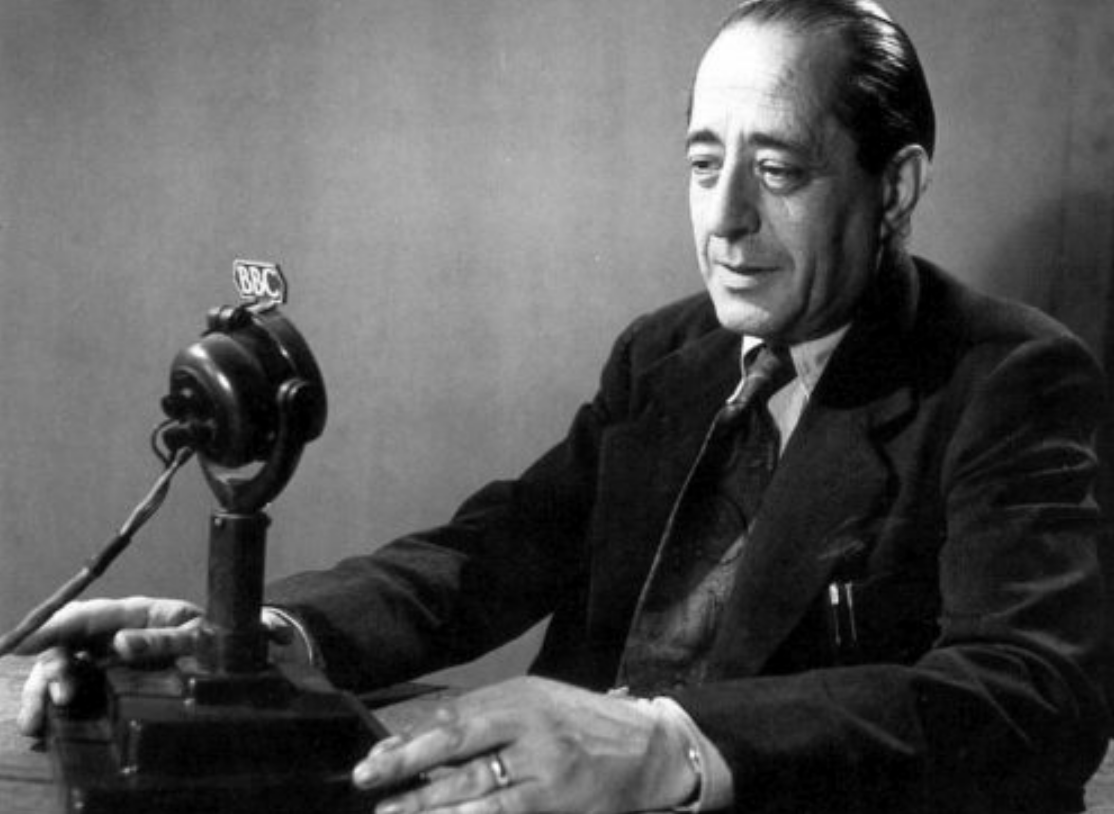
It was one of those rare moments when Arturo Barea could relax. Since he presented himself at the Ministry of War offering his services, and when he learned that speaking English and French could be useful in controlling the press, Barea worked in the Telefónica building as a censor. He worked by day and much of the night. He clashed with the foreign correspondents who did everything possible to place messages, sometimes coded, sometimes simply unreal, but always dangerous for the Republic.
That exhausting work kept him in a state of constant agitation. The calm and assured Don Arturo was today a bundle of nerves.
Barea had decided to stop wearing a jacket and spent his days with his sleeves rolled up, shouting in his office. The only moment he relaxed was that half-hour at the end of the day, when he allowed himself to go down to the Portugese tavern. And there he was, having a glass of wine, when one of the regulars took an interest in his work.
—In the end it is quite simple, mate —Barea turned a tired face—. Journalists can send whatever they want, as long as it is the truth and does not serve as information to the enemy. My function, as censor, is to prevent it. There are things reporters consider irrelevant, mere descriptive details which, however, if transmitted, can be valuable information for the enemy. Therefore, every time the journalist hands me the copy I make sure it is written clearly in his language, with no double meanings or obscure phrases.
»In political news, I check that there is no cipher and that they are not mere rumors, because when a rumor passes censorship it is like giving it official confirmation. Logically, the journalists try to fool me. Everyone thinks they have the right to claim the scoop when it is only an unconfirmed rumor. Others feed me stories coming from coffeehouse conversations or from their own imagination, or invented by individuals they pay to supply information. They also complain because their news is labeled as such, but in my humble opinion I think we have too much leeway for almost everything…
—And what about news that are not about operations or military matters, mate?
—Political news sometimes has military significance. Anything that makes the enemy believe that there are political dissensions or internal discord in Madrid strengthens the rebels. And not to mention when political parties argue about attacking on such-and-such a front… Once the text has been reviewed and approved, there is only to monitor the telephone transmission, cross-checking it with the text itself. And now, salud and the Republic, comrades!, I must return to the task.
All the entries of 1936 day by day
Interview with José Ángel Mañas about 1936 Day by Day