
“No, life doesn’t work like that: life doesn’t need a boss.”
What life, life? My life, your life, our life? No, life on Earth. When the plant neurobiologist and professor at the University of Florence Stefano Mancuso speaks of life he is not referring to human life, but to all life, human and non-human, to what we call animals and to what we call plants. I am fascinated by Mancuso because he has completely assumed, and assumes that we, humans, also assume, that there exists a whole and the human being is only a minimal part of the machinery of this whole. If you do not understand this, reader, you will not be able to understand this book. The Song of the Earth (Galaxia Gutenberg) is the manual of the universe made into poetry and made into science. Because, who said that one and the other do not have to relate?
The title of the book refers to
The Canticle of the Creatures,
by Saint Francis of Assisi, the first poem in the Italian language, which now marks eight hundred years.
This essay is inspired by that beautiful poem which now has greater relevance and need to be proclaimed than ever. Brother Sun, Sister Moon, Brother Wind, Sister Water, Brother Fire, Sister Mother Earth, Sister Bodily Death, each chapter recounts a part of Earth’s ecosystem.
“Be praised, my Lord, through all your creatures,
especially through my lord the Brother Sun,
who is the day, and through whom you give us light.Be praised, my Lord, through Sister Moon and the stars:
in the heavens you formed them clear and precious and beautiful.”
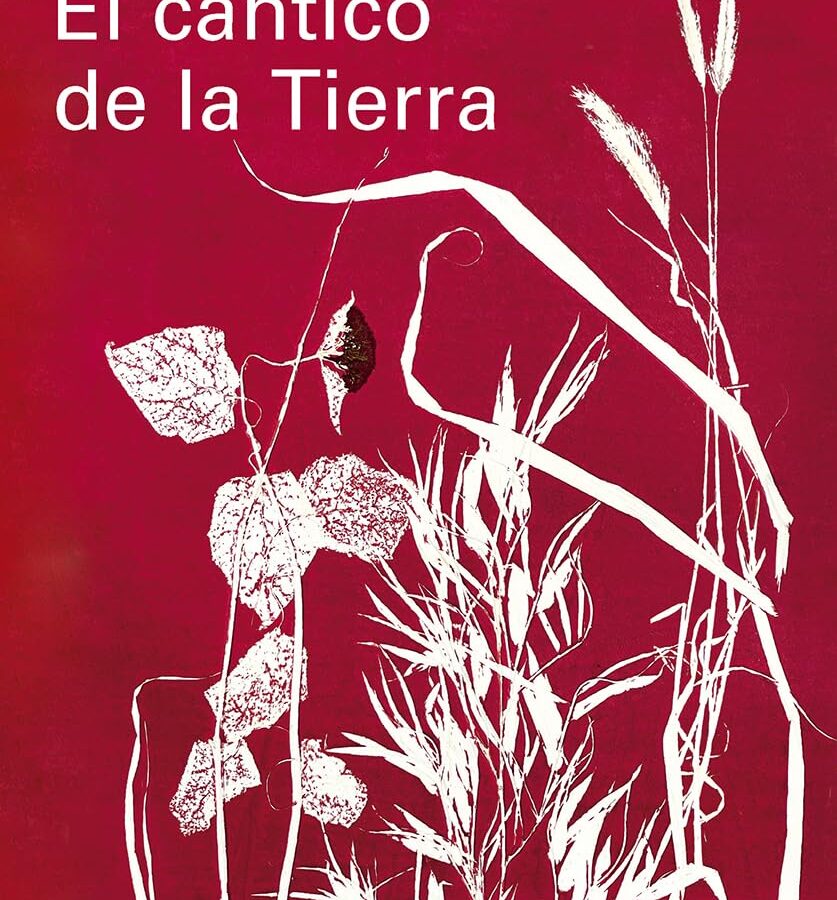
I take the book with me on the trip, with its beautiful illustrations, monotypes signed by the author. The monotype is a printmaking technique that consists of drawing directly on a smooth surface, a crystal or a metal, and whose effect is a drawing with somewhat blurry edges and a texture that resembles plant life. So I carry the travel book as if it had pressed leaves between its words. It turns out I’m going to Rome and near my lodging there is the Capuchin Museum, a branch of the Franciscans. Saint Francis founded the Franciscans in the 13th century, an order that spread rapidly across Europe. Three centuries later the Capuchins were born, with the aim of returning to the radical poverty life of Saint Francis. Mancuso explains well that Francis’s ideal was absolute dispossession. The Franciscans could not even own their sandals. Why? Because everything belongs to everyone. Humans do not own the Earth, nor water, nor wind, nor the Moon. Mancuso values what seems so obvious to us. Let us consider, for example, the soil. The soil, that thin layer of soil that covers the Earth—just 30 centimeters— is one of our most valuable possessions and we are destroying it thoughtlessly and, yet, to obtain 114 millimetres of soil it takes a thousand years. Let us consider, for example, the water that has caused almost two thousand wars in the history of humanity. The data extend throughout the book, while Mancuso’s words order, whisper, sometimes laugh, and always seduce.
The Capuchin Museum is far more chilling than Mancuso’s book. It isn’t that Saint Francis I encounter there is the one who breathes in its pages. In the museum there is a famous crypt full of bones and skulls, artistically arranged by an eccentric monk. But there is also a Franciscan habit, mended, stitched, faded. And that is what most resembles Mancuso’s book. That simplicity, that plainness. Even the humblest part of life on Earth, a cell, for example, has a significant place in the ordering of the universe.
Mancuso unravels in the book the horrors that humans have carried out, but also narrates the life’s vocation for community. He stands against extreme Darwinists, those who believe in the survival of the fittest. He recalls the renowned American researcher Lynn Margulis, who made a crucial discovery: that complex cells emerged thanks to the cooperation between bacteria that integrated into one another. Or as Mancuso puts it: “Life did not conquer the Earth through struggle, but through cooperation.”
I leave the museum and the crypt with the book in my backpack. The last chapter of this essay is titled Our Sister Bodily Death. Perhaps that crypt with its bone sculptures has something to do with that chapter. I sit on the church steps to finish the book. And what happens is that I realize this book has nothing to do with those bones. Because when a living being dies, its components are not displayed, they are reused by other organisms. Displaying bones is not something that nature does. I imagine Saint Francis would not have liked either the museum or the crypt. I imagine Mancuso would not either. Mancuso says that “death is nothing more than a tool that life uses to prosper, not its fiercest antagonist.” He also says that death and community work together in favor of life. And then I understand that life does not need a boss because for millions of years it has sustained itself thanks to the most revolutionary of strategies: cooperation.
—————————————
Author: Stefano Mancuso. Title: The Song of the Earth. Translation: David Paradela López. Publisher: Galaxia Gutenberg. Available at: Todos tus libros.