
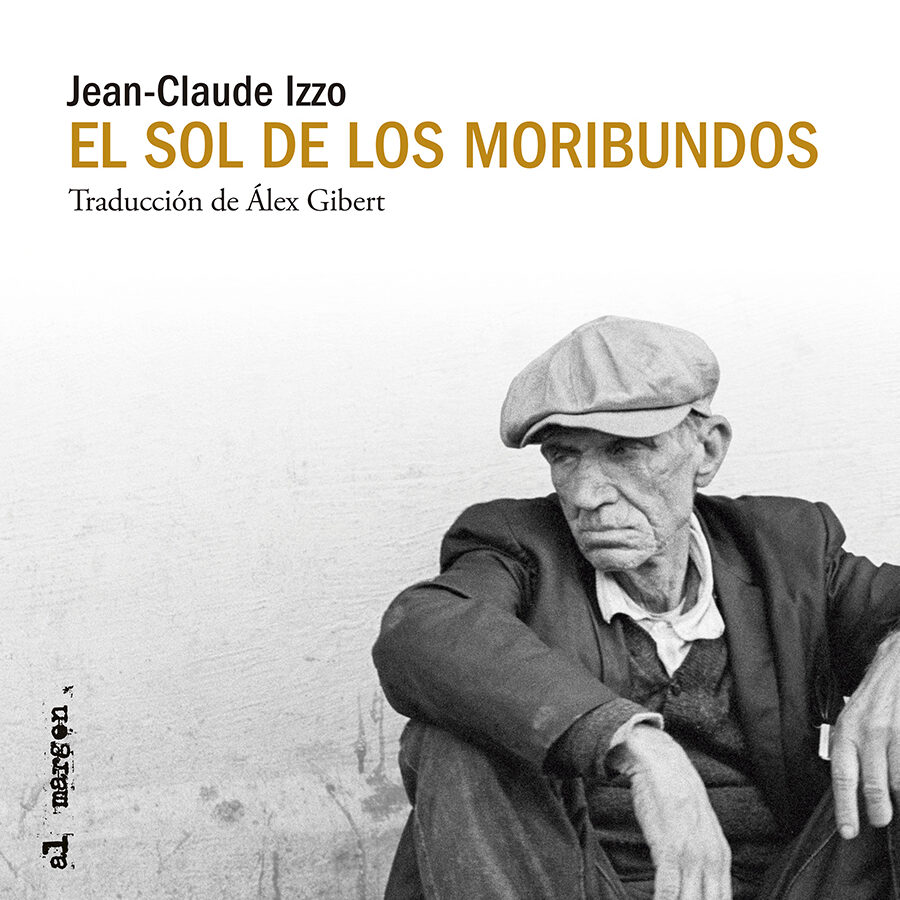
Poverty knows no borders. It matters not whether one camps out on Bowery Street in seventies New York — as photographed in On the Bowery: New York City 1971 by Edward Grazda — or if one battles a Paris winter in the late nineties, the point of departure for the moving novel The Sun of the Moribund by Jean-Claude Izzo (Sajalín Editions, 2026). It was published in French barely five months before Izzo’s death on January 26, 2000, and it marks a departure from his celebrated Marseille-set crime fiction trilogy.
The Sun of the Moribund could be considered among the finest novels about the inner life of the homeless, akin to works such as Ironweed (1983) by William Kennedy; Down and Out in Paris and London (1933) by George Orwell; This Side of the Light (1998) by Colum McCann; or the memorable non-fiction work The Secret of Joe Gould by Joseph Mitchell (1965).
The reader is irresistibly drawn, without escape, by the display of narrative mastery that places us face to face with society’s margins: the smell of cheap liquor, charity diners where sermons must be endured in exchange for a bowl of soup, the humiliations of many kinds and even ferocious beatings among the unhoused themselves to claim a sleeping bag or a comb. Each of the twenty-five chapters bears a suggestive or emotional title, such as “Memories Serve Only to Make You Cry” or “Insignificant Moments, Snatched from Time.”
The plot opens in a cold, hostile Paris. There we meet Rico, the principal character, a man who has already lost almost everything. In the French capital, Rico survives by forming a warm yet tragic trio with Dedé and Tití. The three share street corners, the cold, and the daily hardships of homelessness. Through wandering, a map of Paris’s streets—and later Marseille’s—unfolds. The novel begins with Tití’s death on the icy tiles of the Ménilmontant metro station, the usual meeting place.
Tití is a former teacher who in his younger days read the Beat writers and used to repeat a line from Jack Kerouac: “On the road again and for ever”. After seeing his friend’s body and feeling himself reflected in that fate, Rico sets off toward the south, moved by the nuance of a Charles Aznavour song that says that “misery would be less painful in the sun.” This is not a journey of hope or redemption; it is a move forward, a road trip on the road, since if you’re bound to die, better to do so under the sun.
Rico begins his journey as a stowaway on trains — part of the voyage with Dedé — stopping in several French towns and villages. The author uses time shifts to recount how Rico’s “normal life” once was, the escapades of poverty, and the lives of his fellow homeless as well as his past loves (Léa, Malika, or Julie). As Rico moves south, increasingly weakened by lung disease and alcoholism, his scattered mind returns to the past. Rico was not always a street dweller: he once had a job, a wife named Sophie, a young son he adored, and friends who abandoned him when his fate was cut short.
That is the central thesis the novel states with simplicity and without moralizing: the line between a comfortable life and homelessness is extremely thin: a dismissal, a devastating divorce, the wrong turn into alcohol, and suddenly the family and social network dissolve. As the text notes, love is something that one day simply “takes the door and vanishes,” and after that first door closes, all the others slam shut in sequence.
During his journey, Rico crosses paths with other broken figures who enrich the narrative. In Avignon he meets Mirjana, a Croatian prostitute scarred by the horrors of the Yugoslav wars (her parents were killed in January 1993 in Sarajevo). She takes refuge in the poems of Saint-John Perse to keep alive. Between them a pure affection grows, a genuine companionship that the book defines as “the fraternity that binds the castoffs in their rage and dismay.”
In the second part —the shorter one— the novel shifts its focus and introduces Abdu, a young Algerian without papers who survives in Marseille’s popular Panier district. With Rico’s arrival in the city, the narrator adopts a frank first-person voice. We understand that the narrator who appeared in the first part, like a window to vanish, was Abdu. When he says “when the old ones lock us inside” we understand that Abdu recounts from his own youth to reconstruct the last months of Rico’s life through the eyes of his teenage self, an undocumented Algerian around fifteen years old newly arrived in Marseille. Through the eyes of this immigrant we understand Rico’s inner exile. The novel also returns to the meaning of friendship: in the first part, between Rico and Tití; and in the second part, between Rico and Abdu.
Abdu is a youth trapped in limbo, convinced that he has no future either in France or in his native Algeria, and he clashes with the bureaucratic label some call “the privileged of misfortune.” While Abdu attends a help association, Rico refuses any medical assistance. His body, sustained by painkillers such as Doliprane mixed with wine and beer, seems surrendered to a voluntary blackout. Between them arises a tender father–son bond: Abdu seeks in Rico the father he lost in Algeria —killed by government forces— while they cling to a small teddy bear that they haul in a supermarket cart. The bear is for Rico the bridge to Julien, the son he had with Sophie and who was forbidden to see him once ruin took hold. For Abdu, on the other hand, the bear represents Zineb, his best friend who stayed in Algeria and whom he will never see again.
The climax of the novel occurs when Paris’s past reappears with the unexpected encounter of Rico on a Marseille street with Dedé, closing the circle of that initial trio. His turbulent reappearance drags Rico into life-threatening situations and brings a violent revelation that shatters the memories he kept of his former life and of Sophie. In the midst of this emotional and physical collapse, the music of great French singer‑songwriters fills the pages as a nostalgic soundtrack for the farewell of a Rico sunk in misery.
Jean-Claude Izzo demonstrates here that one does not need a detective plot —as in his celebrated trilogy— to seize the reader and shake them to the point of shedding a tear. The work strikes emotionally. By employing colloquial and direct phrases, in the translation by Álex Gibert, he makes us feel the emotional heft of each character, the chill of Paris, the force of the mistral, or the persistent cough that lingers throughout the book (Rico’s lungs, as well as Izzo’s lungs, entwined as the epicenter of their deaths; fiction and reality). In that final stretch before the sea and under the light of a lighthouse, the fate that Rico sealed the night Tití died in the Paris metro finds its last stage. The Sun of the Moribund is a masterwork of social literature that, far from judging, rescues the dignity of the defeated by presenting their perspective.
—————————————
Author: Jean-Claude Izzo. Title: The Sun of the Moribund. Translation: Álex Gibert. Publisher: Sajalín. Sales: Todos tus libros.