
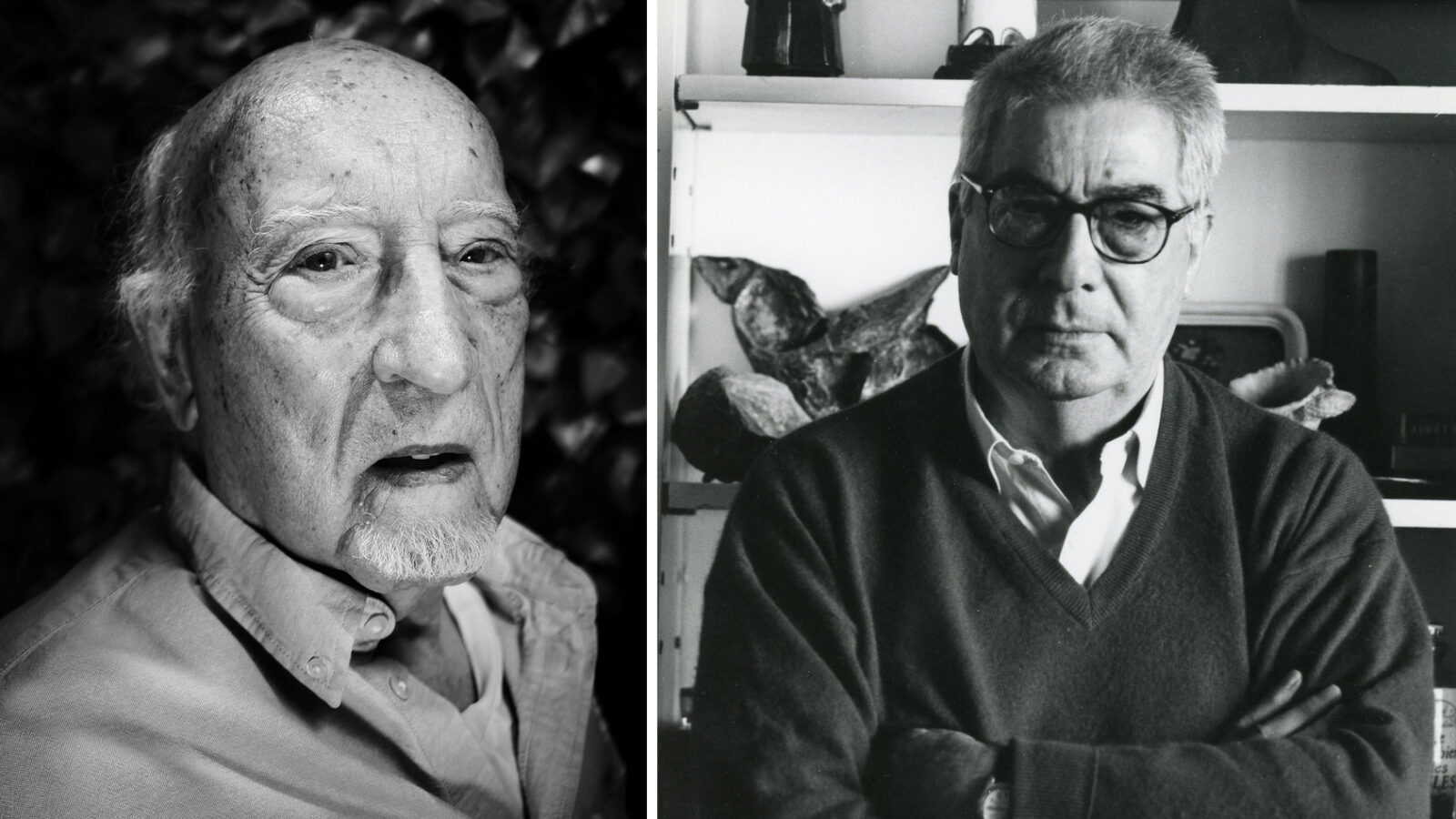
Rafael Azcona, perhaps the most important figure among Spanish filmmakers, and Manuel Vicent, the writer who has done Spanish journalism the best, are celebrating this year with dates of great significance. Azcona would have turned one hundred on October 24. In my rather restless calendar, he remains alive, and every year this date gives me a reminder: pick up the phone and call Rafael… Unforgettable. And this year Manuel Vicent, one of his closest friends, has turned 90 and, in Córdoba, receives the tribute of those of us who continue learning from his wisdom, which we also live thanks to Azcona, that friend.
I wanted you, in reverse alphabetical order, to read with me some of the responses the two friends gave me when, over the years, as a journalist, I asked them about their ways of looking at life.
MANUEL VICENT
The Sea. “There is a teaching. The sea is a moral school. Sail by wind means moving against the wind while feeling part of the wind. Brought into daily life, it is about overcoming adversity by using it to your advantage. And it is a school of morality because it brings down the pompous and arrogant, and it gives the humble or shy an opportunity to become heroes, just as in life. That is the backdrop of navigation. The sea is a challenge for many, a source of pleasure, but at the same time it is a sea full of blood, of wars… Right now one can sail the Mediterranean among the castaways the sea vomits. As a school of morality, the Mediterranean vomits out those who drown because of injustice, but at the same time it receives the ashes of those who die on land, who seek to be renewed through the waters.”
The Search for Happiness. “That is the essence of the Mediterranean. The Parthenon, a mirror of the harmony of beauty, is the product of a dynamite explosion. That marvelous destruction is not solely a product of time, which has also worn the marble down, stripping away the layers of color until the bone remains. It has also been crafted by the wind. The greatest sculptor that exists. Yet it is also the result of human foolishness, human violence. First, the Temple of Athena, then the Christian church (Catalan, by the way), afterward a store of dynamite and, in the end, an explosion. This happens in almost all the temples of Greece because they end up becoming depots for dynamite.”
Corrupt, Arms Traffickers… “But all at the level of a Snoopy T-shirt… All those ideologies, double lives, and corruption, reduce to wearing Mickey Mouse or a Buddhist phrase on the shirt: be happy, think of nothing, the horizon is your gaze… What people communicate on summer T-shirts is ideology. A happiness that is bought and sold, that the sea carries, a beautiful sunrise or sunset bloodied, without being confused by real blood. Or a storm that is good because it is a storm and then done. The answer you give to the storm is the measure you give yourself.”
What would you be as a writer without the sea? “The first bombs of the Civil War fell while I was at sea. I was only months old, of course. I realized I was at sea, but something there seemed determined to prevent me from recovering from that first sight. The sea was always there. It is a natural thing. I discovered it only when I lost it. You discover love when you lose it. Fear of the sea? Yes, very much. The sea humbles the pompous, the frivolous, the arrogant. Yet it gives the humble and the shy a chance to feel like heroes. And it is a school of morality, to sail against the wind by using the old man… A retired sailor from Denia taught me to sail. He told me something almost mystical without realizing it. At first, as a novice, I didn’t understand how, if the wind comes from the front, you must set an angle between the bow and the wind that the great sailors push to 35 degrees. He told me: “When you feel the wind that comes first passes through you and then goes to the sail, at that moment you will know the truth.” It is almost mystical.”
RAFAEL AZCONA
The question that bothered you the most. “What the hell are we doing here? Asking myself what the meaning of life is fills me with a tremendous unease because I don’t know what to answer, and to escape from that unease I resort to very ungainly, even embarrassing, solutions, for I settle with telling myself that the only meaning life has, at least mine, is to wake up in the morning and realize that I’m still alive.”
But there are questions that reality answers. For example, love. “What love? The love based on sex, the love of a neighbor, self-love… What love?”.
The love we first thought was love, a platonic and perfect love… “Yes. Well, you’re right, because you can see what remains of what is known as first love, which is almost always an imagined love. When one is young you want to feel like the protagonist of a novel life — Youth, vanity — Baroja aptly labeled it — and to escape vulgarity the easiest route is to turn a physiological impulse, the urge to reproduce, into a sublime feeling, that platonic love you referred to. When I was young I had the luck to know and to befriend one of the few people I have seen think for himself, Godofredo Bergasa, a family friend. Well: that gentleman, when he learned that I wrote verses because I was in love and not reciprocated, told me: “Don’t worry, that goes away if you go to Paris.” Now I see that he was right, but back then I withheld my greeting.”
A DICTIONARY OF RAFAEL AZCONA’S LIFE
Friendship: “An extremely delicate feeling not to be abused: sooner or later, the best friend in the world tires of lending money. Especially if there is no interest. (A banker).” Cinema: “It’s just a job, mate. (Sterling Hayden).” Frustration. “A mood among the apocalyptic preachers when they warn that their anger only makes them tense. (A nonchalant person).” Patriotism: “I would give anything to know for certain in whose name the deeds that public claims have been done in the name of the homeland have been committed. (G. Ch. Lichtenberg).” Old age: “Old age isn’t so bad when you consider the alternative. (Maurice Chevalier).” Dialogue with Pep Guardiola, footballer. Pep: “Could we start by talking about the Civil War…” Azcona: “For me the postwar ended with the coup—the cut of the State in Spain. It lasted too long; it was horrible.”… Pep: “My grandfather had to hide. My parents speak with fear about all this, and it’s terrible.” Azcona: “I remember that what we’re doing now, here, eating, we should have looked around to see if someone could hear us. But fortunately it’s over. Moving from subject to citizen has been one of the best things of my life.” Pep: “The world remains at war.” Azcona: “Since I can remember I read the papers and there’s always a war on the front page. When one ends, another begins. It must be to spend the bullets.”
When Azcona died, his friend the filmmaker José Luis García Sánchez, who made many films with him, called all his friends, one by one, and told them: “You had a friend named Rafael Azcona.” Today, as I remember him, there are only a few days left until the anniversary of his death, Azcona’s centenary. The annual reminder of his presence has never been erased from my calendar. Such is life, and Azcona was, for this country, for cinema, and for friendship, not only unforgettable but also indispensable.
0/5