
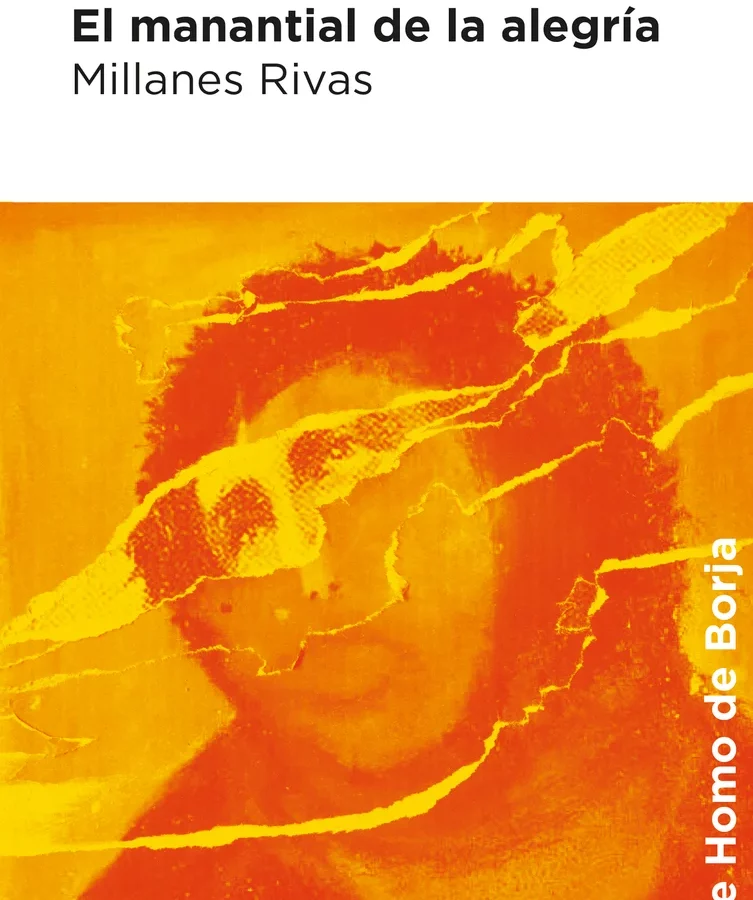
(s.f.) — It was after a meal that I first spoke about the story of the spring. Despite the heat, we decided to eat outside the house; the garden at least cools things down. We set the table up in the shade of a linden tree.
February 21 — The café is full; I found a table by a stroke of luck. Friday afternoon, two men are talking—a older man and a younger one. It is raining outside, but inside the air feels charged, so when I sit I drop my bag, remove my coat and the sweater. As I undress, the young man watches me; I keep eye contact and smile at him. (…)
Paula gave me the idea for the next novel: ECCE HOMO. I went to Madrid and talked about it with Charlie; he advised me not to spend four years writing the novel I had in mind. I went to Madrid for the party of (H)AMOR BI(Y)BOLLO.
March 15, Barcelona T1 — The same waiting seats where we barely slept the night on the way to Paris, while reading Ernaux. Today I brought Ritmo Lento by Martín Gaite. In the same seats where I lay down, a group of Brazilians are playing cards. A stroller carries about half a dozen elderly people through the terminal. On the screens it seems the same advertisements persist. I came to present with Vasallo. I told her about my upcoming book and she encouraged me. I told her that I was frightened of moving away from what is queer, and she told me she was considering something truly queer. I also told Julia; she gave me the idea of recording the whole process to share it when it’s published. To Nico, I did not tell anything.
Holy Saturday — This is the morning I visit Borja. A dark, overcast day, a storm. Thunder and lightning crack the sky. The trip went wonderfully, comfortable, and pleasant with Paula.
May 26 — What ugly days we’ve been having lately! Devoted to drafting calls for proposals: grants, residences, scholarships… in a matter of days the one for Paris, the one for the Ministry, the BBVA, the one for Gijón. All to do what they’re precisely taking away from me: writing. At least — and I feel it now more than ever — in the interior courtyard facing my back room, where I spend so many hours, a family of robins goes about their spring days. Federico and I watch them bustle about.
June 2 — I don’t know how to approach ECCE HOMO. Charlie told me “enjoy it” and I think about that all the time, but I tend to wring my brains and complicate things. I know the facts, the situation, but what do I narrate? A pastiche novel, collage.
June 3 — We’re done. Last video call with Marisa.
June 13 — I HERE DECLARE THAT THE GRANT HAS BEEN AWARDED TO ME, THANK YOU, UNIVERSE.
June 22 — I’m in Bilbao, I HAD TO WRITE IT DOWN.
July 18, 89 years since the uprising — Terrible days at home. Bad news. I quit the job. There is no money.
July 24 — Tomorrow is my last day at work. I’m out of it, penniless. But I will have time to be with people, go to the beach, read Don Quixote, will I write? I MUST WRITE. Reading Javier Marías stimulates me greatly.
July 26 — Here watching the report that La Sexta made about Ecce Homo.
August 6 — All mysteries unfold in this way: a mysterious fact occurs that no one can explain. This mystery can endure for days, weeks, and years. Sometimes the event gives rise to legend, and legend to oblivion.
August 8 — With Jara and Jacobo talking about how beautiful my handwriting is. I write. Paula, Marina, and Nico are making a carrot cake. Julia does yoga.
August 10 — Cecilia contracted the painter’s disease, the love of nature, a well-known malady, and dedicated her life to it thereafter. Despite every misfortune, Cecilia told herself “love of life,” “love of life” with the devotion of either a madwoman or a saint. Footnote citation, ORLANDO p. 134.
August 13 — I take the notebook I have decided to use for writing this book. I have titled The Landscape Painter; I write The Landscape Painter on the cover.
August 19 — It has been impossible to write in my diaries this summer. Let ECCE HOMO serve for it; it’s where I tell it all.
September 7 — The book will begin: “While you have this book in front of you, I am on my way to what they call the spring of joy, and as long as you have the book before you, so shall it be.”
September 11, Borja — Paula takes a shower and I write at the desk in the bedroom; it’s something I practice little but love, writing in hotels like a Hopper character. The bed is in disarray. With the window open, the traffic sounds as loud as when it’s closed; along the hotel’s door a national road passes. My elbow brushes the corner of a book of Goya that I brought. Today we see ECCE HOMO: will Paula cry?
September 12 — Sometimes while traveling in the car I look at the landscape and wonder what the local painters will highlight about it and what those further away will highlight, whether the way Antonio López portrays Madrid is through the proximity and livability of the place — Richard Estes in New York—.
October 8 — Paula and I join forces to push the novel forward. She has prepared an art exhibition, I record it, take notes. What is happening will be the night.
October 28 — I thought the book should begin at the beginning, and that the beginning consisted of explaining what an ecce homo was. Therefore I went to the primary source, the New Testament, which was given to us as children at our first communion. We are talking about a book that is more than twenty years old, kept purely by bibliophilic intention. I read the four Gospels and underlined the phrases that I later copied.
December 13 — I have not died; I am simply working, studying, and writing a novel. It will be called Divine Grace.
January 21 — Jaime had recommended I begin reading Marguerite Duras; he gave me a precious short story, “The Death of the English Young Aviator,” and asked me not to start with The Lover, her most-read book, but I disobeyed. I laid The Lover on the table, a photo-album narrated by its own author.
January 29 — I have a finished novel, but I haven’t informed my editor yet. Late doubts. Paula tells me: “What you wanted was to tell this story, and that is what matters.”
March 16 — I discuss with Charlie the title of the novel: The Spring of Joy or That Man (it sounds like Ecce Homo and Rocío Jurado).
March 30 — Today is my birthday and I went to write at the library. Yesterday, in the car, Paula and I talked about different things — we took the funicular, went up to Bulmes, ate well, detoured to visit an abandoned church, we also stopped at Villa Encarnación (an XXth-century mansion abandoned at the start of the war, used by the Republicans to set up a military hospital and later by the fascists to imprison prisoners of war subjected to forced labor, now a property where ponies graze) — and among these things the new title of the novel: THE SPRING OF JOY. It’s the first time I write it. I told myself that naming it so when my first novel is called THE SORROW is too repetitive, a writing of emotions. Paula asked me, “Can one write about something that isn’t emotions?” At that moment it was sunny, but it also rained and snowed; it was very cold. Hours later I answered with another question: “Can one write about something that isn’t meteorological phenomena?”
May 4 — Sometimes people don’t take me seriously when I tell them this. Then I look at my novel as if it were the Ecce Homo, with affection and condescension.
May 24 — Taking the notebooks out of the beach bag, they still carried sand. I have a cold coffee on the table, SUMMER WINE playing, the cat on the rug. Marta invited us to spend the weekend at her parents’ house. (…) We decided to drive to the lighthouse. Marta told us that her grandfather used to fish on a great rock nearby, but one day a helicopter came and took it away; it was the fossilized trace of a dinosaur. That story reminded me of theEcce Homo scene, at the beginning of LA DOLCE VITA. Up there on the garo, the three approached the wooden fence; on it a sign read “Danger of Collapse” and another with a photo of a girl and a bouquet: “Heaven is worth life” or something like that.
June 8 — At the Circulo de Bellas Artes, waiting for Manuel Guedán to arrive. The ceiling painting, the heavy wooden tables and chairs, the foreigners and retirees. The painting seems to belong to that Canarian painter, the scene of the Fire Cart or the Sun God. They bring me coffee and the bill (2.70€); I’m nervous. I slept last night imagining the bad idea that the novel was rejected. Charlie told me: “It’s not possible; it’s the best thing you’ve written.” A large crystal chandelier hangs from the ceiling, white but it reminds me of Ai Weiwei’s work. In the center of the aquarium, the café’s name, a sculpture: a woman who defines herself, escapes from the stone, the (illegible). I like it as a metaphor for a novel. Seen from the storefront, you can glimpse the traffic and the Papal visit routes, ribbons in the outer parterres. Every time the door rings, a jolt: a man who is not him.
—————————————
Author: Millanes Rivas. Title: The Spring of Joy. Publisher: Lengua de Trapo. Sale: Todostuslibros.