
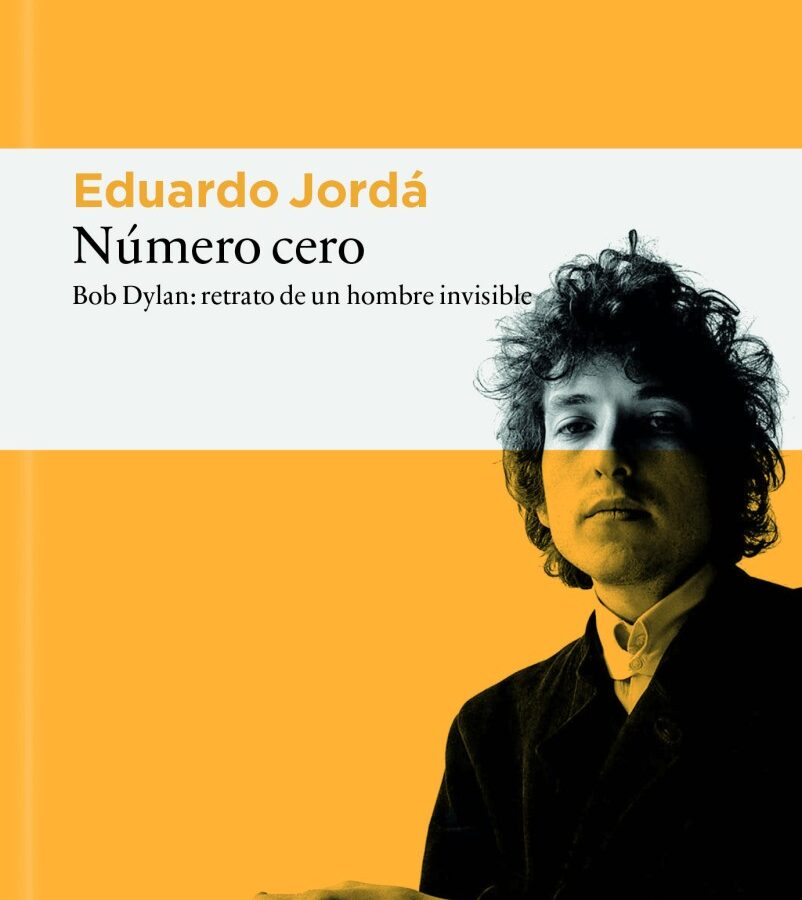
The closing note of this kind of elusive biography about the elusive Bob Dylan takes advantage of the privileged space of the paratext to drop one final clue into the investigations that Eduardo Jordá undertakes in Number Zero concerning the Bard of Duluth, born Robert Allen Zimmerman (Minnesota, 1941): “But if the arrow is straight / and the point is sharp / it can pierce through dust no matter how thick. / So I’ll stand my ground / and remain as I am. / And bid farewell and not give a damn.” (“But if the arrow is straight / And the point is slick / It can pierce through dust no matter how thick / So I’ll make my stand / And remain as I am / And bid farewell and not give a damn”). “I’ll continue to be who I am.” So many things has our invisible man been that there is barely room left for conjecture. And yet, when it seemed that everything had been said, Eduardo Jordá arrives and lends his own Sisyphus-like stone to the sprawling bibliography on the eccentric and fleeting Nobel who managed to provoke Philip Roth to tear at his hair with the disheartening fury of those who have already given everything up as lost, which in the end is how things turned out.
Who has he been, and who remains Bob Dylan? Who is he to himself? And, most unsettling, who is he to us? A buffoon, a preacher, a hustler, a thief, a protest-singing vocalist, a hermit of the woods, a bluesman reborn from his ashes, an angry psychedelic, a conceited despot who manages silences in interviews with the arrogance of the anointed, the poet of a revolution still in progress, the country singer who venerates the papacy, or the artist who makes legends of the Phoenix and Rimbaud look ridiculous together. Isn’t that—and something more—the inexpressible essence of any genius worthy of the name? Dylan’s career closely resembles that ironic Monterroso-like fable in which the vicissitudes of a “chameleon who ultimately didn’t know what color to wear” are recounted. Mysterious as any self-respecting chameleon, ungainly in motion, with a quick tongue and, of course, versatile in disguise, Bob Dylan has been playing at misdirection long before signing the lyrics of the song (“Restless Farewell,” 1964), a concoction refined from many sources—including the Irish-Scottish rooted folk song “The Parting Glass”— that appears on his influential album The Times They Are a-Changin’. If we are to recall cases of fictional camouflages, his polyhedral mutations are not far from Woody Allen’s Zelig (1983). His songs are those same ones, always the same, always different.
Eduardo Jordá (Palma de Mallorca, 1956), a Dylanist, a Dylanian and a confessed Dylanophile, succeeds in weaving a piece that blends the wisdom accumulated through years of listening with biographical investigations, which can be counted by the thousands when it comes to portraying this invisible man. The Mallorcan writer, who had already approached the figure of other musicians such as Van Morrison, Hank Williams or Nick Drake, travels this time to the core of Bob Dylan with the weapons of poetry, that is, seeking the best words in the best possible order. And he finds the image of the zero: the totality and the nothing, what cannot be counted but with which everything counts. The zero as the total energy of the universe and as the universal content contained within a vertical ellipse that leads to the very center of the enigma. Dylan is the all-powerful one who sheds light on the poem God Made (2001) by the same Jordá: without him, without God, without Dylan, “to anyone you could give thanks, / and to no one could you curse.”
Number Zero is not a conventional biography; it is a stylistic exercise, insofar as style resides in the man who tries to seize the myth. He fully understands the difficulty involved in going in search of the singer — many others before him tried — and knows that others knew before him. The anecdotal is infinite. But Jordá does something better than feeding the bibliographic beast with data cascading down. He teams up with anaphora, with pure metaphor to give real substance to the inexpressible of the perpetual enigma around which Dylan himself has fed his biography. Look, look and never stop looking. Only in that way, perhaps, as Jordá imagines, might one say something that comes close to the man who oozes beneath the skin of the artist who flows. “Kid, you’re moving too fast,” quipped the kind Sonny Boy Williamson to the accelerated Bobby Zimmerman back in 1961, when he was already known by the nickname Bob Dylan and was letting that walking jukebox roll that has never ceased to accompany him as a perpetual musical thread to unleash his artistic creation. For what he achieved they awarded him the Nobel, and Philip Roth still writhes in his grave. Yet the creator of Portnoy’s Lament knew deep down that this time the Swedish Academy had hit the mark.
Eduardo Jordá seeks the mystery and finds a formula to capture some of the Dylan-esque essence, knowing that what remains after the chase is more than smoke. When the dozen brief chapters of his treatise fade, a fragrance persists. The fragrance of good literature. The one of Bob Dylan. The one of Eduardo Jordá. A damn envy.
—————————————
Author: Eduardo Jordá. Title: Number Zero. Bob Dylan: Portrait of an Invisible Man. Publisher: Libros del Asteroide. For sale: Todos tus libros.