
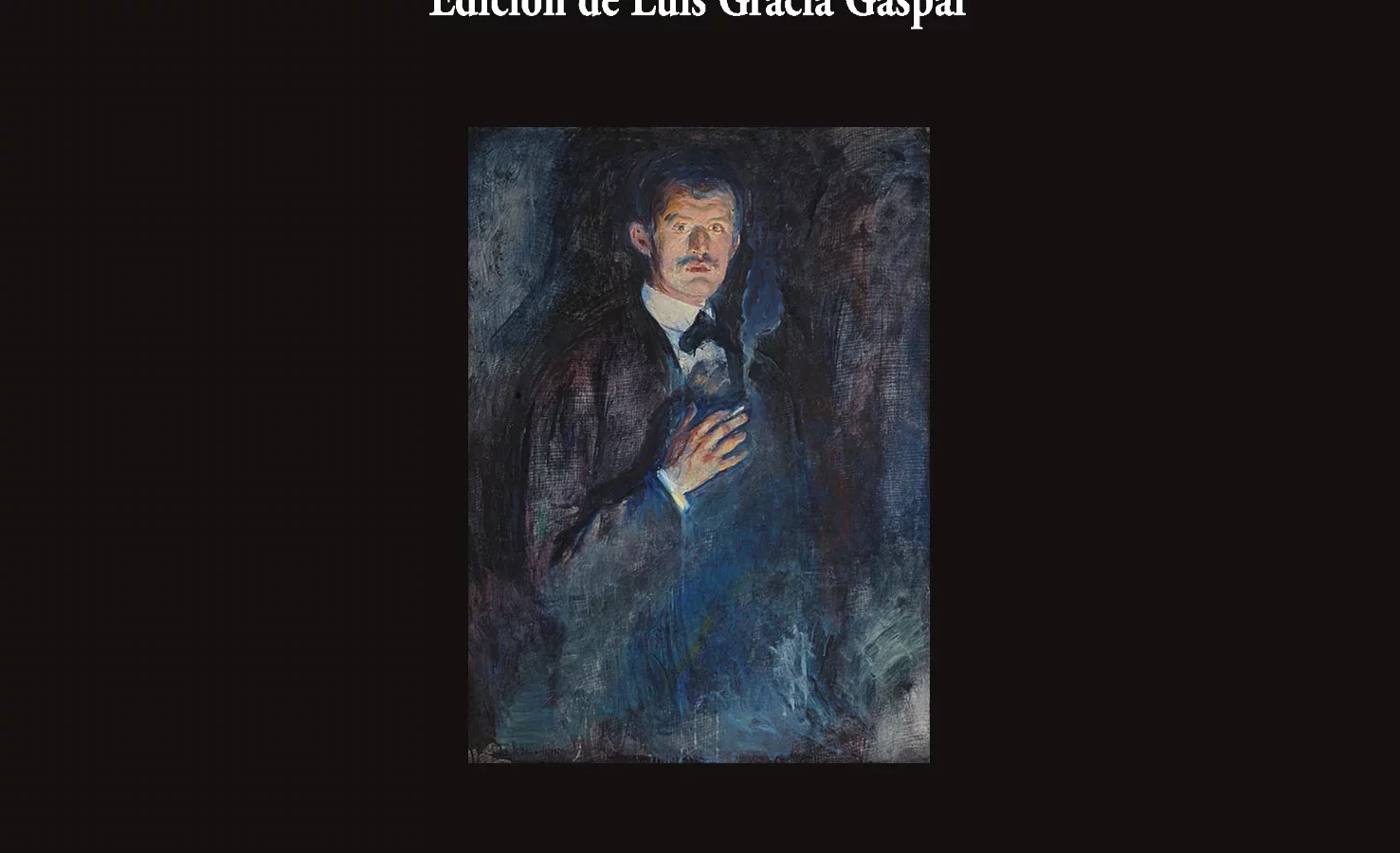
The title Me he fumado la vida that Luis Gracia Gaspar has placed at the head of the anthology coincides with the title of a Guinda poem from the early nineties whose subject refers to the galloping physical deterioration of a man given to turbulent excesses that wore down his health in a palpable way and that hastened the declines inherent in the passage of time, which at that moment took place in a large metropolitan city, let us say Madrid, where the poet had moved from his Zaragoza-born origin in 1987. When a self-presentation like this is attributed to someone who decisively chose to favor the margins of the literary system, the verdict that may emerge at first is that of malditismo. The poet Ángel Crespo, recalling the epithet poeta maldito associated with Charles Baudelaire, did not hesitate to apply it to the Aragonese writer as well in an article published in 1984 in a Brazilian magazine with the title
“Ángel Guinda, poeta maldito”.
The maldito label was adopted by other critics, including the poet and novelist Manuel Rico, who would add to that profile the label of a lateral poet and the empathetic complicity of identifying him also as “a rare bird in the universe of the rare.” In contrast, Ángel Guinda himself came to mock the tag that Ángel Crespo had given him. He did so in his book Breviario, published in 1992 with the paradoxical subtitle “Máximas mínimas,” where he seems to acknowledge that Crespo’s label with an antithetical and ambiguous onomasiological play: “No soy un ángel malo, sino un diablo bueno”. Those words aligned with his progressive distancing from performances and from writing guidelines biased toward malditismo.
In the preliminaries of Me he fumado la vida the professor Luis Gracia Gaspar, to whom we owe the 2024 monograph Diálogos entre Ángeles: El epistolario inédito entre Ángel Crespo y Ángel Guinda, contributes more elements to the human and poetic Guindan profiles, both aspects interwoven, given the habitual interchange produced between the life and poetry of the author. By emphasizing the personal, the analyst underscores his indomitable nature, his rebelliousness, his iconoclastic bent, his misanthropic attitudes well aware of being so, his willingness to situate himself on the margins, contributing without any regret to his relegation. By focusing on his literary work, he highlights a contracultural, anti-establishment impulse that manifests in it against the dominant aesthetics and its underlying existentialism. And one could add his imitation of metrically established forms as canonical as the sonnet; his experimentation with poetic configurations such as the micropoem and the prose poem. Also modes of language that are very direct, among which colloquial and pithy styles carry particular weight.
Ángel Guinda’s work features a singular and constant poetic dialogue with death, tinted with black humor and poetized from the atypical perspective of self-accusation for having died his mother while she was giving birth. Reading the anthology Me he fumado la vida makes all those factors evident: the enduring metaphysical concern with the physical and psychic effects of the passage of time, verses of a solidaristic nature, and even hints of Christian religious belief; but proper emphasis must be placed on his love poetry, evidenced in installments such as 2008 Toda la luz del mundo, 2013 Materia del amor, and the 2022 anthology El arrojo de vivir.
The disruptive character of Ángel Guinda’s poetics did not lead him to look down on the most consecrated literary tradition; quite the opposite: he assimilated it in his own way through a distinctive seal sprinkled with strangenesses of various kinds. Literary stimuli come from far away and reach back to those received from authors of the past century. For example, the recontextualization of secular metaphors with such pedigree as life imagined as shipwreck, more precisely a mental shipwreck, or daily living as a swig, metaphors that imply self-referential ironic nods, just as the genuine image of the box, so illustrative of his vision of the world and of his own disarray in it, as we read at the end of the text “Box”: “Everything is made for us to fit in. / Life fits us. / Some of us do not fit, and we become disjointed.” (103).
Turning to some concrete poets who inspired Ángel Guinda, I will refer only to those pointed to by certain pieces in the anthology. In the lyric of a declared antimystic, perhaps the most, I see echoes of resolute classics such as Saint John of the Cross. For example in “Adamar,” a text from the emblematic book Vida ávida. This piece brings us to the Cantic Spiritual in its contraforte of multiplied human love tested by flight and absence. Another golden classic, Francisco de Quevedo, is also present, and how, at the core of Guinda’s poetic work. I deduce this from his allusion to living focused as an inexorable succession of daily deaths; from the recognition of the damage inflicted on oneself in the poem “Del natural,” where the assertion “I have always been my own greatest danger” may lead us to those metaphysical Quevedian verses that say “And while with my weapons I consume myself, / less does the body shelter me than bury me”; and from the ontological question posed in “Pregúntate” when he tells us “Ask yourself what you were before what you were,” which guides us back to Quevedo’s ascetic La cuna y la sepultura.
If we move even closer in time, and without entering into consideration of more poets, be they Spanish or foreign, we will find in his verses possible echoes of Gustavo Adolfo Bécquer and Juan Ramón Jiménez, but in the poem “Tronco” very evident influences from César Vallejo and Rafael Alberti. And even more recently the influence of two Catalan poets: the first in his native language, the Lleidan Joan Vinyoli, and the Barcelona-based mid-century group poet Jaime Gil de Biedma, whose reading of life and of poetic activity Ángel Guinda advocated.
I end by reproducing a metaphysical Guinda poem of unsettling finality and great depth. Its verses convey a serene, meditative pathos, as well as an undeniable conceptual and expressive force. Its title is “The Disappearances” and it appears in the group of the anthology labeled “The Dazzlements followed by Recapitulaciones (2015-2020)”. It goes as follows:
Life is ours.
We belong to death.
(When the moon goes away like a blot
the sun spreads like a broken egg).
To each one silence will fall,
oblivion will sweep over each one.
Will everything that has appeared disappear?
That is how it was, that is how it is, that is how it will be. (157).
—————————————
Author: Ángel Guinda. Title: Me he fumado la vida: Poetic Anthology. Publisher: Visor Libros. Available from: Todos tus libros.