
In this work
Tijan Sila
(born 1981) recounts the course of his childhood (with slight modifications) during the siege of Sarajevo (1992-1996, and thus joins the line of writers who have narrated recent historical traumas from the child’s point of view. In 2024 the Tusquets Editores prize was awarded to
La casa limón
, by Corina Oproae, which narrated the years following the collapse of Ceaușescu’s regime from a girl’s perspective. The following year
La voz de Hind Rajab
(directed by Kaouther Ben Hania) received prestigious accolades at the Venice and San Sebastián Film Festivals, as well as nominations for the Oscars, the BAFTAs and the Golden Globes, among others. In recent years, the child ceases to be the object of war drama and becomes its subject, a narrating voice.
Tijan Sila recounts the ups and downs of survival within a university-educated family rooted in 1990s Sarajevo. Unconventional in their upbringing and in their incapacity for violence, Tijan’s parents will strive to endure an increasingly hostile neighborhood and to break free from the siege. Candor in this scenario exacts a high price. The outbreak of war entails an unstoppable degradation of ordinary life, where the conquest of the everyday becomes a heroic quest. The author invites us to inhale the scents of horror: nitrocellulose, shampoo, rot. He also reveals his language, using abundant colloquial expressions drawn from the melting pot of cultures crowding the Balkans. Yet differences, loves, classes, or old resentments matter little when one is trying to obtain a sack of firewood at minus twenty degrees. The author offers a common, popular, and ordinary representation of war. It is not a heroic narrative, but real.
The novel explores the corrosion of human bonds in wartime from the child’s gaze. The heroes and role models are nothing more than thieves. The family, an institution organized in functional terms, ends up pierced by quarrels and constant conflicts. Initial neighborly collaboration becomes progressively clouded by hostility. Friendship, too, is subjected to the dictates of the most extreme brutality. The creation of the child-monster is, without a doubt, one of the book’s principal preoccupations.
In Radio Sarajevo childhood is resistance. At first, Sila continues playing with the friends he still has, those who have not yet fled without warning (these, no matter how many years pass, do not seem to shed the stain of the traitor). In the midst of bombardment, dodging sniper nests and trying to forget the images of the first dead, Tijan works to find batteries for his radio. Yet international music soon makes way for patriotic songs and frontline news. Children’s games are replaced by hustling, violence, and death.
Alongside the children, women stand among those who suffer the war’s consequences most intensely. The forms of violence inflicted upon them are constant and tolerated, both within the conflict (given the use of sexual violence as a weapon of war) and in the rear areas, since violence against women and girls is a lucrative business in which both warlords and soldiers (including blue helmets) participate. Violence against women and children is a constant means of retribution. As the work reflects: “To be irascible and cowardly at once is a fate,” so these ways of inflicting harm are the manifestation of a chain of submission. The mother of Tijan, however, stands as a symbol of the strength of women in times of conflict. Completing her doctoral thesis in the middle of the siege, she secures food, confronts her neighbors, and makes pivotal decisions for the family’s survival. A woman who must have been extraordinary, and whom the novel portrays with the following line: “Neither communism nor Bosniak-Ottoman culture had provided a place for a woman who tells men: ‘Shut up. I studied and you did not. You have nothing to tell me!’”
Far from the spectacular, Radio Sarajevo recalls again Gervasio Sánchez’s photograph, Several children playing among destroyed cars and vans, taken in 1993. The power of both portraits lies in their coexistence of the horrific and the everyday, in the persistence of life where everything seems set to annihilate it. The portrait of the war’s customs exacts a high price from its inhabitants: surviving requires learning the codes of violence, becoming familiar with death, making sound decisions, and a bit of luck. Therefore, its reach is not exhausted by the eruption of violence nor by the historical duration of the siege. This work recovers the most common facet of the conflict, the telling of its particular everyday life, and, therefore, pursues its characters because, as the author reflects, war never leaves one.
—————————————
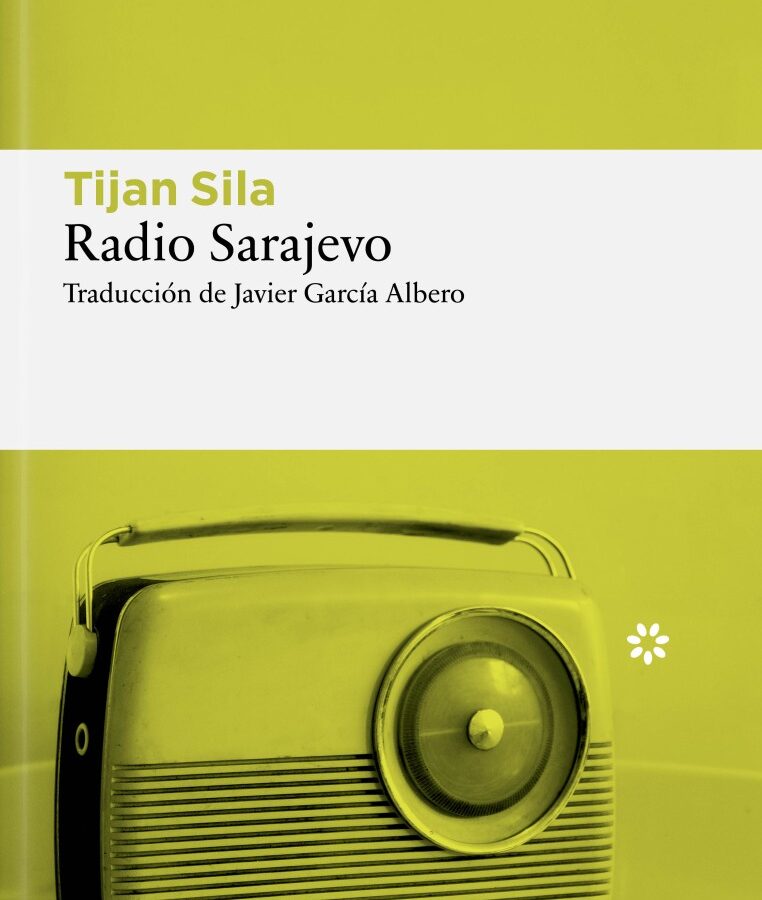
Author: Tijan Sila. Title: Radio Sarajevo.Translation: Javier García Albero. Publisher: Libros del Asteroide. Retail: All Your Books.