
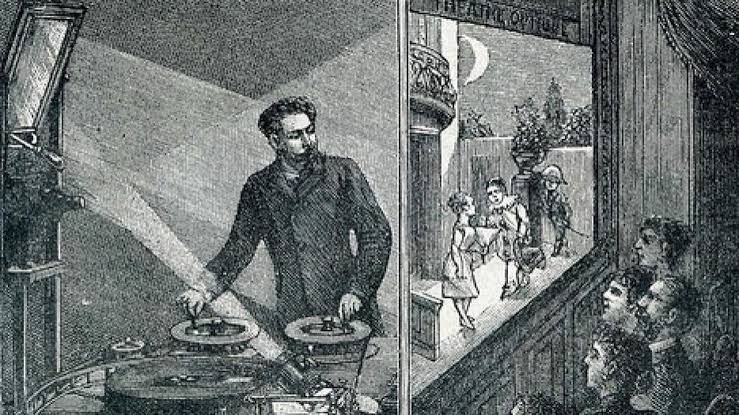
We could go back to the Chinese shadow puppetry, which entertained the evenings at the eastern center of the Silk Road during the Han dynasty, two centuries before our era. Going even further, we could reach those cave paintings in which sequences of figures appear in different poses, as if they were telling a story or showing movement. A complete precursor of comics and cinema. In a sense, they are forerunners of both the comic strip and the shot. Because, since the night of time, humanity has had the need to tell stories in sequence.
Now then, if the prehistory of cinema is born with the magic lantern (seventeenth century), one could say that its golden age — just as the Metal Ages were to the Prehistory of humanity — was
the Era of Optical Toys.
In keeping with that ancient longing of our species to tell stories in sequence, and taking advantage of the eye’s ability to retain an image for a fraction of a second after it disappears, as well as that brain mechanism that provides the illusion of movement when the sequence of still images is fast enough — twenty-four per second, not to mention — optical toys animated the nineteenth-century drawing rooms with inventions such as the phénakistoscope, the zoetrope, and the praxinoscope.
At this point it is worth mentioning Émile Reynaud, inventor of the praxinoscope. Of the many unfortunate fates that mark the dawns of cinema, his stands among the saddest. Although based on the zoetrope, his creation was one of those inventions, enthusiastically applauded by nineteenth-century enthusiasts, so closely tied to the beginnings of animated cinema that both those endearing Animated Fantasies of Yesterday and Today, unforgettable production by Leon Schlesinger which Warner distributed between 1931 and 1969, for the delight of children of all Western generations, as well as the Polish Loving Vincent (DK Welchman, Hugh Welchman, 2017), a feature-length animation made entirely with oil paintings, the technique most used by Van Gogh, the Vincent to whom this masterwork of adult animation pays tribute.
The great finding of Reynaud consisted in the replacement of the obturator by a polygonal drum covered with mirrors that was observed from a raised plane. Unlike the obturator, which could block up to nine parts of the light reaching the viewer, the mirrors of the praxinoscope offered a series of reflections without losing a single bit of light. It was thus that, in nineteenth-century evenings, lovers of optical illusions believed they were watching a child having breakfast, a monkey playing the cello, and a tightrope walker moving along the rope across the different strips of images that Reynaud himself created.
But the final fortune of this pioneer—the manifestation that would become the most important cultural phenomenon of the twentieth century, I repeat—was not what one might have expected from his early applause. Gifted with a great inventiveness since childhood, he patented the praxinoscope in 1877, when he was thirty-three years old. From the very beginning, his ingenuity enjoyed great success as a toy. So much so that in 1879 he opened the Praxinoscope-Theatre, where his animations evolved on a stage.
In 1892 he had refined his invention to the point that it was sought after by the Grévin wax museum, a venue given to the arts of darkness that a few years later would host Méliès’ first projections. In that hall, on October 28, 1892 —today a hundred and thirty-four years ago— Reynaud carried out the first exhibition of his Luminescent Pantomimes. The program consisted of three pieces. The first dated back to 1888. Under the title A Good Bock, it was a vaudeville about a man sitting in a café whose drink is stolen from him again and again as he quarrels with passersby; Clown and His Dogs dated from 1890 and was a charming farce about a clown with his dogs; and Poor Pierrot, the last and most recent of those three delights, was a variation of the classic Harlequin, Colombina, and Pierrot theme from 1891.
This same program remained at the Grévin until 1894. Although the two years of showings certify his success, Reynaud was aware that he would have to create new pieces for the spectacle to continue. In the end, like all creators of shadow arts, his inventions could only offer a single action, but if anything, Reynaud’s work for his brief pantomimes was more laborious than that of his predecessors. Each of his little fictions required a minimum of seven hundred drawings, and all of them were made by hand by Reynaud himself. Relegating his work to collaborators would have been as dangerous as handing over the operation of his invention to strangers. Everything was too delicate to be managed by outsiders.
Although he continued to draw the pictures for two new tales while giving twelve daily performances of the already known seven seven days a week at the Grévin, his luck was sealed. On December 28, 1895, the Lumière brothers presented cinema, as we know it today, in the Indian Salon of the Grand Café on 14 Boulevard des Capucines in Paris. And as is well known, that was the inaugural session of what would become the most important cultural manifestation of the twentieth century. “Life has been captured — the press proclaims —. The world moves before a white canvas”.
With his contract at the Grévin expired at the turn of the century, Reynaud, who had offered in the eight years he was on display some 12,000 showings of his pantomimes, had not become wealthy. After spending the little money he had won on fruitless new experiments, he despaired. Driven mad by the pain of seeing his work and his efforts displaced, he destroyed the filigrees of his optical theatre before selling them as scrap. Thousands of drawings that made up his pantomimes were thrown into the Seine. He died in absolute poverty, alienated, confined in an asylum in 1918. That same year, History was being written on the other side of the Atlantic: David W. Griffith premiered Hearts of the World and slapstick took the stage by storm.