
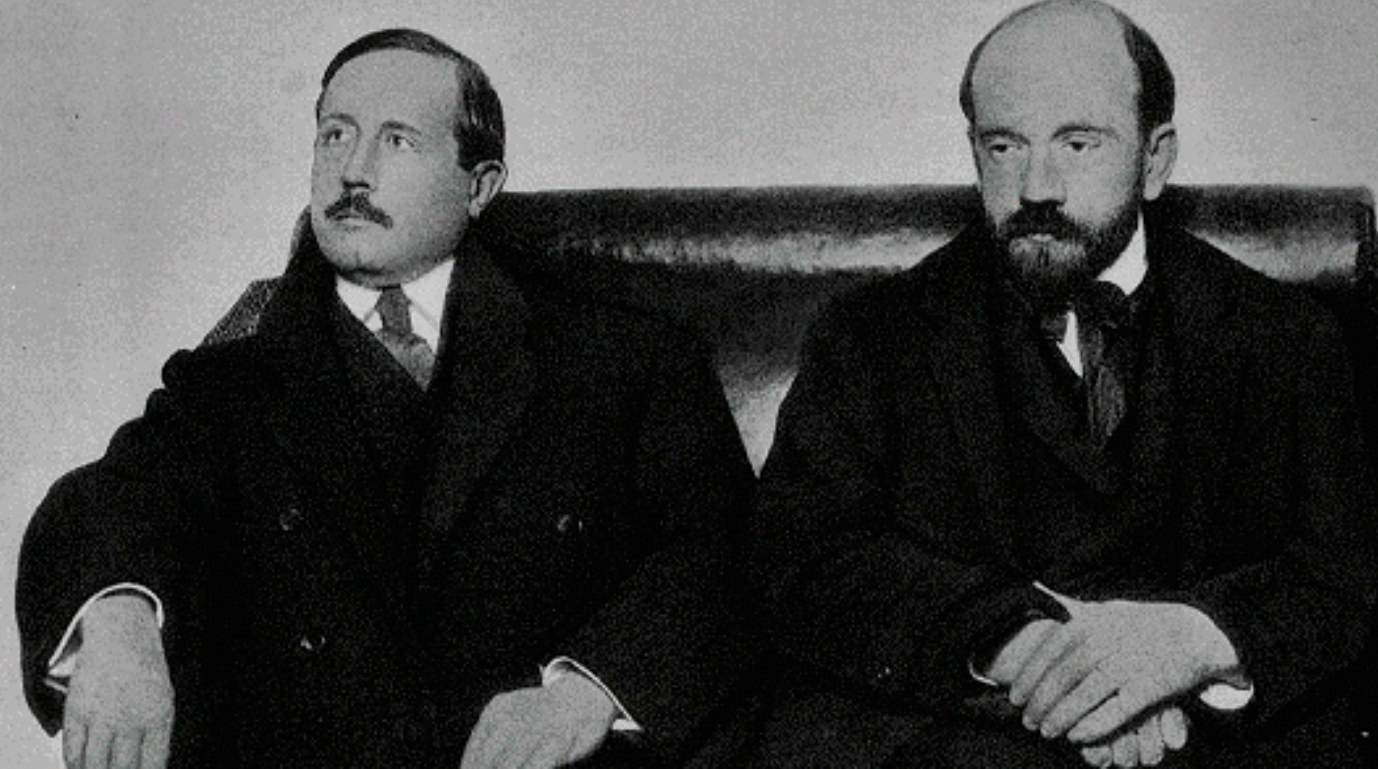
To commemorate the 90th anniversary of the Civil War, José Ángel Mañas recreates in Zenda, day by day in this section, what happened in 1936, perhaps the most pivotal year in all of Spain’s recent history.
Thursday, October 29, 1936: The Spanish College in Paris
What a pleasure to find you here, in Paris. How are you, don Pío?
—¿And you, Azorín?
—Long time no see. It is lamentable to have to meet in this Spanish College, among so many exiles, under such deplorable circumstances…
—You don’t know the half of it. I can see you’re not staying here. Are you merely passing through?
—I came to greet an old friend, don Pío. Would you like us to stroll along the banks of the Seine, or would you prefer we sit in a café?
—I’d rather walk. I miss the walks we used to take in the Madrid of the early century. The world has changed a great deal. But I’m curious, Azorín, where are you staying?
—I arrived with my wife, Julia. We are temporarily lodged at the Terminus Hotel, right beside the Orsay station.
—Nice place. May I ask what your itinerary has been?
—Not as eventful as yours, from what my fellow residents tell me, but I would not say it has been pleasant either. I was fortunate that our mutual acquaintance, the bookseller Noguelores, interceded with the Minister of State, Álvarez del Vayo…
—Curious recommendation.
—Álvarez del Vayo remembers the time, in 1934, when Unamuno, Valle, and I demonstrated, saving twenty prisoners from the death penalty in Oviedo. In February, I had expressed my adhesion to the Manifesto of the Universal Union for Peace promoted, among others, by him. That, and a certain benevolence from the Government toward intellectuals, has allowed my exit…
—And where did you come from?
—I left Madrid for Valencia. From there I took another train to Barcelona.
—Didn’t you encounter trouble at the border?
—Some. I was detained by members of the FAI, but I carried certain letters I had kept from Blasco Ibáñez. On seeing them, they let me proceed. They wished me a good journey. Poor Blasco. Ten years underground, but the thaumaturgy he practiced in his youth, extended from beyond the grave, has saved my life. After spending the night in Toulouse, I headed for Paris. Accompanying me on the trip was Doctor Teófilo Hernando, I suppose you know him.
—Why did you choose France rather than some South American country?
—For the same reason as you, dear Pío. I admire this country. I have trained myself with French classics. We both know that Paris is one of those rare places where things align with the spirit. Everything contributes: climate, topography, the fertility of the fields, the soft light, the haze, this sweet gray that pleases me so, the tranquil river, the rational architecture. There is here a balance between sensitivity and intelligence, between the popular and the refined, that cannot fail to please me, as I’m sure it pleases you. I know you have come to Paris often. In my case, twelve years have passed since my last stay. I won’t deny that I miss the Mediterranean light and the bustle of Madrid. But if one must choose a prison, Paris is the best… I see you looking more somber than usual, don’t you, Mr. Pío…
—Haven’t you heard what Unamuno and Millán-Astray started up in October?
—I heard something, yes.
—Since then he has been confined to his home. They say he is not in good health.
—All that is happening is unpleasant, don don Pío.
—Oh, the 98ers, Azorín, we’re turning out badly! You know? I have the impression that we have lived and written too much. We become a nuisance. Even at the Spanish College, where I must share a residence with many Spaniards. There are some who scheme to take away my pension. They think I am not republican enough.
—That’s why I have avoided the place too.
—I would do the same, Azorín, if I had the means. My collaborations in the American press, the southern one, for the moment, barely allow me to survive, more or less.
Todas las entradas de 1936 día a día
Entrevista con José Ángel Mañas sobre 1936 día a día