
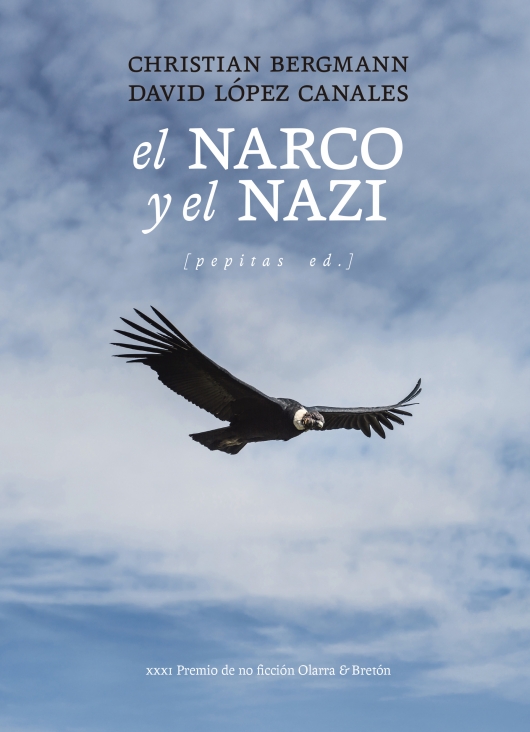
Who is “the narco”? Pablo Escobar? The Chapo Guzmán, perhaps? No: the predecessor and master of them, Roberto Suárez (1932-2000), a cattle‑breeding entrepreneur but rightfully called “The King of Cocaine”, including distribution all the way to the product’s final destination.
And “the Nazi”? None other than Klaus Barbie (1913-1991), a stalwart figure of the German Army during the occupation of France. His nickname, equally well justified, is “The Butcher of Lyon”, the city of the two rivers: where the Saône flows into the Rhône.
How, where and why did both specimens coincide? The answer obviously lies in the rat route, which carried, among many others, a Josef Mengele (1911-1979), “The Angel of Death” or “The White Angel”: in fact, he died in the Sao Paulo region. And also to an Adolf Eichmann (1906-1962), directly responsible for the so‑called Final Solution against the Jews, though in his case luck was not as good: in 1960 he was transported to Israel, where he was sentenced to capital punishment and was hanged. In that context, Klaus Barbie arrived in Bolivia in 1951, and in 1955 he acquired—under a different name, Klaus Altmann—that nationality. He remained there, engaging in lucrative activities, until 1983, when he was deported to France, where indeed he was tried, albeit without a death sentence. He died in prison in the same Lyon four years later.
Thus the figures coincided, in time and space. And they met and collaborated, for example in the coups d’état of Hugo Banzer (1971) and Luis García Meza (1980), in the era known as “Operation Condor”. Incidentally, one should note that we are dealing with a country that holds the world record for such military overthrows: since 1946 there have been 38, of which 17 succeeded. Most of them, and certainly those of that era (and earlier the 1964 one by René Barrientos), leaned to the right or, to be more precise, anti‑communist. Today, since 2009, with Evo Morales as president, it has a Constitution that speaks of a “plurinational state” and proclaims the rights of the pacha mama, the Mother Earth, expressed in the Quechua and Aymara languages, in whose cultures she embodied a goddess. All very woke and lovely. Some excesses that, as is often the case, can only be explained as a reaction to the prior — the corsi e ricorsi of which Giambattista Vico spoke— and as Antonio Machado well explained, the buttstock (the culata) is usually much stronger than the shot (tiro). These swings, however, cannot hide the continuity of the essential. And indeed, before and after, with one rhetoric or the opposite, we are facing what is known—knowing there is no precise metric to apply that label—as a Narco‑state.
Bolivia, by the way, a country worthy of study. If we go back two centuries or more, we will find that the territory belonged to the Viceroyalty of Peru until, with the creation in 1776 of that of the Rio de la Plata, it partly joined it; although it is well known that in the jungle there are no borders, and without borders there is no administrative division—State or anything else—that count, which becomes one of the reasons that, as long as there is demand for cocaine in the rich world, the plantations are so vast and so prosperous, regardless of the rules established here or there. Of the Ibero‑American countries it is often said that, while forming nations—an artifice—cost them a great deal, they found it easy to create States—the viceroyal administration, including the Captaincies General, showed great adaptability—but the truth is that in Bolivia everything has conspired—from the very beginning, indeed with nature, the so‑called pacha mama—to make neither of the two tasks easy. And yet it was there that, at the start of the 19th century, shortly after the Napoleonic invasion of the peninsula, the conflicts began—largely civil wars among criollos, as Tomás Pérez Vejo has suggested, though in this case with a stronger indigenous presence—that eventually led to independence: that initial position is usually recognized as the so‑called “Revolution of Peace” of July 16, 1809, much earlier than 1812, when in Cádiz the bihemispheric character of the Spaniards was proclaimed, in despair.
But it is insisted that this book does not intend to be a complete history of Bolivia from its origins to the present. Its authors, a German and a Spaniard, have focused on the period indicated—when, to speak plainly, the worst of humankind came together in space and time—but, precisely because of the limited scope of their chronological object, they have been able to do so with a rigor that is truly exemplary, with which they have produced a portrait of how far we can degenerate, as Juan Belmonte would put it.
—————————————
Authors: Christian Bergmann and David López Canales. Title: The Narco and the Nazi. Publisher: Pepitas de Calabaza. Sale: Todostuslibros.