
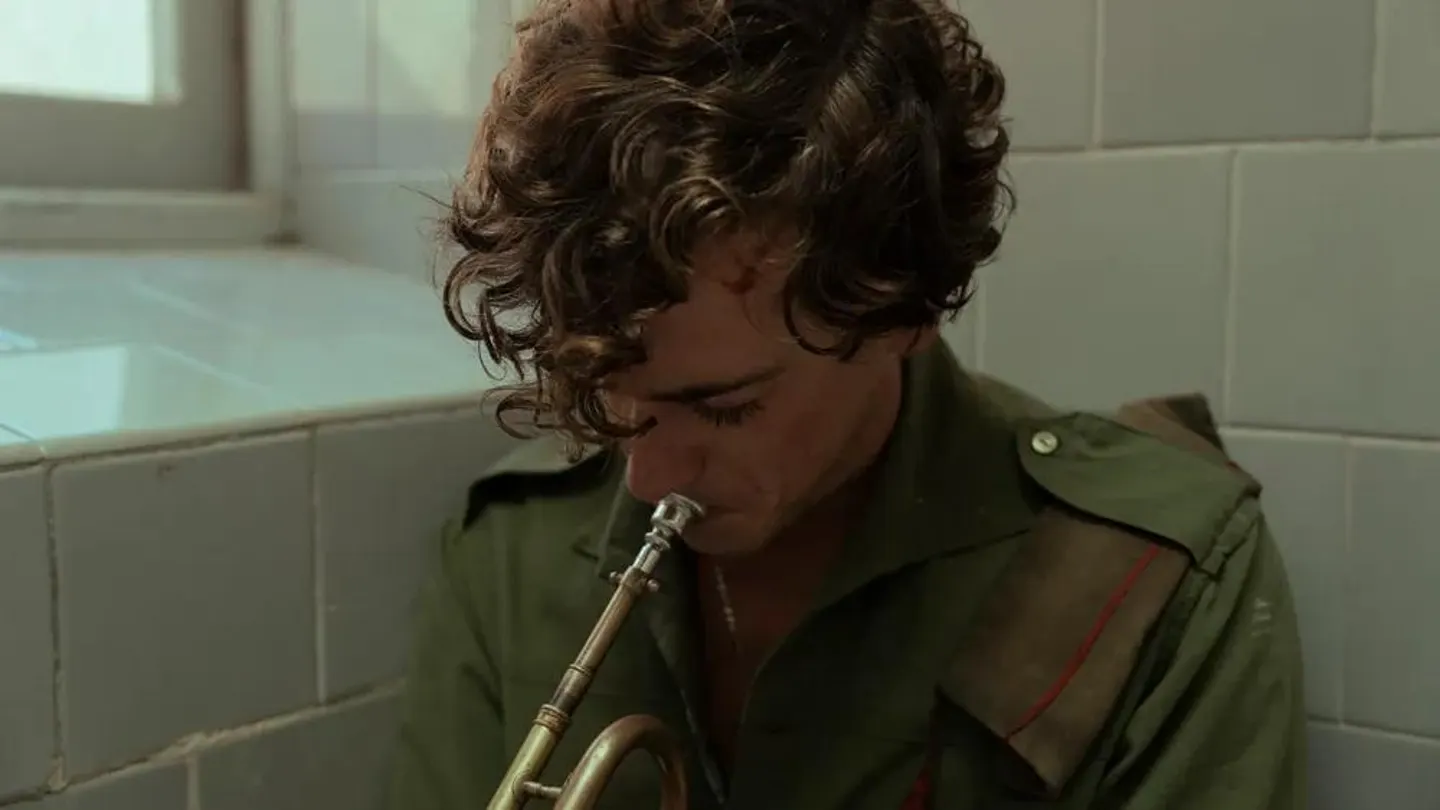
It seems there is a deeper reason for someone to hate The Black Ball: that someone else does not hate it. This happens with adolescent malevolence. Someone, while young, foresees embarrassment or even misfortune in a rival they envy, and eagerly awaits the shove, the teacher’s scolding, or the fall. Since these mishaps don’t occur, in the end he provokes them himself. Someone has to do it, he thinks, even though, in his moral misery, he hadn’t planned to do it in the first place.
Thus, the right-wing crowd (sic) has not condemned The Black Ball as it should, has not mocked it, and has not wielded with sharpened edge the word “faggot” to speak of the film. In fact, if millions of people have gone to see the movie, it means millions of fascists have gone to see it. And they have recommended it. The entire conservative electorate is watching The Black Ball, as if they didn’t already know it was bound to irritate them.
Only then did highly destructive reviews of the film begin to appear. They are criticisms, strictly speaking, of a lack of critique, as if a vacuum compelled them to take a step they expected someone else to take. But Soto Ivars spoke well of the film by the Javis, and Carlos Boyero, and the whole Twitter, and no one truly felt offended or mocked or pamphleteered or unsettled by the trifling, trifacial three-part story. This is, of course, very grave: that there isn’t in Spain a fascism properly divine, one that goes to cinemas to intercept access, to burn copies of The Black Ball.
One spring critique of the film was written by Carlos F. Heredero, who I’m not sure who he is, but he’s been a film critic for ages. We know him from the pages of Fotogramas, or from newspapers (El Mundo?), and we know him from the star grids of the Guía del Ocio, in the 1990s. Now he runs Caimán (sic), a film magazine.
And there, in the Caimán, this gentleman said that The Black Ball is very bad. A dreadful film. Then I read another negative review in the magazine Ctxt (God save small magazines, which are, in the end, the only ones fighting against LGBT cinema!). Vicente Monroy signed a long meditation on the fascism underlying a gay film that should outrage the fascists. As a curiosity, both Monroy and Heredero have insulted the author of this piece, by those quirks of life that are quite consistent.
Heredero, Carlos (F), recently declared in El Confidencial that there are two kinds of film criticism: one, his own, and another, that of Carlos Boyero, who is “a friend.” The latter is called, in places where people name notions as “critique of taste,” a form of “taste criticism.” You simply like or dislike a work, without even knowing why you like or dislike it, because you are either dull or thick. You might like it because you are dull, or because you support the fascists.

Heredero believes that wordiness backs up the opinion, so the ability to express concepts that are complex and linked to other complex ideas within a long tradition of scented thought turns your “I like it” into a more important “I like it.” It is no longer simply “I like it,” but “academic truth.”
In truth, Heredero’s critique (which I have in front of me) selects adjectives against The Black Ball that are clearly debatable, very “guys.” Adjectives: “redundant”, “embarrassing”, “hyperbolic”. Nouns: “amphibology”, “grandiloquence”. More adjectives: “baroque”, “overelaborate”. About the performance of Alberto González: “limited”, “pathetic”. About the Lorca scene, the same: “staged”. The review apparently ends with a mini-review of another gay film, The Man I Love, which is indeed good gay cinema. Heredero was in Cannes, writing review after review, and, by his account, the Javises were unlucky that their film was shown on the same day as a better, but roughly equally camp movie. In fact, it’s the other way around: Heredero was lucky to be able to comment positively on a gay film after criticizing a gay film, thereby quashing the inevitable suspicions of homophobia in the text.
The point is that the professional and academic review by Carlos F. Heredero does not differ from the review that any boor could produce, Boyero’s own or mine. Heredero’s is merely another opinion, filled with bile and bungled prose, also prone to an excess of adverbs, and motivated openly by one sole fact: that the right-wing is fuckable, and that the nationalist faction in the film does not obey the caricature of good cinema in his eyes. You know that if a priest appears in a film, and he has not molested a child, it is a fascist film.
All the opinion or taste of Heredero in his review aligns, point by point, with mine, only inverted. Except for the acting black hole Bernardeu, and the silliness of the character played by Glenn Close, I think the opposite of Señor Carlos in absolutely everything. Why is my opinion, I believe, better than Heredero’s? Because I do not base it on political prejudices. I watch, forgive my French, the film inside the film, not my militancy in the film.

Then the young Vicente (Monroy) wrote a long, measured diatribe about why we must not share a cinema seat with fascists. The Black Ball is “a promotional artifact”, though before getting into the matter we should employ the verb “displace,” so that “the political shifts toward the psychological” (for whatever reason). It seems that The Peninsula of Empty Houses, by David Uclés, also shifts things. According to someone (cited in the text) “magic substitutes for politics.”
What a bore these people are, right?
As “a catastrophic result” Monroy sums up The Black Ball. They tried to expand an unfinished and barely known Lorca text, and the result has been a catastrophe. Gosh.
Because it has “many and serious defects”. They speak of “the erotization of fascism” (though not considering it as grave as that), for one unforgivable thing about the Javises is that they see fascists as fuckable. Note that erotizing swastikas doesn’t seem wrong to us if we consider the sustained prestige of films like The Night Porter (1974), by Lina Cavani. All the same, the gravest thing is this: “The truly unpleasant thing is their inability to conceive of the viewer as a mental subject capable of charting their own path among the images.” And more: the film “denounces the lack of freedom that its protagonists suffer while it is denied to those watching it.”
Who decides that a film grants freedom to its viewer? What would that freedom be? Who, in a cinema, wants freedom of any kind? These are human questions that barely scratch at the whimsy of our nefelibatic critic’s approach.
A filmmaker like Abbas Kiarostami, for example, pointed out the lack of room for the viewer he noticed in the flawless scripts of Billy Wilder, and defended the irregularity and imbalance of his own scripts, which gave the viewer an opportunity to express themselves. Everyone here has very chic theories, friends!
Yet, whatever Abbas Kiarostami may say, Billy Wilder is a great filmmaker, and the Iranian director himself is as well, so what a director says about another simply means one thing: I defend the cinema I make.
Nevertheless, that a critic demands such odd things as “freedom for the viewer” in a film doesn’t mean anything, because he himself hasn’t made a film showing what he means by that. Resorting to great directors or great films to win an argument is ridiculous, as if I were to critique a novel and my main argument were: “It’s not Proust.” Proust isn’t taking your side. Fassbinder isn’t taking your side. Do not speak in their names.
From Heredero to Monroy, there is a grand intellectual effort to deny the merit of a film full of talent and stimulation simply because it isn’t the film they would make if they could do anything. In truth, they don’t know what film they want to see, and they only discover that a film isn’t the one they wanted to see when the credits roll. This poised emptiness—the refined void—is what defines the most useless criticism: they are unable to act as spectators and, therefore, adopt the film as if inhabiting a distinct, not vulgar, not retinal, not universal, almost juridical, almost paternal entity. That entity does not exist. You are one more person in a cinema, not even the most honest one.