
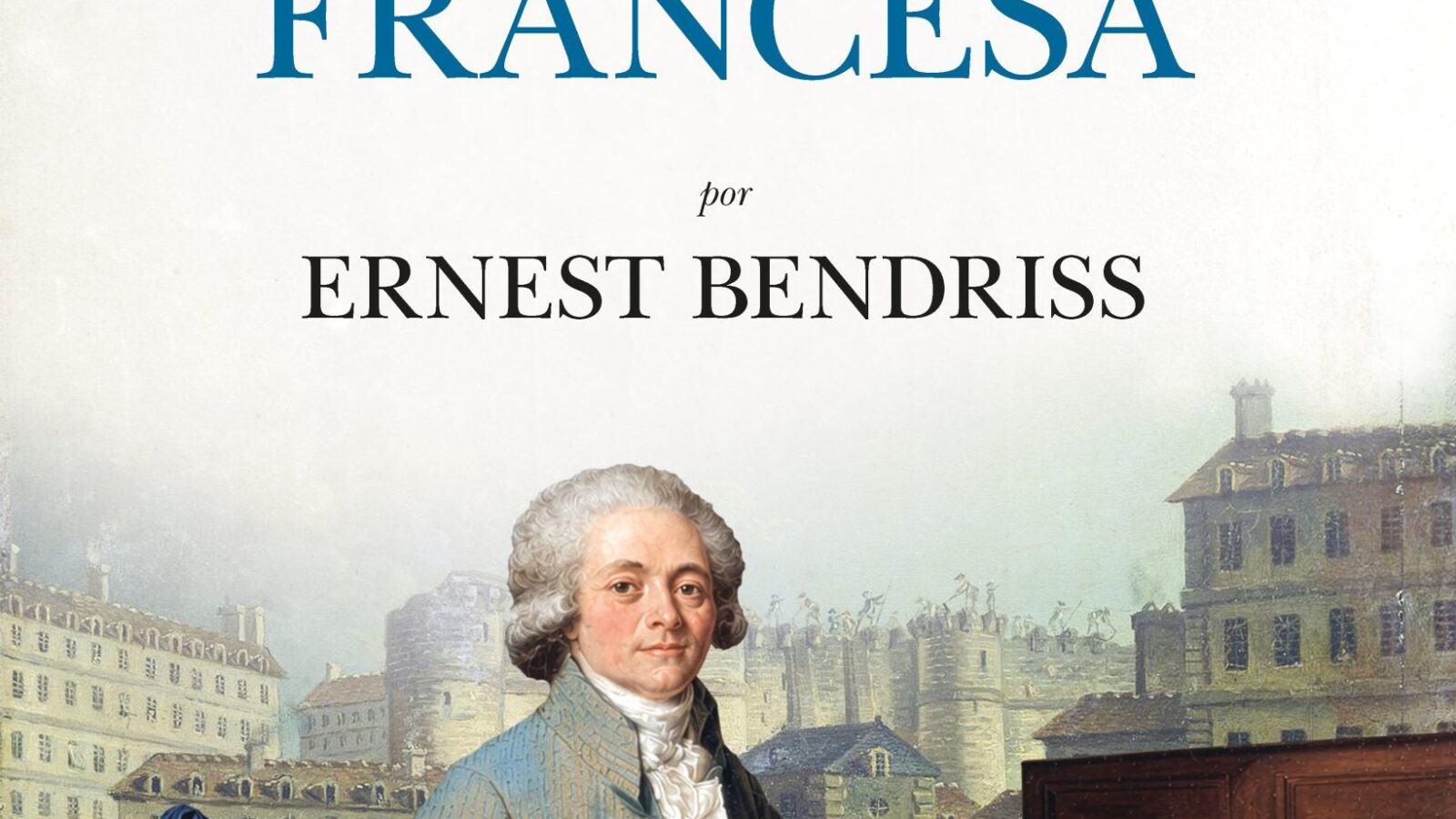
Did you know that the storming of the Bastille was, in reality, an extraordinary propaganda coup? That the marriage of Louis XVI and Marie Antoinette could have steered the course of Europe in a different direction? That the French Revolution did not originate with the intention of abolishing the monarchy? Or that women, long relegated by school textbooks, also played a decisive role in the Revolution?
Here we reproduce an excerpt from the book Eso no estaba en mi libro de la Revolución Francesa (Almuzara), by Ernest Bendriss.
*****
NOTICE TO READERS
The French Revolution, at its core, constitutes the creation of a “new man,” through an ideological transformation grounded in abstract principles distant from concrete realities. One of the most notable achievements of this process was the development of a new semantic framework, established through strategies that blended coercive methods with broad dissemination. In 1789, the term “regeneration” gained substantial notoriety and general acceptance, even influencing the monarch, who used it in his address to the representatives of the three estates gathered at Versailles. The revolutionary ideal aimed to shape a transformed France, with the central purpose of establishing an order founded on scientific principles deemed essential to guarantee a kingdom of happiness that is purely material and immanent. This longing for perfection, guided by science and reason, marked the Manichean character that had distinguished the Revolution from its outset. Regeneration of the country entailed leaving behind centuries of history to mold a completely new model, where the State would assume absolute control over all aspects of individual life. To realize that transformation, it was essential to reform the language, adapting it to exert a deeper influence on minds. Undoubtedly, this semantic renewal represented one of the greatest achievements propelled by the Revolution. In keeping with its ideals, concepts such as homeland, nation, and people were redefined under the lens of the new ideological perspective. For the revolutionaries, the notion of homeland ceased to be tied to historical narratives, geographic territories, or inherited communities, becoming the idea of a citizenry founded on universal principles. No longer was it seen as ancestral legacy, but as a republican construct open to the world. In this context, the notion of homeland aligned completely with the Republic, making the terms patriot and republican interchangeable. Within this conceptual framework, words such as homeland, constitution, liberty, social contract, and revolution were viewed as interchangeable, reflecting a single essence. This approach endowed the revolutionary struggle with a strong ideological character and an absolute outlook. The enemies ceased to be exclusively other nations, becoming anyone who rejected the Constitution, opposed the Revolution, or questioned the abstract happiness and fervor promoted by the revolutionaries.
On the other hand, the patriot was defined as someone who embraced the revolutionary principles, regardless of their origin or personal background. In this semantic reinterpretation, the term “people” ceased to refer only to the French population and came to denote the followers of the Revolution. This ambiguity between the real people and the ideal people reached its apex during the Terror, when the main victims were humble individuals distant from the abstract revolutionary discourse. The French Revolution cannot be understood as a mere reform project; it was a radical aspiration to radically transform society, heavily influenced by the Enlightenment ideals. The revolutionary assemblies clearly demonstrated their commitment to the philosophy of “tabula rasa,” driving an absolute transformation that sought not only to modify what already existed but also to establish a new conceptual and structural paradigm in line with their worldview. This approach led, for instance, to replacing the traditional space-time references tied to monarchy with a new republican model symbolized by a new toponymy (cities, towns, squares, streets, etc.) and a renewed calendar. Moreover, removing opponents was deemed essential for the social regeneration they sought. The radicalization process began with the elimination of the declared enemies of the Revolution, particularly the royalists, and ended up leaving even the revolutionaries themselves as victims, including those considered moderate or less committed, as someone was always pointed out as more “pure.” It is worth noting that the atmosphere of terror was brewing from July 14, 1789, long before the fall of the monarchy. Conversely, the Revolution is associated with several myths, including the supposed ideological opposition between the Girondins and the Montagnards. That confrontation was more a personal struggle than a political one. Another recurring myth is that the Revolution marked the beginning of democracy in France. Many people perceive that the 1789 revolutionary movement gave rise to a democratic State. This perspective deserves re-evaluation, as, in fact, the revolutionaries established a censitary representative system that was far from democratic. It is important to emphasize that women and those who did not meet certain economic criteria related to income or property were excluded from voting rights. As historian François Furet demonstrated, the French Revolution, with all its intrinsic complexity, must be understood fundamentally as an ideological revolution.
It was a total political disorder whose aim was to destroy the existing social and legal order to replace it with another based on an ideology deemed scientifically irrefutable. Between 1789 and 1793, this latter date, commonly associated with the radicalization of the Revolution, did not show a fundamental difference, but rather a simple shift in the magnitude of events. Indeed, 1793 was, in many respects, an inevitable outcome of what had begun in 1789. Unlike Britain’s Glorious Revolution of 1688, the French Revolution did not focus on restoring traditional liberties linked to the monarchy. The revolutionaries pursued a different goal: the creation of the citizen as a new entity, fully freeing him from any trace of a past they despised. The formation of this “new Adam” became an essential element within the Jacobin political outlook. This metamorphosis of the human being would have been inconceivable without the anthropological materialism advanced by the encyclopedists. The human being was conceived as a machine that responded to external stimuli, which entailed the belief that one’s surroundings could influence him and, thus, modify his nature through changes in perception. For Robespierre, the objective of the revolutionary government was clear: “to found the Republic.” This meant building a society composed of virtuous republican citizens, wholly devoted to the ideals of the Fatherland, Democracy, the Republic, and Equality. This dedication had to extend even to the sacrifice of one’s goods, affections, and very person. The Revolutionary Fatherland sought to establish itself as a new religion, as evidenced by terms such as “regeneration” and the notion of the “new man.” Soon, the leaders of the Revolution adopted religious terminology to exalt these ideals, erecting “altars” to the Fatherland around which revolutionary celebrations took place. As for counterrevolutionary discourses, Robespierre did not hesitate to use the term “blasphemy.”
Even the designation of “Montagne,” used to refer to the left in the Assembly, carried religious overtones; it was not uncommon to hear calls of the “Holy Mountain.” To transform the human being, the Jacobins first turned to the law, whose reach knew no bounds, even venturing into metaphysical matters. This is evident in Article One of the decree of May 7, 1794, which established the Republic’s official recognition of the existence of the Supreme Being and the immortality of the soul. Through legislation, they also changed fundamental aspects such as the division of inheritances, aiming to dismantle large estates rapidly. In the educational sphere, the Jacobins developed a plan whose principal objective was the formation of republican citizens. There was even a proposal to separate children, from the age of five, from the family environment to place them under the care and instruction of the State.
Robespierre defended this idea on July 29, 1793, arguing that ensuring the education of the young in republican and egalitarian principles should be considered both a parental duty and a civic imperative. For those who rejected this measure, an economic sanction was proposed, such as doubling their direct taxes. The Convention deputy, Antoine Thibaudeau, summarized this view by stating that children should be regarded as the property of the State, with parents acting as mere temporary custodians. In their aim to transform the entire social order, they instituted a new calendar that symbolized the replacement of religious references with the exaltation of nature. They also created a civic religion grounded in respect for the social contract and the laws, seeking to channel religious fervor toward service to the nation. To reinforce this collective transformation, they organized civic festivals with elaborate artistic spectacles designed to emotionally impact individuals and alter their mindset without their full awareness. Finally, in their struggle against the Revolution’s opponents, they applied a Terror policy supported by legality. Robespierre clearly expressed this approach on May 8, 1793, during a discussion on the Vendée rebellion, noting that the laws provided all the necessary tools to legally eliminate the enemies of the Revolution. From that moment, the Terror policy, which sustained the climate of fear established in France since the first heads were displayed on pikes on July 14, 1789, is seen less as a survival reaction to threats against the Republic of 1793 and more as an instrument of social regeneration that foreshadowed the totalitarian regimes of the 20th century. A clear example was the extermination policy implemented in the Vendée by the Convention on October 1, 1793. And the echo of the French Revolution continued to resonate throughout the 19th century, before becoming a powerful source of inspiration for Lenin and his Bolshevik henchmen.
—————————
Author: Ernest Bendriss. Title: That Wasn’t in My Book about the French Revolution. Publisher: Almuzara. Availability: Todostuslibros.