
To commemorate the 90th anniversary of the Civil War, José Ángel Mañas recreates in Zenda, day by day in this section, what happened in 1936, perhaps the most pivotal year in all of Spain’s recent history.
Saturday, October 31, 1936: Off to the gallows!
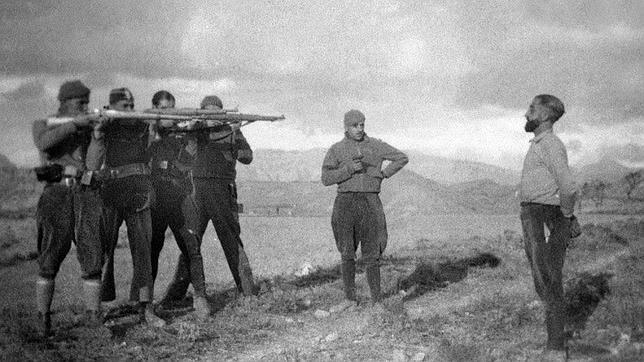
In the Abastos offices, José María Tárrega and the Mendívil brothers discussed the executions of Maeztu and Ledesma. It was said that when Maeztu was awakened in the middle of the night, the jailer told him he could go wherever he went in his pajamas. The Basque writer, already before the firing squad, had exclaimed: “You don’t know why you are killing me, but I know why I die. I die so that your sons will be better than you!”.
The ideologue of the Falange was taken out the same night. But according to the prison officer, when they tried to put him on the truck, he lunged at a militiaman to snatch the rifle: “You will kill me, but it will be where I want and not where you want!.” A shot was fired at him and he died on the spot. The two had appeared beside the gates of the Aravaca cemetery.
The most well-known executions were discussed weekly, just as bullfights or football, during the coffee break; Mañas listened in silence, not taking part. Sitting at his desk, he recalled that his friend Basilio had passed along some issues of Ledesma’s magazine, La Conquista del Estado. Then they did not speak of the matter again. He did not draw the conclusions that were appropriate. Ending up at the Montaña barracks, in the end, seemed a logical evolution. And what about mine? he thought, what is my evolution, what logic is there in it?
With the death of the father still hovering in his mind, the context favored morbid thoughts. The bluntness of the anecdotes, the way they were received, showed how easily men adapt to the harshest reality, how thick-skinned they could become. Although it could be that all of this served precisely to desensitize people and help them endure the continual presence of death in their lives…
Those conversations sharpened the sense of precariousness of existence and led him to try to imagine how he would react to imminent death, whether he would be able to face it with dignity…
Suddenly Oedipus Rex by Sophocles came to mind, when at the end of the play it is proclaimed that until the day of one’s death no one can be said to have truly lived happily. War was a laboratory to watch people live their last moments. The proximity of death heightens the senses and, in many cases, sharpens the will to live. When there is nothing to lose, everything is somehow permissible, he thought.
By then the Government had given good publicity to the deaths of a large part of the rebellious officers. General Fanjul, before being shot, asked to marry: it was granted. He married, in prison, with his de facto partner from the last years. There was some leniency toward him, which could have helped him face his end with resignation and stoicism.
Another case was Goded. After failing his attempt to control Barcelona, he was captured and confined on the prison-ship Uruguay. There he had a moment of despair when he saw the scant support for his uprising, and as the Capitanía General fell, where he resisted, he attempted to shoot himself. Only when he pulled the trigger did the ammunition fail him…
Then, before the war council, he appeared haughty. When they came to fetch him to shoot, he was allowed to go in his uniform, as a general. During the boat trip to the coast he smoked a last cigarette with a cold-blooded calm that impressed those accompanying him to the firing squad. Of course the military—even more so the high-ranking officers—were conditioned, by their profession, to control their nerves at that moment.
Less time did Sanjurjo have, as destiny played a heavy prank on him. Ready to leap into Spain from exile and lead the uprising, with a trunk full of uniforms and medals with which to present himself to the Spaniards, as he liked, bragging the insignia of a general to erase that other humiliating image at the Dueso prison, dressed as a prisoner. A sad death for a soldier, a death without glory in a meaningless aviation accident, charred before the eyes of his wife and those who saw him off at the foot of the plane…
But the most tragic and senseless death so far was that of López de Ochoa. A progressive, republican and a mason, who had negotiated the surrender of the miners led by Belarmino Tomás and, under adverse conditions, achieved the pacification of Asturias, he was one of the generals most hated by socialists, anarchists and communists, who considered him, together with Franco and Yagüe, one of Asturias’s “butchers.” María Teresa León wrote about him in Ayuda, the newspaper of the Socorro Rojo Internacional (Red Aid): “López Ochoa, an unscrupulous adventurer, his cruelty was known, responsible for pursuing fugitives, raping women, grinding down children… Sick in Carabanchel? Perhaps for fear that the masses would judge him.”
Lopez de Ochoa’s loyalty to the Republic counted for little. He was taken out in his pajamas and executed. A mob decapitated him and paraded his head through Carabanchel, mounted on a bayonet.
It was hard to say that these men had lived a happy life.
All the 1936 day-by-day entries
Interview with José Ángel Mañas about 1936 day by day