
To commemorate the 90th anniversary of the Civil War, José Ángel Mañas recreates in Zenda, day by day in this section, what happened in 1936, perhaps the most pivotal year in all of Spain’s recent history.
Sunday, November 1, 1936: The Mañas leave their home
A bed of oak with a copper heater, a wardrobe with a full-length mirror, an enameled basin on an iron stand, a chest at the foot of the window, a table on which their Law books — the Notarial syllabus — were piled — and a chair, the floor of well-waxed red tiles, and on the wall, presiding over the bedroom, a painting of Saint Francis. That was their den, the space in which he had spent the last fifteen years, since his arrival to Carabanchel. There he grew, almost without noticing it.
He never imagined he would leave it like that.
Nodding his head, Pepe Mañas gave his wife one last look. He did not take any books. With an almost inaudible sigh, he closed the shutters. In the half-light, he closed the door and went down the stairs. It was All Saints’ Day.
—Pepito, where are you?
Mariana and her cousins, Rosa and Inés, had already closed the shop. The three waited at the kitchen door, which opened onto a side yard of the house. They carried many full bags. A cold, biting wind blew. Two union militants waited at the entrance to the courtyard, the one facing General Ricardos along the odd-numbered sidewalk. On the street, where cars were still passing, the Commission of Supplies truck waited. At the shop door, still gleaming from being so clean, there was a metal plaque: ULTRAMARINOS, GRAINS, SEEDS AND BRAN. LUIS MAÑAS.
—Anyway, lately there was hardly any stock. It hardly sold —said Mariana.
It was like that. Since her husband had been killed, many neighbors stopped coming to the shop for fear of being linked to the family of a «paseado».
—Wait, I forgot one thing —said Inés—. Do you have the key, aunt?
Inés ran back to the shop. She opened it and disappeared inside: the door remained open. Her movements could be heard inside. Two militiamen approached to tell her, in harsh tones, to hurry. When she came out, she carried her favorite frying pan under her arm. She was going to lock the door, but one of the militiamen, the one who had warned them that the house would be requisitioned for the front, shrugged.
—Can’t you see, comrade, that as soon as you leave, the militiamen will knock the door down and occupy everything?
Inés nonetheless locked the door and the man shrugged. He lit a cigarette. Inés moved toward where the others were waiting. “They’ll be bold, those.” Pepe climbed onto the truck, helping them up.
They settled the four of them in the back as best as they could. As soon as they learned the shop was going to be requisitioned, Ángel Navarrete took care to have them assigned an apartment in one of the abandoned buildings in the Salamanca district: that was where they were heading.
—Are you all aboard now? —the driver asked.
—You can start —said Ángel Navarrete.
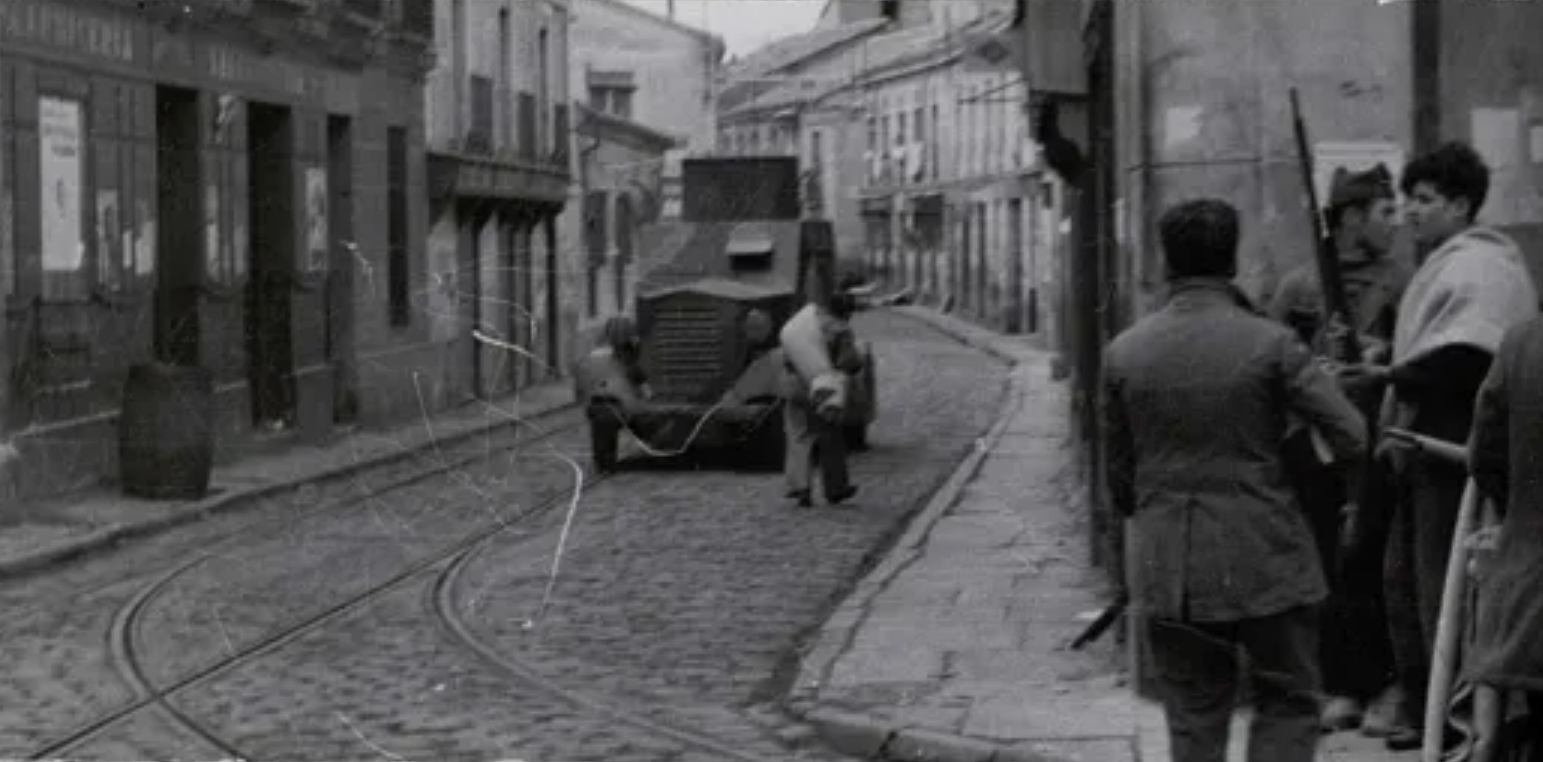
Along General Ricardos, many armed militiamen could be seen. Other neighbors were also leaving their homes and heading off with their belongings toward the Toledo Bridge. As they moved away, Pepe Mañas preferred not to look back. He would never return to his Carabanchel home.
All the daily entries for 1936 Day by Day
Interview with José Ángel Mañas about 1936 Day by Day