
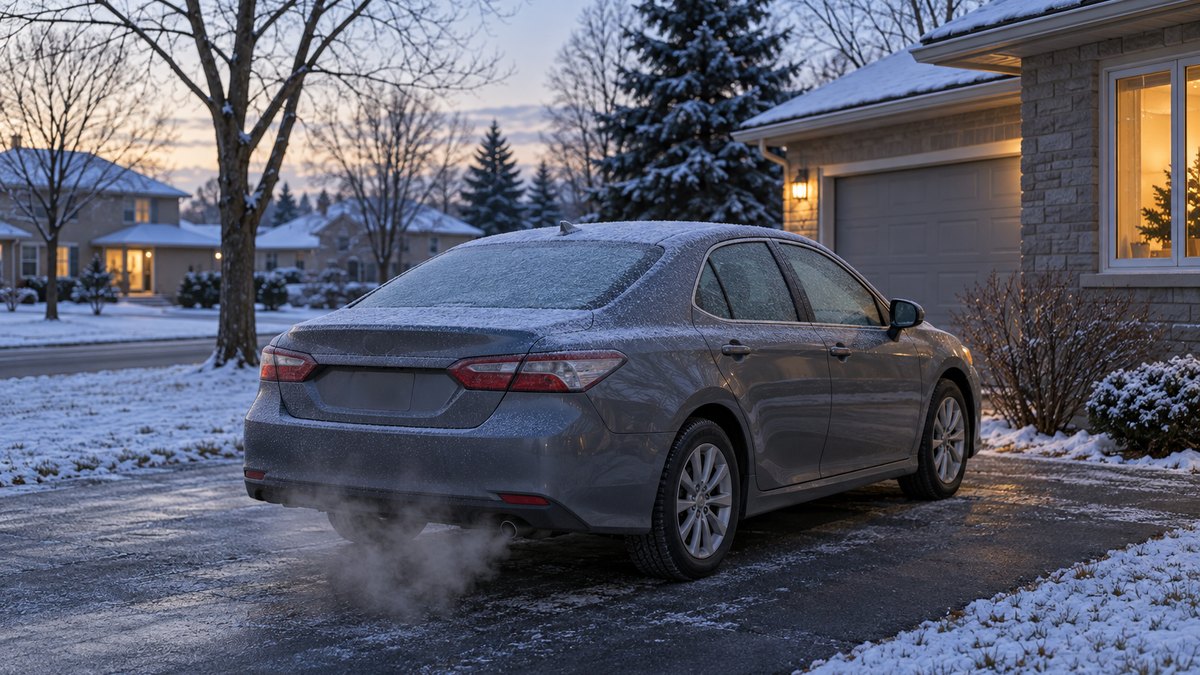
It happens in thousands of driveways every November. The first real frost coats the windshield, someone grabs a coffee, turns the key and heads back inside while the engine idles for ten minutes. It feels responsible. It feels like the kind thing to do for a car that has to face a Canadian winter.
Ask the people who actually open those engines in the spring, though, and the answer is surprisingly blunt. The long morning idle is a habit inherited from another era, and on a modern car it mostly wastes fuel while doing the engine no favours.
A ritual that made sense in 1985
The old advice was not invented out of nowhere. Cars with carburetors genuinely struggled in the cold. Fuel did not vaporize properly, engines stalled at the first stop sign, and a few minutes of idling helped everything settle into a smooth rhythm.
That world disappeared decades ago. Almost every vehicle on Canadian roads today uses electronic fuel injection, with sensors that read the outside temperature and adjust the mixture in a fraction of a second. The engine knows it is cold. It compensates on its own.
“People treat their car like it’s still their father’s pickup,” says a mechanic who has run a small garage in the Eastern Townships for more than twenty years. “I hear it every fall. ‘I let it run fifteen minutes, it’s good for it.’ Honestly, it’s the opposite.”
What actually happens while the engine sits there
An idling engine produces very little heat. It turns slowly, burns a small amount of fuel and warms up at a painfully slow pace. Meanwhile, the cold engine runs a richer fuel mixture to stay alive.
That extra fuel is the problem. Part of it does not burn completely. It can wash along the cylinder walls, slip past the piston rings and end up diluting the engine oil, the very fluid meant to protect everything inside. Over a whole winter of long morning idles, the oil can lose some of its protective quality before the next change.
Several other side effects show up on the bill:
- Wasted fuel, often a noticeable share of a tank over a season of daily idling.
- Extra carbon deposits on spark plugs and valves, because the combustion never gets hot enough.
- A catalytic converter that stays cold longer and cleans exhaust far less efficiently.
- More engine hours on the clock without a single kilometre gained.
“The fastest way to warm an engine is to drive it gently,” another technician explains, wiping his hands between two winter tire jobs. “Not to stare at it from the kitchen window.”
The routine mechanics actually recommend
The alternative is almost disappointingly simple. Start the car, give it thirty seconds to a minute so the oil can circulate, clear the windows properly, then drive off at a calm pace.
The first five or ten minutes are what matter. Light acceleration, no high revs, no hard merging onto the highway with a frozen engine. Under a gentle load, the motor reaches its operating temperature much faster than it ever would in the driveway, and the cabin heater starts blowing warm air sooner too.
On the coldest mornings, when the thermometer drops toward minus thirty, many garages point to a different tool altogether: the block heater. Plugged in for a couple of hours before departure, it keeps the coolant and oil from turning thick, and the engine starts in far better shape than any amount of idling could achieve.
Safety comes before the warm seat
There is one point everyone agrees on. Visibility is not optional. Driving off with a small peephole scraped in a frosted windshield is dangerous, and clearing every window, mirror and the roof is part of the routine, even if it takes a few extra minutes.
The other rule is just as firm: never let a car run inside a closed garage, not even for a moment while you look for your gloves. Exhaust builds up quickly in a confined space.
Many Canadian municipalities also have anti-idling bylaws that limit how long a parked vehicle can run, with fines that can surprise drivers who assumed warming up was always allowed.
So this winter, the coffee can wait in the car. Start the engine, scrape the glass, and let the road do the warming. “Your engine will thank you in five years,” the Eastern Townships mechanic says with a shrug. “Your wallet will thank you by March.”