
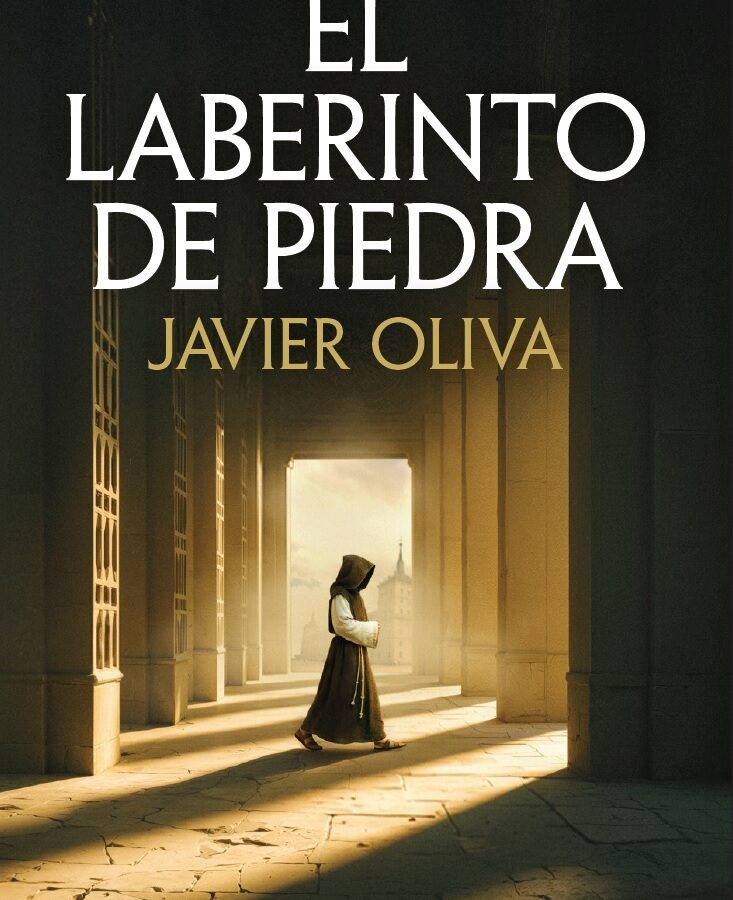
Year 1563: Philip II has ordered the construction of a building commensurate with the magnitude of his faith: El Escorial. But it quickly becomes apparent that a sinister hand haunts the corridors of the future convent, sowing chaos among the workers and leaving a trail of corpses in its wake.
In this making of Javier Oliva explains how he wrote The Stone Labyrinth (Grijalbo).
***
This is the first time I bend an obsession without burning myself out. Or the second. Because stepping back in time to live how the construction of the El Escorial monastery was undertaken began as a brag and ended up as a challenge. Let me explain:
Throughout my life I have visited on many occasions the great building designed by Juan Bautista de Toledo, succeeded after his death by Juan de Herrera.
But above all I remember the first time.
Being a child, I was herded there by my school. I must have been about ten years old, no more. I recall the imposing monument, the hall, the entrance and part of the route we took. And unlike what happens to a boy who is pressured to soak up culture, my interest did not fade but left a lasting mark. Perhaps it was because my father was a surveyor and knew that this work surpassed anything he could imagine. Or perhaps because my mother was passionate about art, and for the first time I missed her explanations. Or perhaps because, at ten, when something impresses you so deeply, it sears itself into you and seeds neurosis, paranoia, and madness.
By then I already knew that inventing stories and then trying to put them on paper was something I was passionate about. Of course, in those years—and in the forty-something that followed—I dedicated myself to achieving a series of more attainable goals in an orderly fashion. So, little by little, the small tales of then transformed into youth novels, then into beginner novellas, and later into somewhat more dignified and crafted texts until publications and prize mentions arrived, which, by the way, are not without their poisoned sweetness for almost all authors if one does not know how to savor them properly.
The thing is that, just like Philip II, facing the writing of a historical novel (I had never done it before) with thriller overtones (that had never occurred to me either) and launched to the public by Grijalbo (an opportunity I would only waste by dying), was like projecting the work of El Escorial: something that in your head has a shape, but you don’t quite know how it will end.
Three years ago, bold and determined, when I started seeking documentation to support my story, the first thing that struck me was that the monastery’s mass was not built all at once, but in four phases, one for each building it comprises — the convent, the palace, the college, and the basilica. Twenty years of work on a vast expanse gave me room to maneuver among scaffolds, workers, and ashlar stones. The project looked promising, but, alas, foolish me, I soon learned that the first building to be completed was the convent, and since it is run by a cloistered order (the Jerónimos in the past and the Augustinians now), it cannot be visited. Still, nothing is worse than challenging a writer.
I’m not going to tell you how I managed to get inside. Thanks to Father Navas (and the permission he obtained from his superior), I had the opportunity to walk the convent from top to bottom, north to south, and east to west. And you cannot imagine how grateful I am for the time he gave me, because it’s one thing to invent a scene, or recreate it in your head from old descriptions, and quite another to wander through it for a couple of hours. From that moment, all I had left was to learn the development of the works, the people who participated, how the tasks and spaces were distributed, their day-to-day life, the problems that arose, the threats that hovered over them, the money, the scaffolds, the cranes, the carts, the ropes and pulleys… or the accidents they suffered, the wounded and the dead there were… I pulled all that out, I almost lived it!, from that visit and through hundreds of pages read, illustrations and photographs found — others taken by myself —, fictional interviews conducted with the protagonists of the novel — some real and others not —, removing and adding, creating and erasing, hiding and finding…
And so I approached recreating the works of El Escorial, a place where secrets and mysteries spring forth like purulent and incurable infections but are sustained with a generous dose of truth, to such an extent that someone suddenly told me I had gotten lost in a labyrinth of crazies and would not be able to extract anything clear. Really? It is precisely there that The Stone Labyrinth was born. And I did enjoy it.
And you who read it.
—————————————
Author: Javier Oliva. Title: The Stone Labyrinth. Publisher: Grijalbo. Available at: Todos tus libros.