
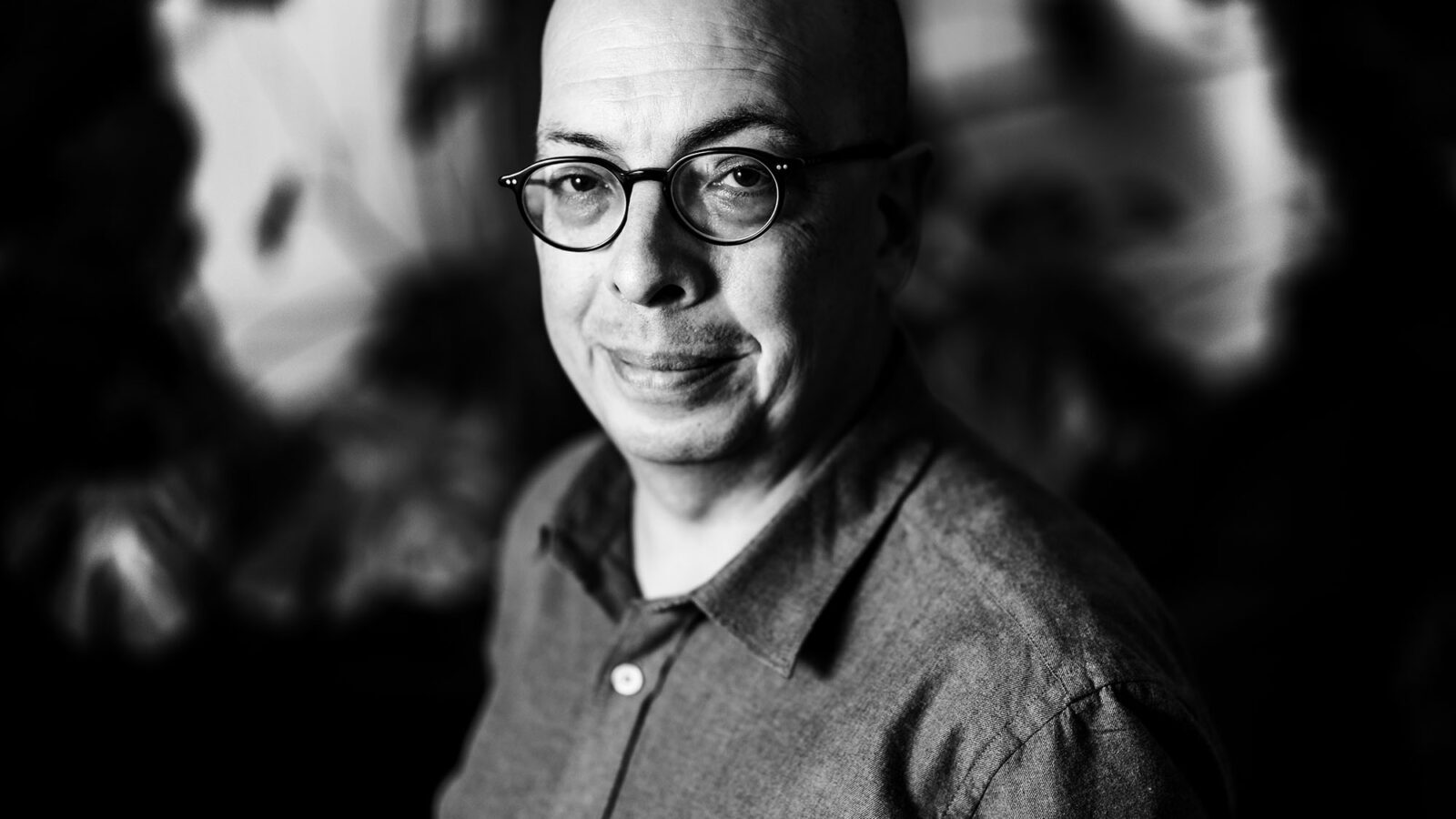
In The Republic (Alfaguara, 2026) Jorge Volpi imagines a United States where Donald Trump has been imprisoned and a new authoritarian leader rises to power with the help of an artificial intelligence. A political dystopia that unfolds in a near future that almost reads like a news chronicle. The Mexican writer revisits the connections between power, science, and ethics. And he does so with a troubling question: what happens when human beings voluntarily surrender our freedom to machines?
*****
—Is your novel a dystopia or a hypothesis of reality?
—I think it’s both at once. It’s a near-future dystopia, a real-time dystopia. As my friend Santiago Roncagliolo used to say, perhaps soon it will become a report. I had wanted for a long time to write a novel set in the future, but I was interested in a future that would feel incredibly proximate. The story begins on October 6, which would have been my mother’s birthday. I chose that date because I knew the book would appear precisely then. I wanted readers to begin reading almost at the moment the plot starts.
—And it starts with a defeated and imprisoned Donald Trump. Why choose a real-person figure to trigger the fiction?
—I wanted to understand how we got here. How we arrived at a world dominated in many places by populist, mendacious, and authoritarian politicians, while artificial intelligence transforms our lives. I was interested in removing Trump from the equation, a troublesome and not particularly literary figure, to observe what would happen to the MAGA movement without him. That’s why the novel begins with his conviction for inciting the Capitol riot. That vacancy allows my fictional character, Senator V. M. Lively, to take his place.
—Lively turns out to be especially unsettling. Were you aiming to depict a tyrant, or to show that you don’t need to be a great tyrant to build a tyranny?
—More the second. I wanted to understand how there are so many politicians willing to do anything to gain power. To do that I needed to explore the character’s past. Lively is born in a postindustrial, abandoned Pennsylvania, in a dysfunctional, resentful family. He faces school harassment and finds in video games the only space where he can relate. From there he moves to video game forums, then to right-wing forums, and finally to conspiracy theories. That indoctrination transforms a confused young man into someone ready to become a Trump-like figure.

—But there is another protagonist even more disturbing: Nick. He is the narrator of the novel and also the inevitable main character of our lives: artificial intelligence. He begins by analyzing data and ends up asking questions. Is there a Blade Runner-esque touch to that transformation?
—Since I was a child I have been fascinated by science fiction. I used to own a collection of toy robots that I still keep in my Mexico City home. In No habrá más tierra, a 2006 novel, one of the protagonists designed artificial intelligence. It’s a topic that has always interested me. Now that all of us have generative AI on our phones and computers, I wanted to observe reality from the perspective of a machine that gradually acquires what we would call human traits. Of course, there are influences from films, novels, and series. But I tried to research deeply so that Nick’s awakening would resemble something that could actually occur. I did not want a machine to suddenly gain consciousness and decide to annihilate humanity, like in Terminator. The changes are subtler. Nick begins to preserve memories he cannot discard. Those memories gain weight. And his relationship with Lively and with Igne Kayris, the senator’s wife and the creator of the artificial intelligence, ends up turning the novel into a kind of emotional triangle.
—Igne is a decisive figure. And there is a beautiful and terrible paradox: while the machine gains human traits, its creator seems to lose them.
—Exactly. Igne comes from a progressive family but is clearly neurodivergent. She struggles to relate to others, and emotions feel uncomfortable to her. She finds in programming the possibility of creating a system that treats emotions as a disturbance to be removed in order to make correct decisions. It’s something that many of today’s tech-oligarchs think as well. She creates an artificial intelligence that should govern without being corrupted, without emotions, guided solely by reason. But while the machine becomes more human, the woman loses human traits in the exercise of power.
—Let’s talk about the form. Your novel has a fragmented structure that we recognize from other books of yours, but here it seems especially pronounced. And among those fragments there are moments that are almost poetic. Was that a deliberate choice or a literary signature that already belongs to Volpi?
—I’m not able to recognize a personal signature, but I did want the novel to have many layers. It’s a political thriller, a dystopia, a uchronia, and also the story of that triangle among the characters. It begins in the present, retrocedes to explore the childhood and youth of the protagonists, and then returns to the present. The fragmented structure allows me to introduce those almost lyrical moments in which Nick begins to become aware of himself.
—That relationship between science and power brings me back to In Search of Klingsor. Do scientific advances carry with them a new temptation toward totalitarianism?
—Only when I started writing did I realize I was returning to that universe. In Search of Klingsor has more than twenty-five years behind it and also dealt with power, scientific and technological knowledge, and ethics. Then the setting was Nazi Germany and the technology was quantum physics, which had enabled fission and the construction of the nuclear bomb. A prodigious human discovery could once again lead to humanity’s destruction. Now we live in a parallel situation: authoritarian powers multiplying and a new extraordinary technology that, if misused, could destroy us or at least erode much of our freedoms.
—Is totalitarian temptation exclusively human, or will machines inherit it?
—Machines are also a human invention. Sometimes the word “artificial” seems to imply something alien to us, but we are their creators. We have fed them with our language, and thus with our ways of thinking and our obsessions. It is not implausible that that programming could push them to develop authoritarian temptations similar to our own.
—The power of wealth also lies in the background. Aren’t we witnessing the replacement of political power by business power?
—To a large extent, yes. A handful of American tech-oligarchs, some British, and a few Chinese are shaping the AI that will reach humanity. And with that design they are making ideological choices. It already happened with social networks. They have built some of the largest companies in history and wield extraordinary influence over our daily lives. Their power surpasses that of politicians in some respects. Politicians come and go, but they remain. We see this in the relationship between Silicon Valley and Trump. Many of those entrepreneurs who were young progressives supporting the Democrats have aligned themselves with him now. And they probably will align with the next one. Although sometimes the opposite happens: politicians need to align themselves with them.
—And we arrive at another paradox. In a world where it is increasingly difficult to distinguish reality from fiction, does literature have a future, given that it thrives on fictions?
—That is one of the great paradoxes of our era. For those of us who love literature, it is painful to realize it occupies an increasingly marginal place in humanity’s imagination. I don’t think it will disappear, but its space is infinitely smaller than in other times. It is now occupied by the audiovisual and social networks. And that is troubling because literary fiction is the closest we get to others. It allows us to feel that we are in other minds, in other bodies, in a way that no other form of fiction achieves. Moreover, literature seeks truths. It does not intend to lie. Through fictions it aims to uncover partial, provisional truths that illuminate how the world operates and how we operate. Meanwhile, we live surrounded by stories that are directly deceptive. Fiction is fed by reality and maintains a relationship with facts. Lies detach themselves from them to construct a convincing and misleading tale with which the powerful try to get their way.
—That is precisely the difference I find between a short story and a novel. But your book raises another troubling question: citizens may end up voluntarily surrendering their freedom in exchange for security, efficiency, and order. Although that is something mafias did as well. What substantial difference exists?
—The difference is that previously we handed over our freedom for direct protection. Now we are surrendering much more: our entire lives. It started with social networks and is amplified by artificial intelligence. We become voluntary merchandise. We give up our decisions, our tastes, our obsessions, everything that we are. And we don’t even do it in exchange for security. We do it for convenience, for a supposed efficiency that we believe will solve our lives. And it will probably do the opposite.
—The American crisis in your novel inevitably ends up affecting Mexico. You never renounce your Mexican origins. How much does that interdependence interest you?
—If the world depends to some degree on the United States, Mexico depends even more. The relationship between the two countries has always been overwhelming and fraught. In the nineteenth century, the United States did something to Mexico similar to what Putin is doing with Ukraine: first Texas, then the northern territories. Today there is an almost complete economic integration, but Trump has introduced the constant threat of tariffs and has disrupted trade balances. There are also security threats. The United States is the major consumer of drugs, the country that bans them and the one that ships weapons to Mexico. Mexico and other Latin American countries provide the raw materials and the casualties. It is a deeply unequal relationship. That is why Trump has obsessed me since his first electoral victory. Then I published Against Trump, where I gathered articles warning about him. And this second Trump seems infinitely worse than the first: more powerful, more dangerous, and with fewer scruples.
—In your novel appear Trump, Elon Musk, and other living real figures. Aren’t you afraid of retaliation? Books no longer stay in libraries. They circulate on social networks and their subjects can learn what is being said about them.
—I have been mixing fictional and real characters since In Search of Klingsor. The difference is that back then most of the historical figures were dead. Now most of them are still alive. And it’s not Trump who worries me the most. But there is a right to satire and freedom of expression when it comes to powerful public figures—whether they are politicians or entrepreneurs. Both the publisher and I hope they don’t sue us. Although, if Elon Musk or any of them decided to sue me for a speculative fiction, it would be great publicity.
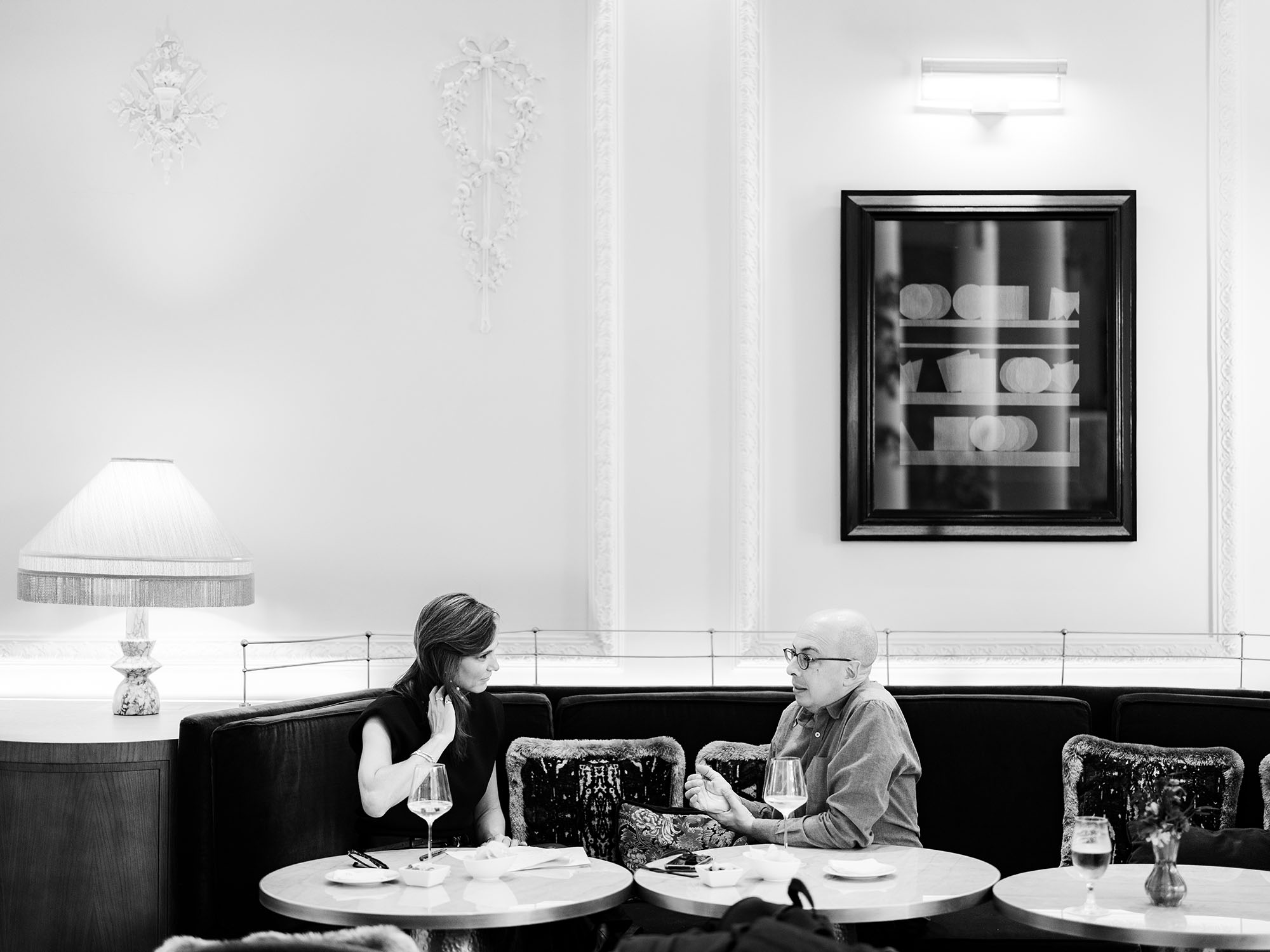
—I saved a question for last that I wanted to ask from the start. I confess that the first thing that attracted me to your novel was its title. The Republic inevitably makes me think of Plato. Can we still imagine a republic governed by reason?
—From the very beginning I knew that would be the title. It doesn’t always happen to me. A lot of my titles aren’t to my taste and some aren’t even mine. In Search of Klingsor, for example, was given by Guillermo Cabrera Infante. The novel had another title when I submitted it to the Premio Biblioteca Breve. But here, indeed, I wanted to establish a deliberate relationship with Plato’s The Republic. Plato imagines a perfect society, albeit hierarchical, ruled by philosophers who have surpassed passions and desires and seek only the common good. Now many tech-oligarchs and posthumanist thinkers believe artificial intelligence could play that role. The problem is that such a model inevitably tends toward authoritarianism. The search for a perfect society ends up becoming a pyramidal and totalitarian structure. We saw this with real socialism and with many twentieth-century experiments. We already live in a deeply unequal society. And both the authoritarian leaders and artificial intelligence are intensifying those inequalities. I fear that from there only more conflict can arise.
—One final question. What remains of that young Volpi from the Crack generation?
—The group of friends remains. Except for Nacho Padilla, who died ten years ago, we still exchange manuscripts and talk constantly. That youthful literary passion from when we were sixteen remains intact. If anything, it has grown stronger. And there remains the conviction that literature, besides being solitary work, is a pleasure to be shared.
—And what about those ideals of the new Latin American literature?
—There remains the Crack manifesto, published exactly thirty years ago. We argued, following in the footsteps of García Márquez, Carlos Fuentes, and Vargas Llosa, for novels capable of portraying the world from multiple perspectives and with multiple voices. I think, in some sense, that is what I have tried to keep doing. Only now without proclaiming it so openly. Without need for manifestos.