
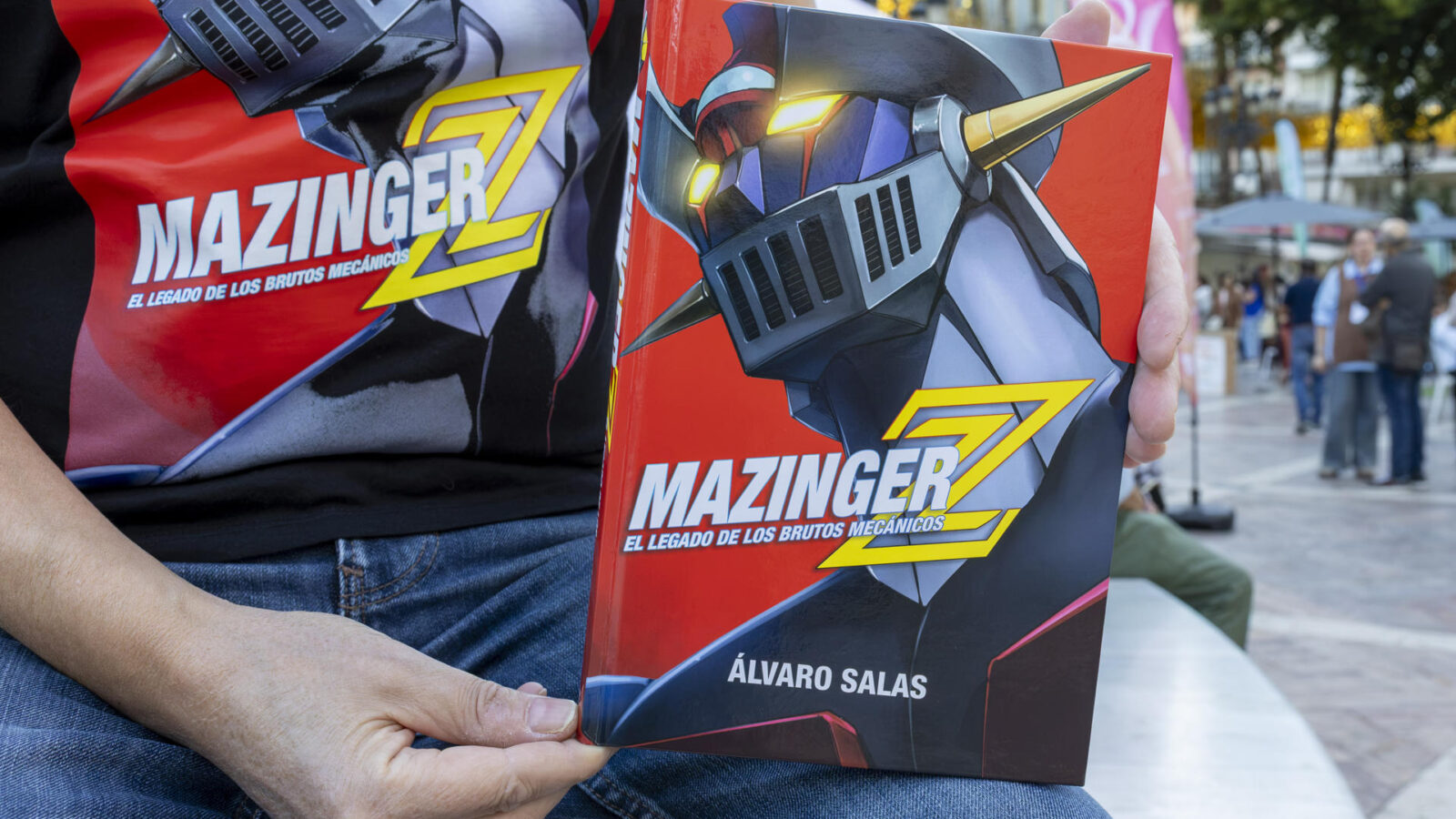
The figure of Mazinger Z continues to evoke nostalgia and passion in equal measure for thousands of people, and that is captured by the Huelva-born Álvaro Salas in Mazinger Z: The Legacy of the Mechanical Brutes, a book in which he traces the history of cartoons that left a mark on an entire generation.
Álvaro was 12 years old when those “brutes” fought the robot piloted by Koji Kabuto, and surely back then he did not know that years later he would be gathering unpublished information in Spain about the giant robots that the Doctor Hell built to dominate the world, in a book published by Dolmen Editorial that serves as a comprehensive reference manual for those who experienced that era with childlike eyes.
And it hasn’t been easy, because although it is etched in memory that the series marked all childhood, in reality Televisión Española only aired 33 of its 92 episodes, between March 4 and September 9, 1978, since those were the only ones for which broadcasting rights were secured. Surprised by its success, they couldn’t acquire more because, in addition, they already had commitments to broadcast another series, Orzowei, from September 16, which appeared on screens without warning, when children anticipated watching at 3:30 PM the episode 34 of Mazinger Z.
The author of the book explains that the series “made all the kids rush home on Saturdays to catch it on TV,” and for him the idea of making a book emerged from his passion for layout and design. “From time to time I paint something, and I started drawing the monsters, but I realized there were too many, and I considered laying them out and creating something akin to a sticker album.” However, he thought of producing something that would document everything he had designed and consulted with a journalist friend, Paco Núñez, who guided him on how to approach the process, until the book finally went on sale a few days ago.
It isn’t solely about rendering drawings. Álvaro Salas reflects on how the series has aged and why the villain Doctor Hell elicits no empathy whatsoever, unlike villains such as Darth Vader in Star Wars, which even arouse affection. “Let’s say the icon of Mazinger Z is Mazinger itself, while Doctor Hell is in the background; it doesn’t unfold the same way as in Star Wars, where the main role is shared among several characters.”
It’s clear the book is aimed at a certain age group, but he has designed it in a way that he does not rule out “reaching new generations,” to whom he proposes opening it and enjoying it “in a very illustrative manner because it has been created with illustrations,” and he preferred it that way precisely to capture all audiences. He also discusses iconic scenes, how Mazinger evolves into a flyer even though it was conceived as terrestrial, always adapted “to what Doctor Hell was designing, from aquatic monsters to flying ones,” or how tricky it would be today to have a character like Aphrodite A, whose main weapon was to launch her breasts, which were missiles in reality. “It has come down to us that its pilot — Sayaka Yumi — would say ‘boobs out’ when launching the missiles, but that was never the case. It’s an urban legend.”
Álvaro Salas believes that today it would be difficult to get children to watch a cartoon series made with 1970s technology, and even to convince them “that either you watched an episode on the day it aired or you would never see it again,” but he encourages enjoying the book and revisiting scenes, such as the moment when its wings were attached, it came out of the pool, or the glider was placed on its head, which he considers his favorite part of the series.