
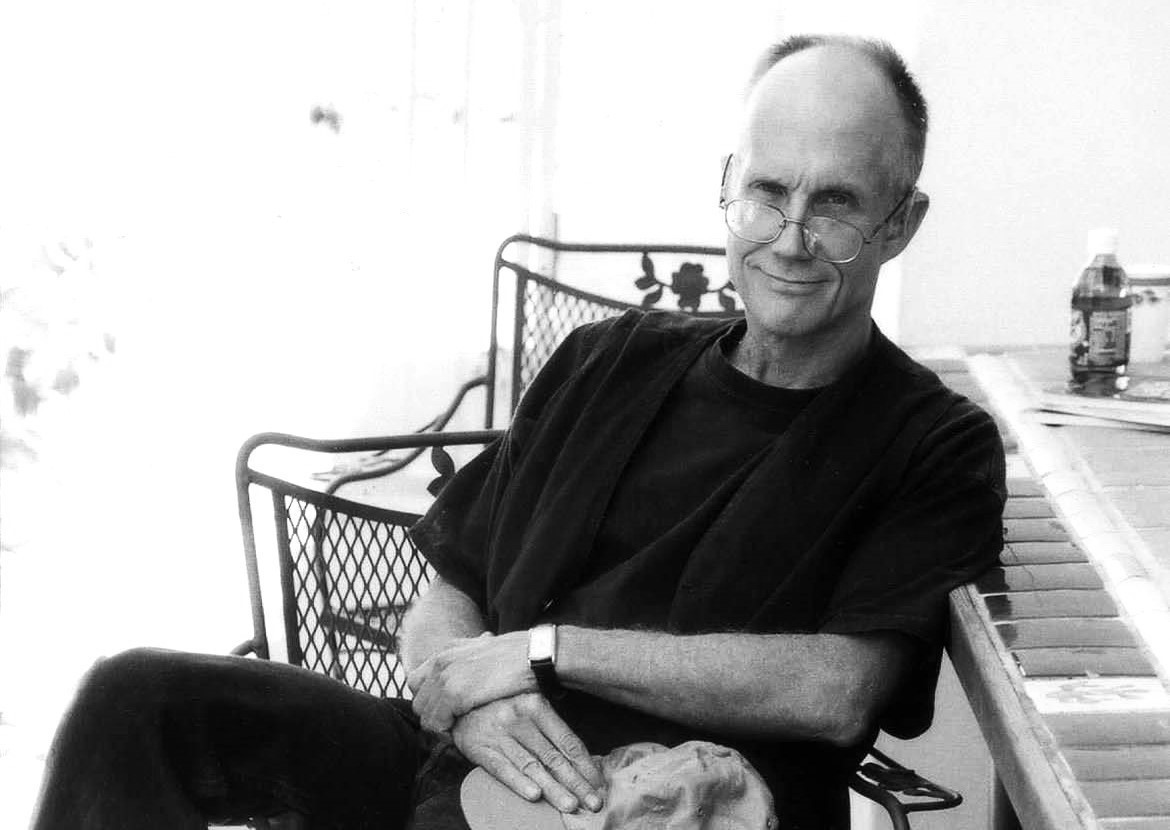
Tony Hoagland was a poet and critic born at Fort Bragg, North Carolina, in 1953. He published the poetry books Sweet Ruin (1992, Brittingham Prize), Donkey Gospel (1998, James Laughlin Award), What Narcissism Means to Me (2003), which was a finalist for the National Book Critics Circle Award, Rain (2005) and Unincorporated Persons in the Late Honda Dynasty (2010). He also published the book of poetry essays Real Sofistakashun (2006). He died in Santa Fe, New Mexico, in 2018. He is one of the foundational critics for understanding contemporary American poetry. We present a selection of poems with translations by Gustavo Osorio, Hernán Bravo Varela, and Berna Wang.
***
Jet
Sometimes I wish I could stay out there
on the back porch, fueling up on jet fuel
with the boys, making ourselves louder
as the empty cans fall from our claws
like jet-propelled rockets dropping back to Earth
and we rise toward the summer stars.
Summer. The great stellar river runs overhead,
carrying asteroids and mist, blind fish
and old spacesuits with skeletons inside.
On Earth, men celebrate their hairiness,
and it is good, a way to let life
out of the box, uncork the bottle
to let the fizzing surge
pour out through the narrow, usually constricted neck.
And now the crickets plug in their devices
in unison, and then the fireflies flash
in dots and dashes on the grass, like scoring
for the labyrinth, tall tales of sex
someone is telling in the dark, though
no one actually listens. We stare into the night
as if remembering the bright and intact planet
from which we once came,
to which we will never
be allowed to return.
We are astounded by how hurt we are.
We would give anything for what we have.
***
The Memory as an Auditory Prosthesis
Somewhere, someone asks a question,
and I rise, glancing around the classroom
with one cupped hand behind my ear,
trying to locate where that voice is coming from.
Perhaps he is already an old man,
trying to remember the night
his hearing was lost,
front row, center stage, in the Battle of the Bands,
where many secondhand musicians, dressed in leather,
amplified to dinosaur proportions,
were test-driving their gear through our ears.
Whenever the drummer threw a tantrum,
the guitarist spun and sprayed us with machine-gun riffs,
as if they wished to leave us flat
literally dead.
That is what we called fun in 1970,
when we weren’t sure it was worth surviving our lives.
I am here to tell you that yes, it was worth it,
and many did it, despite themselves,
despite the road from here to there
being paved with dead brain cells,
parents stunned to silence,
and police cars painting the entire neighborhood
with the trembly tone and texture of red jelly.
Friends, we should have marks on our foreheads
to show where we have been;
we should have pointy ears, or skin with freckles
to show what we were thinking
when we did the drag races in God’s front yard,
and Death kept blinking.
But here I am, an average-looking man
staring into a chamber
where a blonde braided woman
with a beautiful faith in answers still asks questions.
Through the silence in my dead ear,
I can almost hear the future whispering to the past: it says this is not a test
and everyone passes.
***
Personal
Don’t take it personally, they said;
but I did, I took everything quite personally –
the breeze and the river and the color of the fields;
the price of grapefruit and stamps,
the damp hair of women in the rain –
and I cursed what hurt me
and I praised what gave me pleasure,
the simplest and plainest of possible answers.
The government reminded me of my father,
with his deafness and his laws,
and the weather reminded me of my mother,
it’s her tropical downpours.
Enjoy it while you can, they said about Happiness
Think before, they said about Speaking
Get over it, they said
in the School of Broken Hearts
but I couldn’t and I didn’t and I don’t
believe in a clean break;
I believe in the fractured whole
served with a sauce of dirty remorse,
I believe in saying it all
and retracting from it all
and saying it again to keep balance
while the air fills with sorrys
like birds in a flock
and the trees seem dazed by the wind.
Oh life! Can you blame me
for making a scene?
You were that yellow van, the moon
disappearing over a cloud bridge.
I was the dog, tethered in some idiot’s backyard;
barking and barking:
trying to convince everyone else
to take it personally too.
***
How It Keeps Adding Up
There is the day I swam in a river, a lake, and an ocean.
And the day I quit the job my father had gotten me
And the day I stood outside a door,
and heard my girlfriend making love
with someone, obviously not me, inside,
and I felt strange because I didn’t care.
There is the morning I was born,
and the year I was a loser,
and the night I won the prize
for which the audience applauded.
Then there is someone else I met,
whose face and voice I cannot forget,
and her memory
is like a prison in which I am trapped,
or maybe she is only something I use
to keep my real life at a distance.
Happiness, says Joe, is a red wildflower
torn from a river of lava
and held aloft by a taut rope
dangling between two gaunt trees
over a canyon
in a manic-depressive windstorm.
Don’t let it go, Don’t let it go, Don’t let it go—
And when you do, you’ll keep searching for it
everywhere, for years,
while behind you,
the tracks you leave
will look like notes
of a crazy song.
***
No Word
There is no word for walking out of the store
with a gallon of milk in a plastic bag
that should have been double-bagged
– so that before you exit through the door
you do not feel the bag dragging downward, pulling
the thin plastic handles more and more
and you know that only a matter of time remains
before the bottom suddenly gives way.
There is no immaculate word for that vague sense
that something is slipping away from you
as it exceeds its elastic capacity – which is very bad, because that is the word I would like to use to describe
standing in the street, talking with an old friend as certainty grows in me that he is no more than a acquaintance,
a person with whom I never made the effort –
until this moment, when as we say goodbye
I think we share a feeling of relief,
a recognition that we have reached
the end of a pretense,
though to be honest
in what I am already thinking
is my gratitude toward language –
how it will stretch just enough and no further;
how there are some gaps it can never fill;
how it will move, if not inward, then
around the circumference of almost any thing –
how, over the years, it has returned to me
all the hours and the days, all the slow
love and heavy faith, all
the misunderstandings and the secrets
I have willingly poured into it.
***
The Father’s Story
This is another story I think about sometimes:
the story of the father
after the funeral of his son, the suicided boy,
who comes home to burn the photographs of the boy already dead;
who stands by the backyard grill
and tosses the images into the fire; who watches the smoke rise
and fade into the sweltering Mississippi sky;
aware that he is standing on the edge of a vast border,
not realizing that he has hoarded the pain entirely.
How calm the suburbs are in the middle of a afternoon
in which a man is destroying evidence,
inhale the chemical of burned Polaroids,
watching the trees through the rickety fence,
how they seem to rise and nod in recognition.
Soon after, he will be surprised
by the anger of his own family:
the wife who covers her face with her hands
and the daughter insulting him.
But for now, he is sure of what he is doing; now
he seems like a man who might destroy some religion
or hew the roots from some tree.
Without stopping, I have arrived just in time
to see him take a rusty wire
and, with it, push the last photo
of the boy into the orange part of the flame:
the face browning to coffee, the memory ending in negative.
Not the bastard logic of the father,
not the pity for a wasted youth,
but the ancient intelligence of pain,
that is what I admire:
how it moves around and inside him, like smoke;
how it knows exactly what to do with human beings
and thus remains in them forever.
***
Benevolence
When my father dies and returns as a dog,
I already know what his favorite sound will be:
the soft, almost inaudible whine
of the rubbery lips of the fridge door
as they pull away, followed by that arctic hiss of cold air;
then the click of the ice tray on the sink
and the gentle tinkle the ice cubes make
as they fall into a glass.
Unable to pronounce the name of his favorite drink or to express
his preference for single malt, with a rough bark
he will point the damp black arrow of his nose
upward toward the bottle on the shelf,
then he will sit before me, trembling, expectant, the water pouring
from the long pink hanging tongue as the memory of his former life’s pleasure
makes him tremble like a tail.
What I will remember when I rise above him,
holding a dripping whiskey-flavored ice cube over his open mouth,
enjoying the power that runs through my veins
the way it ran through his,
what I will remember when I stand there
is the hundred tricks I learned to please him
and all the time I wrongly believed
that what hid in my closed fist was love.