
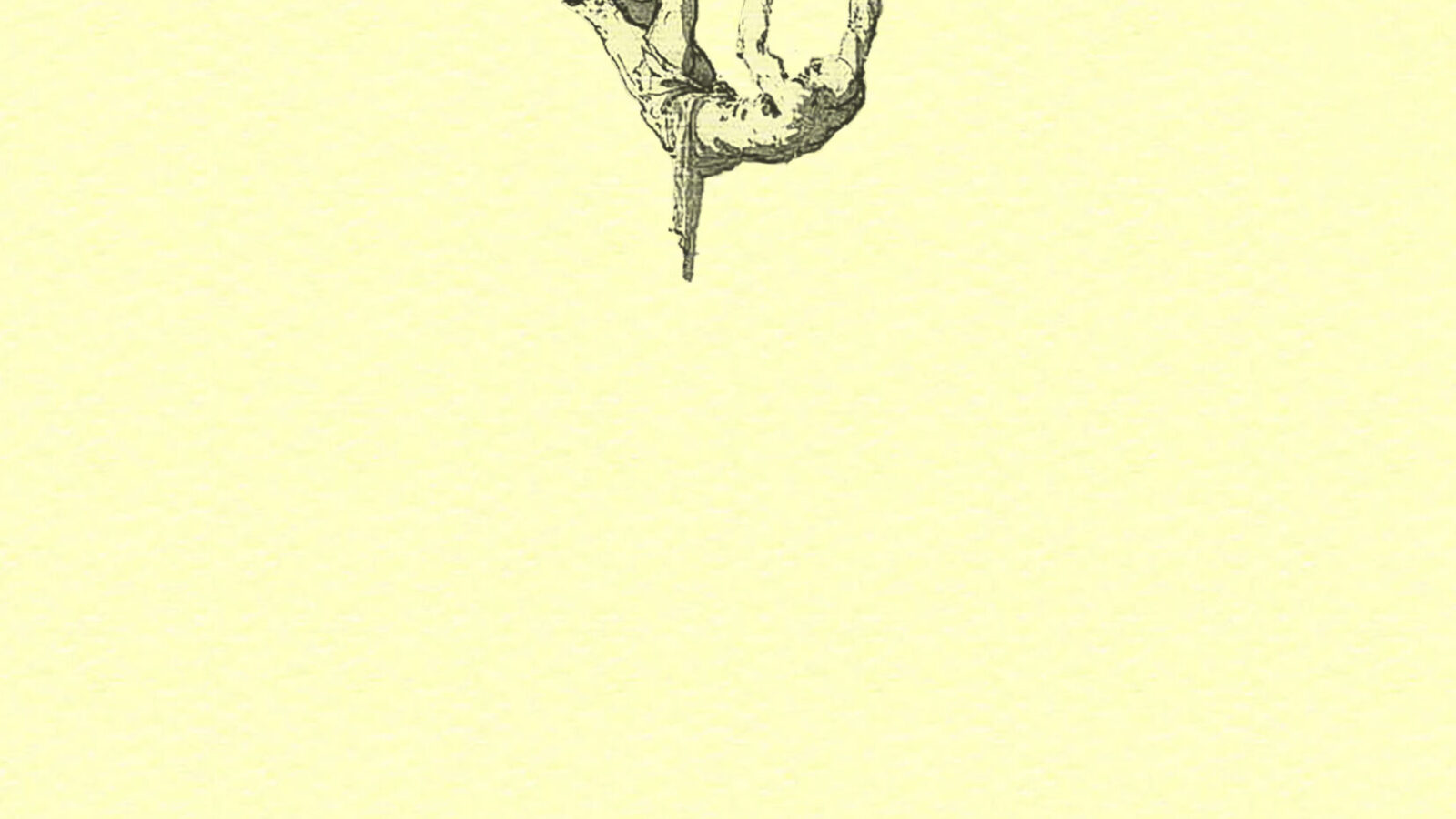
Aeneas, bearing the body of his elderly father as he fled Troy in Virgil’s Aeneid; Ada Salas bearing the body of her mother in the verses of Mad Grammar (Pre-Textos, 2026). An ineffable pain, which alters grammar, threads through this new book by the Extremaduran poet. The title recalls The Extraction of the Stone of Madness, both to Bosch’s painting, which she cites, and to Alejandra Pizarnik’s poetry collection, in which the Argentine approached the possibilities of language to refract the complex experience of madness and alienation. In this, she connects with that slide along the edges of language to open syntax and semantics, disemboweling the impotence of both to express the experience of dementia and maternal death.
Mad Grammar
is a book that unsettles on every front. The care provided by the daughter to her elderly mother with senile dementia or Alzheimer’s disease does not hide the sores and the wear that this coexistence and caregiving entails. Care, historically feminized and relegated to the domestic sphere, takes on an ethical dimension that we can associate with Carol Gilligan’s reflections on the ethics of care, which contemporary society tends to ignore or push aside, making this writing even more indispensable.
The book unfolds as an unfinished, disenabled dialogue between an adult daughter and her elderly mother, whose cognitive decline alters the usual forms of communication and makes the dialogue uncertain:
“the other day she said
I am making love
who/said that”, while it becomes a meta‑linguistic reflection on the limits of grammar: “My mother is a suffix / lying on a cot” or “-adverbs in the mind have something / of useless to write / it is useless / but a single adverb can save you / for example, finally, so that something happens /
unexpectedly
-. What comes after -attribute- is /
desperation
”.
Perhaps for this reason, one of the most significant aspects of this book is the tension and twisting of language as a reflection not only of illogical and incongruent communication with a mother who seems to talk only with figures that inhabit her disoriented memory and childish regression:
“communicare: what can
be done in common. She moves
her right hand
toward something toward someone we do not see or hear
we are
not
us.”
But it is also a reflection of the language’s incapacity to reveal and confirm a lived experience, as if words and syntax disguise reality to make it bearable:
“-what
could I be thinking, you idiot, I believed language
orders the universe-”
Or
“I speak well the correction
of syntax. Syntax
comforts.”
Neither poetry nor writing remediates the tightness of the air that suffocates the word, challenging its faith in them:
“poetry is what we freely make
that bargain. And here come
the buts who said
words are light and light
does not obey words
(…)
the wrath of the muses heating up the engines you see
you don’t want ready-made phrases
well you’ll have to put up with them
it comes out, so you’ll just have to deal with that”
Ada Salas goes further with this poetry collection in that she abruptly breaks linguistic rules to reproduce the fracture between thought and speech, as well as the impossible mosaic of a maternal conversation. The short lines, the harsh enjambments, the syntactic alterations and the repetitions, along with the scarcity of punctuation and capitals and the absence of titles, compose a long fragmented poem that eschews pre-set structures. It is a book that moves away from conventions, where the poem sits between the saying and how to say what one does not even know how to say, because it dwells between life and death, a cognitive deterioration that, like a limbo, cradles a body suspended at the limits of language, clearly in tune with María García Zambrano and Her Body Speaks. Because Mad Grammar leaves behind the realization of the cultural debt to rationality and its linguistic expression to shape the world and its bonds and one’s own identity: “I take that word with me. I place it / in the puzzle it does not fit with any.”
The suffering for and from the mother, already dying in the first poem, moves from the everyday into verse to sketch the failure of language. The book thus embraces an ambivalence between tenderness and trembling, between love and the caregiver’s exhaustion, sustained by a measured alternation of diminutives (mamita, cuerpito, vasijita, lombricita), children’s songs (“sawdust/ they saw/ little hallway of San Juan”), curses (“son of a bitch” “fed up to death”), filler phrases, proverbs (“eyes that do not see, heart that does not feel”) and stock phrases (“my mom doesn’t pamper me”) which, like the systole and diastole of the maternal heart, pump the heart of this book. These resources braid with the linguistic lexicon (metaphor, syntax, circumlocution, deictics, irregular verbs, adversative conjunction, nouns, adverbs, pronouns, attribute, synonym…), germinating as a hypernym acting as the warp on which the futility of dissolving such pain is told, a semantic field from which they cannot free themselves:
“the shell
empty
of language
I cannot
digest
what you tell me”
The use of italics sustains and amplifies these resources, while attempting to reproduce an impossible dialogue, sometimes an expression of colloquial speech, noticeable for example in recurring structures that alternate the verbal person, to distance and identify the voice of the poet and that of the mother: “finish up really I can’t breathe” and, in another poem, “the little owl of time finish up really cannot breathe.” The stupid and incomprehensible language, from whose briars she desperately tries to disentangle herself, gradually returns after the mother’s death to re‑adjust itself, because “an ending can be / an infinitive,” and:
“today, what does it matter
that my mother is dead.
Mother, my dead mother. I had to
write it that my mother
has died.”
The language becomes indispensable for a farewell that implies a discovery of oneself.
This stumble between the mother seems to migrate, instead, into another dialogue with poets and writers, in which the poet appears to find mirror and refuge: Jorge Manrique and his vita flumen, Cervantes, María Zambrano, Celan, Rimbaud, Machado, Lorca, Rosales. There are also Homer and his Iliad, whom she dares to sing of her daily life, her fatigue and her suffering, an epic perhaps greater than Priam’s in rescuing Hector’s corpse. The references to the Greco-Roman world are not few: Nike, Zeus, Orpheus, Scylla and Charybdis, Saturn, Latin epitaphs… which evoke her previous Archaeologies (Pre-Textos, 2023) and remind us of the perpetuity of pain in the face of the loss of loved ones.
In Mad Grammar, Ada Salas stuns with a hybrid poetics in an aesthetics that wobbles between the avant-garde and the figurative, wielding language to brush the threshold of what humankind’s abyss trembles with. This book rests on the paradox of a writing that makes visible its own insufficiency and incapacity, stripping bare its fragility and its limits, while at the same time revealing its necessary existence. Although language cannot reconstruct the loss, she surrenders to it as long as grammar can order the world. Ada Salas carries her mother in every verse to save her from the collapse, as Aeneas did when fleeing Troy with his father.
—————————————
Author: Ada Salas. Title: Mad Grammar. Publisher: Pre-Textos. Sales: Todos tus libros.