
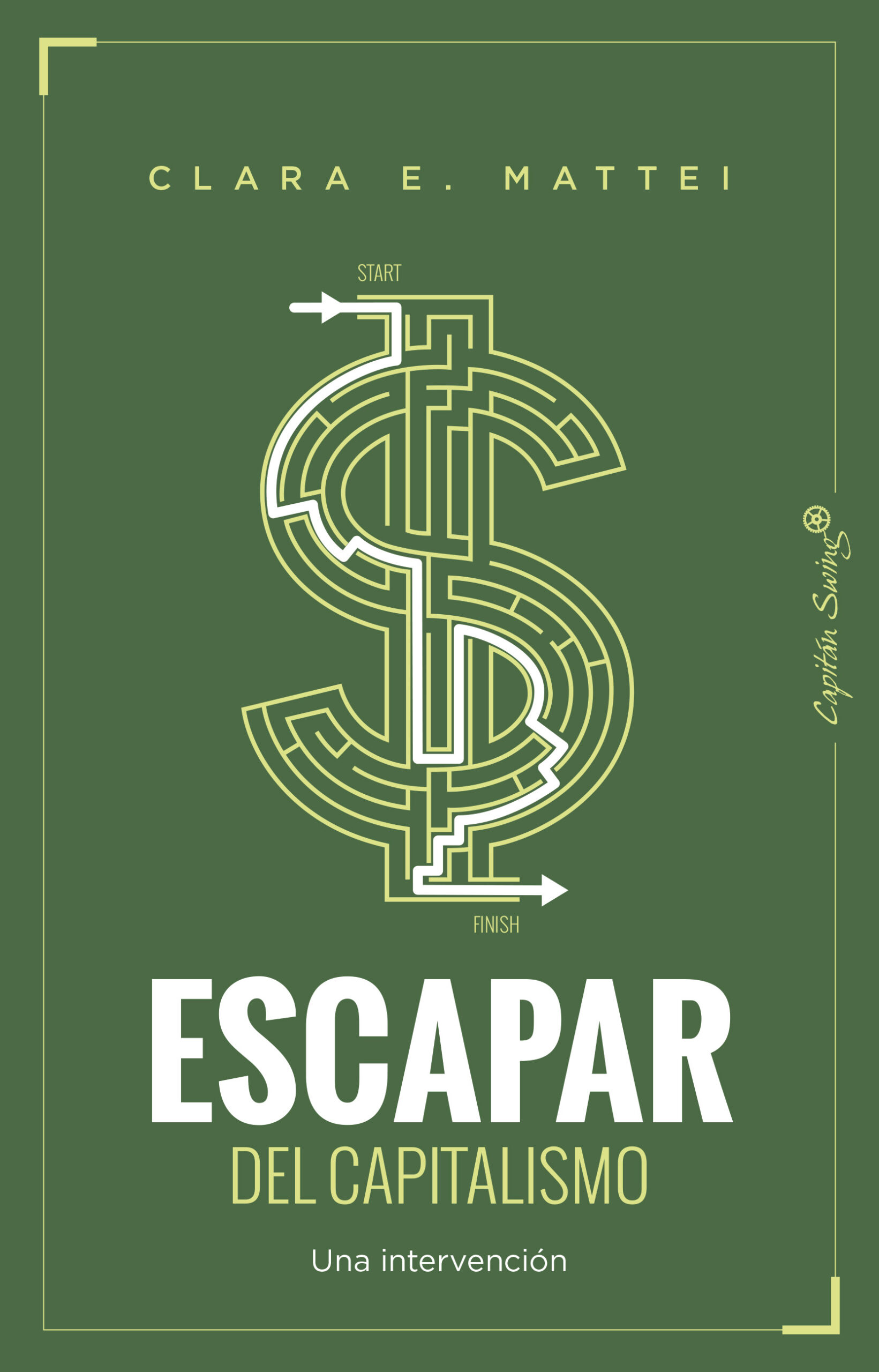
According to economist Ameth Tonak, the rate of exploitation of workers to produce the iPhone X (Apple’s 2017 model) is twenty-five times higher than that of nineteenth-century factories at the dawn of the Industrial Revolution. If Apple were to manufacture its popular mobile phone in the United States, it would have to sell it for $30,000 to obtain the same profit. Although working conditions in many Asian countries are inhumane, American workers are not faring any better: more than 44% of wage earners in the US do not earn enough money to cover their basic needs. It isn’t only that many of those who receive government assistance have a job; more than half of the “homeless” have a job. All these data, and many more, are found in Clara E. Mattei’s essay, Escaping Capitalism (Capitán Swing). Mattei, in her book, challenges the idea of the inevitability of capitalism, a system that can be replaced; she denounces that the economic decisions shaping our lives are made by organizations and institutions outside democracy, such as the Federal Reserve and the IMF; and she advocates fighting to achieve a different economic system from the current one — grounded in perpetual debt, as punishment for people and a driver for the growth of the wealthiest, and that uses austerity as a tool to benefit a few — that does not prosper at the expense of humanity. A final note gathered in this work: Clara E. Mattei cites in one of the chapters David Harvey, who asserts that if an observer could travel through time, they would find no differences between the working conditions of Manchester’s cotton factories in 1840 and the employees of the Rana Plaza textile complex (Bangladesh), which collapsed in 2013, killing 1,129 workers. Robert Chalmers uttered a century ago a phrase that alienated workers: “Work hard, live hard, save hard.” The motto remains in effect, but with a small variation: “Work hard, live hard, indebted hard.” Cthulhu has already been subduing us for a long time, and Mattei argues for returning it to the depths of the Pacific Ocean and seeking a more humane and solidaristic economic option.
We spoke with Clara E. Mattei about how exploitation is in the DNA of our economic system, about how Keynes tried to shield capitalism from itself and the punishment that austerity represents for workers.
*****
—Capitalism concentrates wealth in ever fewer hands: “For every dollar earned by someone in the bottom 90%, a billionaire earned $1.7 million.”
—In my study I have sought to show that this is not merely a problem of the financialization of the economy, of the system’s corruption. There is now a great inequality, and this is something that is hard to hide. There are different methods to analyze this inequality. The less radical ones point to financialization and excess monopolies, together with corruption, as the causes. In my case I refer to the Marxist critical tradition, which speaks of a structural inequality in the capitalist productive process. We must understand that there can be wealth only if there is poverty. That is how capitalism works. The exploitation of labor is the key. This is not discussed because it is assumed that in our dominant economic model there is no exploitation. In mainstream economic theory there is no such concept. The idea is that the worker receives compensation according to the marginal productivity of labor, i.e., what they deserve. I realized that if you do not understand that exploitation exists, you cannot understand all the processes that generate inequality. This exploitation is intrinsic to the capitalist system.
—Should we understand techno-feudalism as a degradation of the wildest capitalism or as an opposition?
—The existence of great power in the hands of a few is a consequence of capitalism. This, of course, is an excess, but it is not an opposition and it is not corruption. The system needs debt, the system needs oppression, the system requires the subordination of many. Mainstream theory is very Keynesian: combat poverty, defeat unemployment, social measures are good for the system… This is Keynes’s innovation; he tells people that these measures can be good for the system because they help improve productivity, growth, and stability. I think that is very confusing. In fact, returning to the Marxist tradition, these social measures are bad for the system because they can empower us. And this is not compatible with capital accumulation. If we speak of feudalism, we are talking about a very deep power; there is still wage labor and economic coercion. In feudalism you knew who your exploiter was; there was political coercion and you were not free under the law. That hasn’t changed. We are still exploited by economic forces. I think talking about feudalism distracts from the fact that we are still under wage labor, and that all processes have accelerated to create more inequality. I don’t find it useful to avoid pointing to capitalism in this situation and blaming techno-feudalism. This is not an opposition to the system, it is merely its most extreme manifestation. I return to Keynes: his idea of capitalism and humanity, of capitalism and social reforms, is not true; Keynesianism was a bourgeois lie. It did a lot of harm to social movements that could have capitalism and workers who are happy. Keynes tried to shield capitalism from itself. When there was a great Depression in the 1930s, everyone wanted to escape capitalism, and he said: “We can have capitalism and simply make it more humane.” And I think this is conceptually very distorted, because it prevents us from making a real critique of the system.
—Milei, Trump y el resto de populistas se proclaman alternativa al capitalismo. Esos políticos señalan que la austeridad es la solución.
—Keynesians tell you that austerity is bad for the economy, but, in truth, austerity is bad for us, for the logic of necessity; whereas it is very good for the logic of profit, which governs. Austerity encourages private investment and maintains our dependence on the market. Austerity protects wage labor and private investors. Austerity is not cheap; austerity is very costly for the State. Why? Because you are not taxing capital. The State relinquishes its revenues, apart from tax collection. The State does not tax corporations, does not tax rents, does not tax inheritance; it taxes workers, who now have less income. And moreover, the State is spending a lot of money subsidizing private investment. We must stop thinking that austerity is good.
—Many people who work do not have housing. Seventy percent of those who receive assistance are also wage earners. Are we witnessing a regression to the conditions of nineteenth-century workers?
—Now is the moment to ask ourselves whether we want to continue turning every aspect of our lives into a commodity we cannot have because we do not have the money. And to question whether we want to demarketize services. We cannot remain trapped in the idea of delegating everything to private investors. We are handing over decisions about our lives to private investors who have no real interest in us. And yes, in that sense we are like the nineteenth century, and we need to change this. The aim of my book is to use a new lens to see that this is the real problem, and that capitalism will not provide us with humanity. There cannot be a future for us with capitalism. We need to radically change the system, and this will not be easy.
—In these past weeks in Spain there have been many protests demanding changes in housing policy. We had an encampment at Puerta del Sol and on November 11 there is a scheduled general strike. People are coming together to protest.
—This is the message of the book. If we understand how the system works, we understand that economic value is produced by workers. If workers organize, they can change things. This is the only lever of pressure, because technocrats reason according to the logic of profit, which is incompatible with the logic of need. In Tulsa we have created FREE (Forum for Real Economic Emancipation), where we are organizing a model with the assembly as a way to relearn collective decisions. It is about not being just consumers, but being co-decision makers, making decisions together. In this forum we organize public events about the economy. Now we are defending public schooling in Tulsa. Now they are paying a voucher to parents to send their children to private school to close the public one. Now we are working on the land ownership project — Community Land Trust (CLT) — to prevent speculation, guarantee housing affordability, and have people manage their home as a common good. We are also expanding the FREE model to other cities and countries. We aspire to create strong organizations that can be heard by the city councils of their cities. If you organize something solid, you can press the governments, you can organize alternative economies, and break the market’s dependence.
—We conclude. The book not only contains data and reflections on economics and politics, it also tells the story of her great-aunt Teresa Mattei.
—Teresa was my grandfather’s sister, on my father’s side. They were a family deeply committed to the fight against fascism. She was a partisan and suffered greatly in that era. When the war ended, she became the youngest deputy in Italy’s Constituent Assembly. Teresa was a very strong woman and also very nonconformist. She was a member of the Communist Party, but she criticized Stalinism and left the organization. She was extremely independent. For me, maintaining independence and integrity is also very important. I learned this from her. Her brother, Gianfranco, who was also a partisan, was detained and tortured; he committed suicide to avoid betraying his comrades. It is important to remember that fascism is a kind of consequence of capitalism, and that its violence is real. This was also seen in Spain. And we are now seeing it in Palestine. We also need to understand oppression from an economic perspective: “Israel has established an economic dependency of Palestine analogous to the one Western countries exert over the rest of the world […]. In the last hundred years, the economic structure of Palestine has transformed to serve the Israeli economy” (p. 132).