
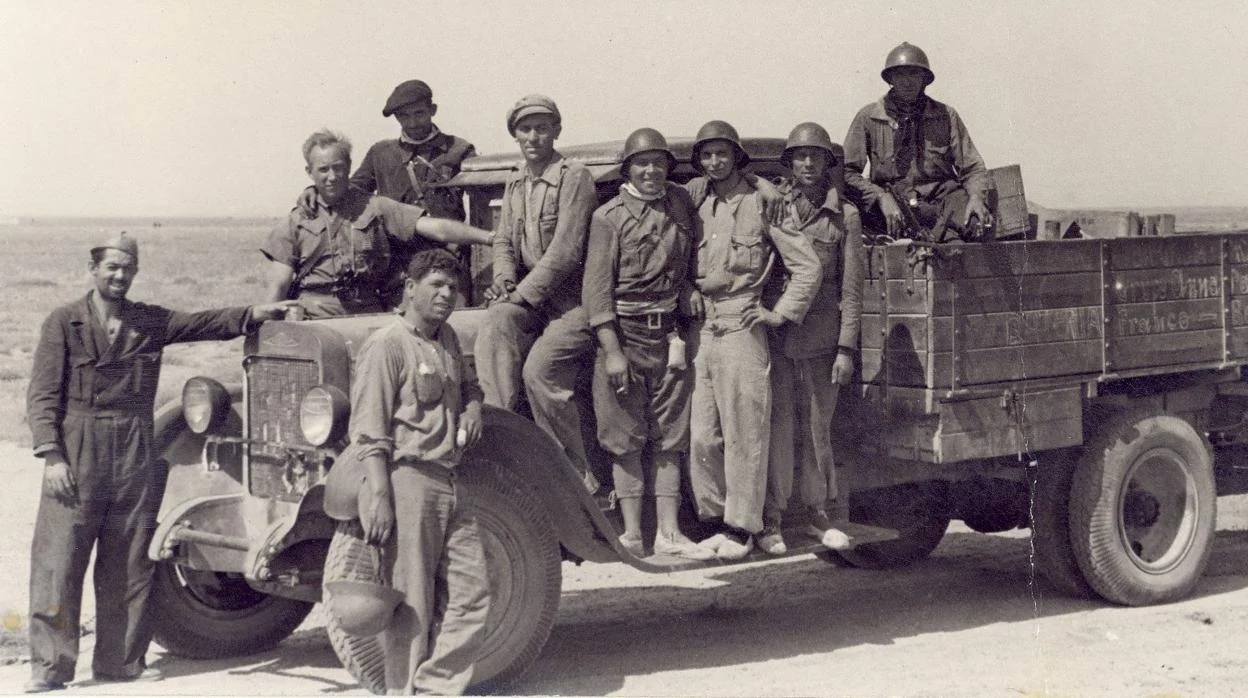
To commemorate the 90th anniversary of the Civil War, José Ángel Mañas recreates in Zenda, day by day in this section, what happened in 1936, perhaps the most transcendent year in all of Spain’s recent history.
Thursday, November 5, 1936: The Brigadists’ Trucks
“This driver doesn’t know where he’s going,” said John Cornford. “We’ve gotten lost.”
The English brigadists looked at each other, sour-faced. Their rifles shone under the rain. They were American-made Remingtons from 1914, with a five-round magazine, a glare shield. The stocks showed nicks, but the metal was in good condition. John Sommerfield liked his. The bolt moved smoothly. The trigger worked, it was well balanced. The one drawback was the weight, five kilos. But they were as good as any rifle you could find among the Republican side. Since they had been handed to them at the Albacete training center, he and the rest of his comrades had treated them with care.
The ammunition arrived in somewhat old British packaging boxes. Each man was issued two cloth cartridge pouches, fifty rounds per head. On top of that, each day they were given bread, sardines, wine. That was what they had eaten for supper before departing. Since they had been in the truck, they spent the time singing typical English tavern songs such as The old grey mare and She was poor but honest.
She was poor but she was honest
A victim of a rich man’s whim
First he loved her, then he left her
And she lost her honest name
The journey was tricky. From Albacete, by train, to Alcázar de San Juan. There, upon leaving the station, they found a long line of trucks. The forty Englishmen climbed aboard theirs in a hurry. With them went their gear: forty packs, forty rifles, forty blankets. The truck wasn’t large. Some of the rifles pointed at the eyes of others. John Sommerfield, the tallest of the group, crouched in the back. While they sang again, he kept glancing at his companions. The rear gate pressed into his back.
The road was in terrible condition. Any Spanish county road was narrow. At times they disappeared, turning into dirt tracks with potholes, winding. Despite everything, the trucks advanced at a reasonably brisk pace, crowded with men, cold. Among the British only John Cornford, acting as leader, laughed when the song ended and protests began.
“What did you think the war would be, a bed of roses?”
Sommerfield’s rear end ached. His legs went to sleep. Around them, dawn began to break. He confirmed that, indeed, they had become lost. Up to then, every time they took a turn they could see the convoy of trucks, dark green, full of troops, in front of them. The fields were covered with olive groves. The line had stretched out as the night wore on and, before dawn, they eventually lost sight of it.
The driver stopped the vehicle at a crossroads. The signs pointed to cities. John Cornford got out to argue, before turning back to the others, who were stretching their legs again.
—Toledo is fine, but we don’t want to go there —he said—. We’re heading for Madrid. For Alcalá de Henares.
The first rays of the sun brushed their ruddy faces. There were yawns. The light dazzled their eyes, warming their cheeks a little. While Cornford argued with the driver, John Sommerfield checked the truck and found that it was Russian. The engine had something written in Cyrillic on the tires and hubcaps.
—It’s a good truck, sturdy and efficient —observed Bernard Knox, approaching.
All the entries of 1936 day by day
Interview with José Ángel Mañas about 1936 day by day