
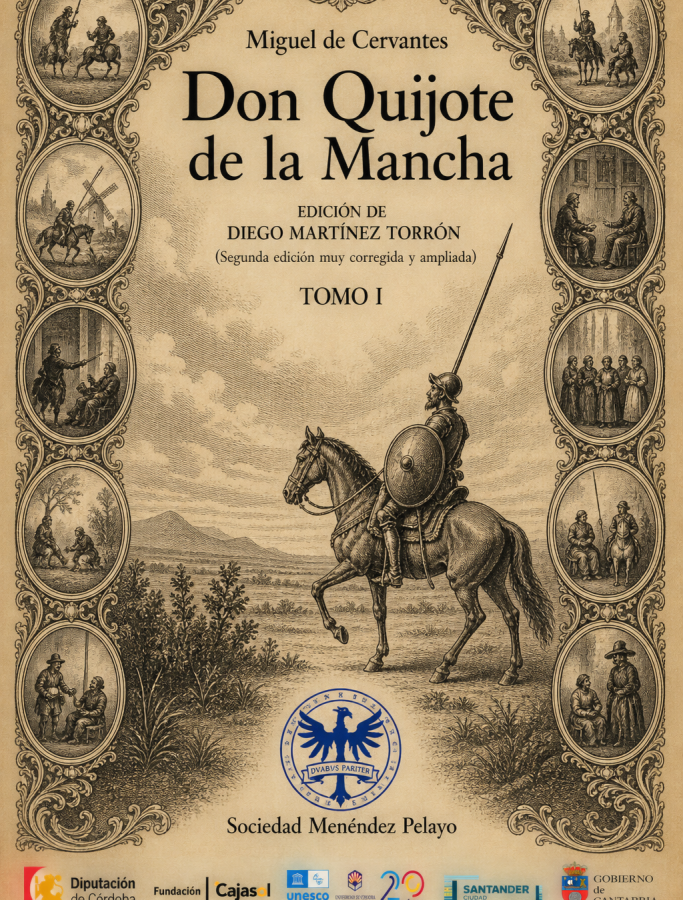
Monumental edition of the Quixote that the author has been working on since 1987. With almost 6,000 philological notes, it is published in a web edition and in print in a non-venal bibliophile edition for distribution in libraries. With a back-cover text by Luis Alberto de Cuenca.
In this making of Diego Martínez Torrón (editor) summarizes his years of research to develop this critical study of The Ingenious Gentleman Don Quixote of La Mancha, 2nd greatly expanded and definitive edition, Santander, Sociedad Menéndez Pelayo, 2026, 3 volumes. And freely accessible online (Volume I, Volume II, Volume III).
***
This is a monumental edition of the Quixote that I have been working on since 1987, alongside my studies in Spanish Literature of the 19th and 20th centuries.
It can be downloaded for free, and saved on the computer, in the three files mentioned above.
In print it is published in a non-venal edition for distribution in libraries
.
It is a different edition that completes, greatly expanding, the Renaissance edition (2020), additionally adding a third volume that contains almost all of the author’s Cervantine studies.
I used to be asked by a colleague why I write for a reader. I have a clear answer: I abhor fame but I would not mind being a cult author, both in my research work and in my creative work — poetry and prose — most of which is freely accessible on my portal at Cervantes Virtual.
I write for a minority, especially in these times. For an idealistic reader who is passionate about literature, about its beauty and its ideas, from which we can always learn in the classics.
This Quixote corresponds to my dual formation as a philosopher and as a philologist. It thus addresses matters of thought and content, rather than the formalism of many other editions that are examined here. But it also places a wide emphasis on Cervantes’ thought in a way that had not been done before. And it proves to be the work of an author with ideas very relevant today, with a remarkable richness in its progressive character. It contains a broad interpretation of Cervantine expressions, whose meaning we have lost. And a textual fixation that differs, placing the sentences in apposition between commas in a more logical way, compared to the traditional form that I believe was based on the text’s intonation for being read aloud by the scarce readers of the time: this is rewriting Cervantes’ text in a more logical way. It also greatly emphasizes, in a distinctly different manner, the editions from the eighteenth to the twentieth centuries, with particular focus on those of the eighteenth and nineteenth centuries, yielding interesting conclusions.
Preparing this edition has been a long process in which, as I have said, I have been immersed since 1987, participating in research work at major North American and French universities, collaborating in numerous international conferences, and delivering lectures in doctoral courses in Berkeley, Sorbonne, Oxford, etc.
This Quixote offers a detailed study of the content of the work, clarifying Cervantes’ thinking, very advanced for his time, with a modern democratic vision and a very brave social critique of the powers that be, which manages to evade censorship through irony, in a very intelligent way, and with the play of opposites to mislead the censor.
In contrast to the more formalist, though valuable, approaches of other editions of the work, this one thus tackles questions of thought and content. And it demonstrates Cervantes’ progressive vision. Thus this edition represents an application of the methodological concept of the relationship between ideology and literature that the author has been writing about for many years. Therefore, the detailed analysis of Cervantes’ ideology constitutes one of the principal contributions of this edition.
It shows that the truth underlying the narrative makes it eternal, in contrast to the more evasive modes of fiction of other literatures.
For example, it shows how Cervantes destabilizes the era’s penal code in the scene of the galley-slaves. The feminist sense of the delightful character of Marcela. The social critique of the all-powerful aristocratic caste of the era in the episode with the dukes. The nearly anarchic sense of the discourse of the Golden Age. Critical allusions to the Santa Hermandad and even to the Inquisition. Defense of the Moriscos. Bold positive allusion to the Lutherans in the dialogue between Sancho and the Morisco Ricote. An open-eyed view of the Muslim world, though guiding it toward social integration through the conversion in the female character of the captive’s tale. And a long etcetera across more than 6,000 philological notes.
Together with the previous, this critical vision dodges censorship with two resources: the use of irony; and the balance of one part lime and one part sand in a game of opposing paradoxes. Also in the fact that madness was allowed to tell the truths in that era because it was part of the entertainment.
A monumental edition that I hope you will enjoy freely.
—————————————
Author: Miguel de Cervantes and Diego Martínez Torrón (editor). Title: The Ingenious Gentleman Don Quixote of La Mancha. Publisher: Sociedad Menéndez Pelayo.