
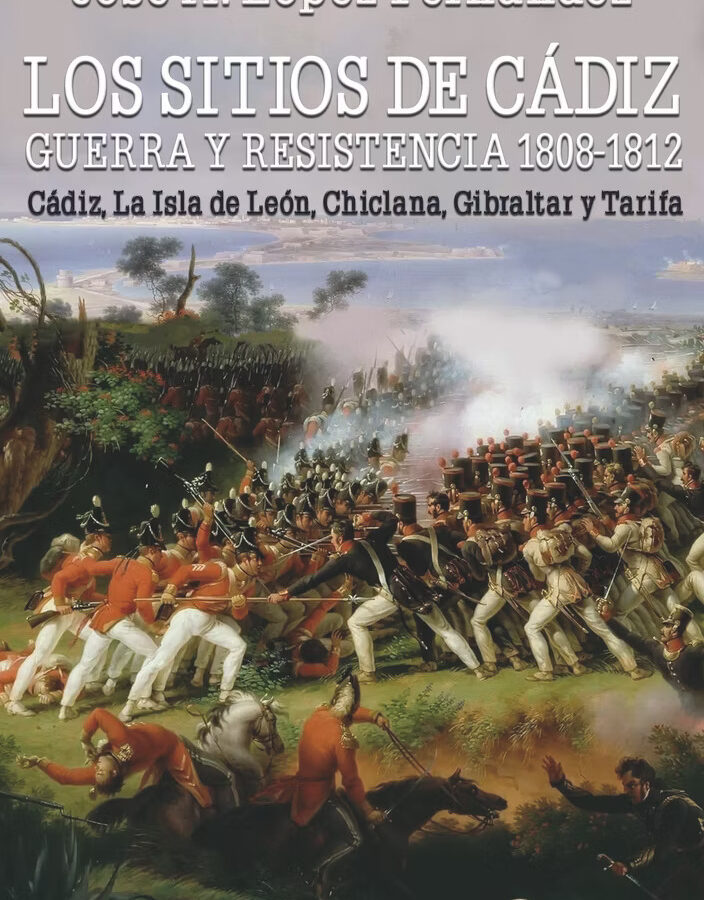
The author offers first the historical and social context of the place and the era, to then move on to the arrival of the French in 1808, to the description of the fortifications already in place and the improvements made in 1809, to the siege of León Island, to review the naval forces and the so-called “guerrilla warfare,” continuing with the preparation of the Anglo-Spanish counteroffensive and the military actions that occurred in 1810 and 1811. Finally, a detailed analysis is provided of the main combat actions, especially the Battle of Chiclana (March 1811), the siege of Tarifa and the battles of Bornos (1812), culminating in the abandonment of Andalusia by the French army. The book, published by Ediciones Salamina, has 320 pages and contains maps, illustrations of uniforms and weapons and photographs of the current state of some of the places mentioned.
Through a QR code on page 29 one can access the Atlas of Fortifications of León Island, by Carlos Vargas Machuca, hosted in the Virtual Library of Bibliographic Heritage. Detailed information is also provided for each military unit involved on both sides in each action described, though it spans several pages, and for the evolution of the troops and the battles, sources such as the operation diaries of the 4th Army or press reports appearing in publications like El Conciso or La Gaceta de la Regencia just a few days after the events are used.
From Cádiz, the army of the Captain General Castaños had already departed in 1808 and defeated General Dupont at Bailén, a pivotal moment that helped persuade the British and Portuguese that it was worth helping to stop the French advance, and from Cádiz troops would also be supplied that in 1813 and 1814 ended up driving imperial forces out of Spain. In the meantime, especially from 1810 to 1812, the Cádiz province (although it did not take its modern boundaries until 1833) received the firm and violent attention of the best of the Napoleonic army.
After the May 2, 1808 uprising in Madrid against the French occupiers and the open war that it triggered between Spain and France, Cádiz was one of the places where similar actions occurred, namely an assault on the French consul’s house, on the artillery park to seize some weapons, and on the Captaincy General, guarded that day by none other than José de San Martín, the future “liberator” of Chile and Argentina. As a result of these disturbances the military governor of the city and captain general of Andalusia, Francisco María Solano Ortiz de Rojas, Marquis of Socorro and de la Solana, was killed.
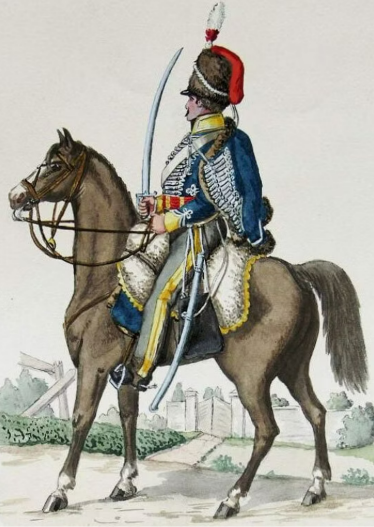
In early June there was already a first victory in direct confrontation against the French, at Santa Isabel Passage, a naval battle that ended with more than 3,600 prisoners, almost 5,000 edged and fire arms seized, and more than four hundred cannons captured from the enemy, which were used to reinforce the new batteries installed on León Island. The fragments of the very formal (and very threatening) correspondence between the commanders of both sides are a real gem. For example, General Morla wrote to Vice Admiral Rosily: “I have been ordered [by the Supreme Government Board] to demand from You a prompt surrender, and otherwise use all the means that the Art prescribes and are in my power to batter the Fleet until surrender. For this purpose, I give You two hours to decide on surrender; but if you refuse after this time, or if you see any movement in your actions, I will unleash my bombs and solid-shot fires (which will be red if You obstinately persist), and will attack the Spanish squadron, and also the subtle forces (…). The shedding of blood is always painful to anyone with a sense of humanity, but far more so when it happens without the slightest hope of success, as You cannot have. (…). Moreover, inflamed by the people’s anger even more with your obstinacy and the harm, however brief, that it may cause us, I do not answer for their vengeance upon innocents and victims (…). You cannot have the slightest notion of not being crushed, your ships lost, and not only the lives of your crews, but perhaps others outside the field of Mars.” Thus, who wouldn’t surrender.
However, in other military theaters the French troops were victorious over the Spanish, and in February 1809 the Board ordered the enrollment of all useful young men for the war, from 16 to 45 years old, married and widowed without children, unless seriously physically impeded. At the same time, the British sought to take advantage of the situation to deploy ships and troops in the most advantageous way for themselves with an eye toward ending the conflict and reinforcing Gibraltar, their possession since 1713, while peering into the mouth of the transatlantic trade between Spain and the Americas. If throughout the war they were a useful but quarrelsome and scheming ally, in Cádiz they had extra reason for it to be so, and the Junta had to stay very alert at all times about what they allowed to be done rather than the British. Moreover, in one of those episodes that would seem incredible as fiction if it were not true in reality, a battalion of Poles, Prussians, and Swiss deserting from the French army arrived in Cádiz, as upheaval erupted over the Junta’s provisions to avoid unnecessary expenses and excessive celebrations. The culprits even managed to kidnap the Junta’s representative, the Marquis of Villel, who was released with the invaluable help of Capuchin friars.
In 1810, after Seville capitulated on February 1, a Regency Council began operating in Cádiz and later Constituent Cortes were established as a resistance to the Napoleonic government imposed in Spain with Joseph Bonaparte. The French troops, although they achieved several military victories across the Iberian Peninsula, never had sufficient forces to truly control the territory, and the longer the war lasted, the more their lines extended and the less effective they became. Coupled with this, the reason the Regency ended up in Cádiz was the great difficulty of attacking the capital and surrounding towns (especially if a substantial number of troops could be gathered there to defend it), due to geographical conditions, mainly the abundance, greater than today, of marshlands and channels that hindered the advance of infantry and artillery, and that only locals with a deep knowledge of the terrain and its changing nature with every tide could exploit. In contrast to the invaded side, however, stood political discord and chronic shortages of all kinds of supplies, aggravated by tensions in relations with the Americas.
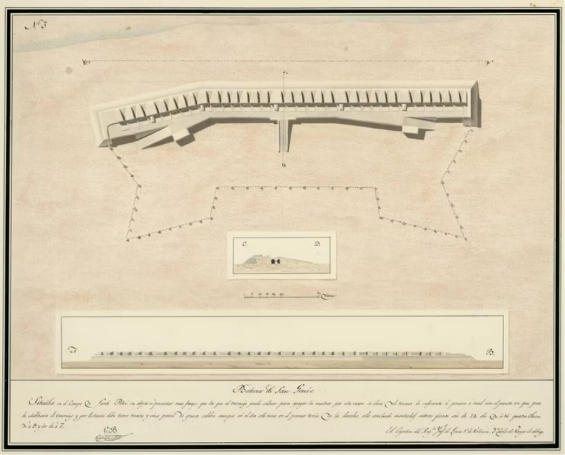
The French directed their attention to Cádiz definitively under the command of Marshal Victor, and the first skirmishes were the Portazgo engagement and the defense of Matagorda Castle, after which the towns of Rota, El Puerto de Santa María, Puerto Real and Chiclana fell into enemy hands. They managed to stop the French at the Sancti Patri canal, but a long siege of Cádiz and León Island began. Along the siege, however, the vastness of the area, the lack of manpower, and the allied naval superiority allowed numerous sorties by the besieged, sometimes reaching as far as Huelva and Málaga, which damaged the French lines and troops, and in turn led to reprisals against the civilian population of Chiclana and Puerto Real. The saltworks’ shot-defending company of Cristóbal Sánchez de la Campa, an irregular unit recruited among the salt workers, stood out in this task. The use of “sutiles” forces, or small-sized units, especially boats, was also notable. In November eighty thousand new recruits were called up.
During the following months, the war in Cádiz and neighboring provinces continued with a second expedition against Huelva, a skirmish in the Gaena dehesa that destroyed a veteran French regiment, an unsuccessful attack on Ronda, incursions against French ships in Barbate and Tarifa, and a failed attempt to retake Seville that forced the diversion of French forces from other fronts. In September the Ballesteros division arrived in the area, having begun the war in Asturias and gradually moving down the Portugal frontier, becoming a seasoned and cohesive force. With its presence, command was unified, civilians who did not contribute to the war effort were punished, and even guerrilla bands were instructed by it or were destroyed if they merely engaged in plunder. El Conciso even dedicated sonnets to it. Throughout the rest of the year the operations of columns Cassagne, Rignoux and Combelle, the action of Jimena de la Frontera, the blockade of San Roque and Algeciras, the reconnaissance of Tarifa, the first action at Bornos, and the occupation of Vejer de la Frontera are explored.
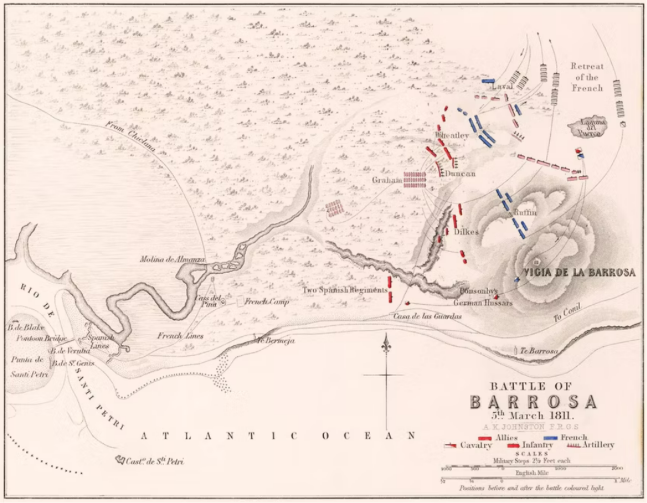
The eighth chapter explores “the other siege,” Tarifa, which, like Cádiz, Gibraltar and León Island, withstood the imperial army until it withdrew when a relentless storm filled the streams and torrents of the area and turned the landscape up to La Janda into a mudflat lagoon. And finally, 1812 was the last year Cádiz had to endure the French assault: with almost no part of the Iberian Peninsula under firm imperial control and with Napoleon pulling troops from Spain to send them to Russia, it was only a matter of time before the invasion failed. The second action at Bornos, in June, was the last notable engagement; by the end of July orders to retreat arrived and, ultimately, after enduring continuous harassment in their marching movements, in September the last French forces left Andalusia toward Murcia.
The War of Independence is usually explained through major events such as the May 2 uprising, the Bailén battle, British intervention, imperial campaigns, and the development of guerrilla warfare. However, this overview can push into the background certain scenarios whose importance was decisive for the survival of the Spanish resistance. Cádiz represents precisely one of those cases, and with this book you cannot pack much more into so little space. López Fernández places this event within the context of a conflict far more complex than a simple clash between two armies. Geography, fortifications, maritime control, and the difficult cooperation between Spaniards and the British were decisive factors in explaining why the French failed to conquer this territory.
_________________
Title: The Siege of Cádiz: War and Resistance 1808-1812. Author: José Antonio López Fernández. Publisher: Ediciones Salamina. Sale: Todos tus libros.